“The Manila Poker Club” by Mark Sy
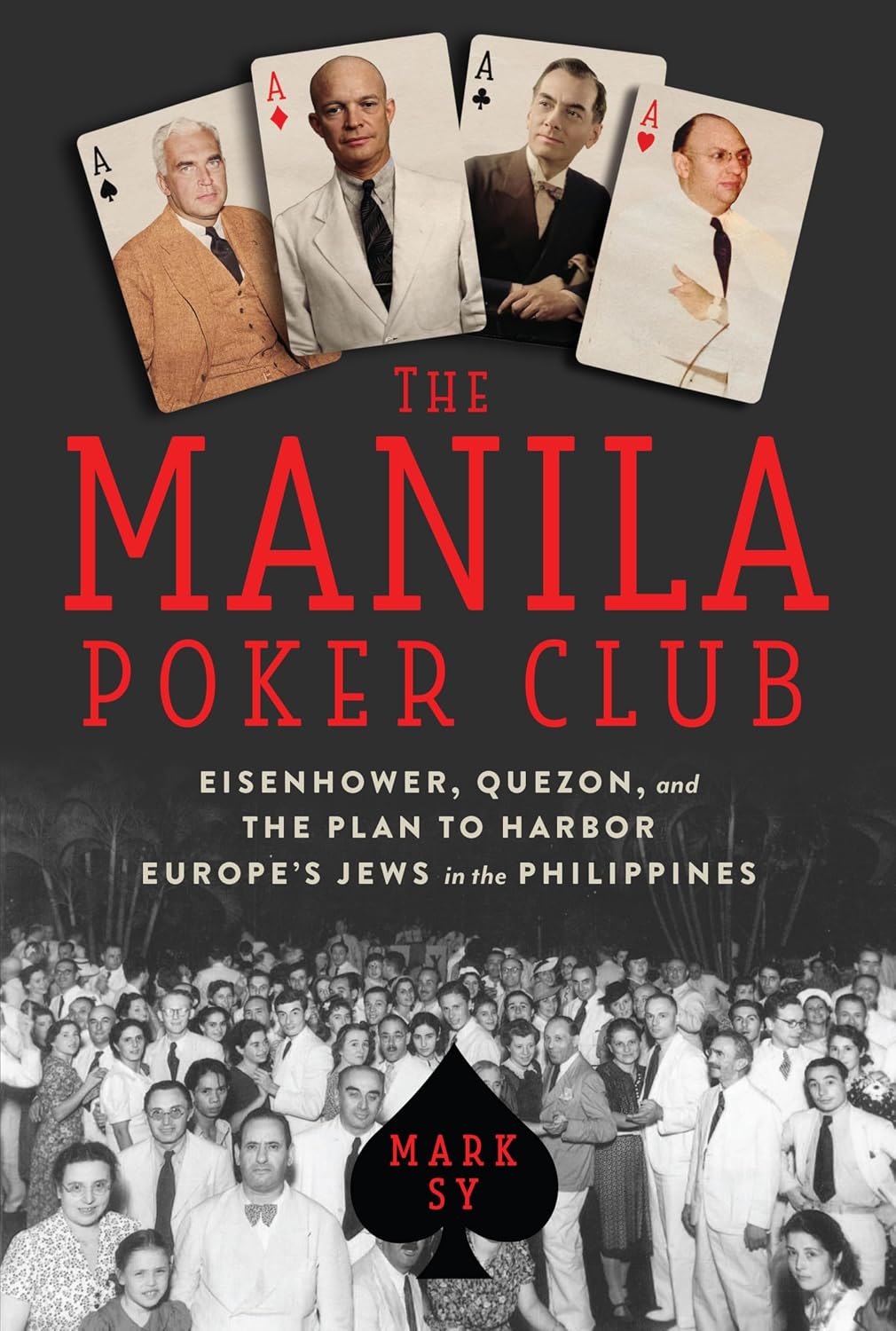
In the 1930s, up to 20,000 European Jews turned to Asia for refuge before Japan entered the war as an Axis ally. Shanghai was the best-known destination, but the Philippines also played host to hundreds of German-speaking Jews. Mark Sy recounts this lesser known example of geopolitical empathy in The Manila Poker Club: Eisenhower, Quezon, and the Plan to Harbor Europe’s Jews in the Philippines.
Unlike Shanghai with its open port and grassroots relief efforts, the situation in the Philippines differed in many ways. As one can gather from the subtitle of Sy’s book, the highest levels of government were involved in this plan. The Philippines had been an American colony since 1898; future US President William Howard Taft was the first American Governor-General. Even after Taft was recalled to Washington in late 1903, he insisted on overseeing the development of the Philippines to, Sy implies, remake the physical islands in an American image.
By the time Manuel L Quezon was elected president, the Philippines was all but self-governing, at least in domestic affairs. Early in Quezon’s presidency, he toured Europe, including Nazi Germany; he didn’t like what he saw there. Closer to home, Quezon also worried about Japanese expansion in Asia and asked Douglas MacArthur to train a Filipino army to better protect the archipelago.
But MacArthur wasn’t the easiest person to work with and tended not to arrive at the office before lunchtime, so most of the army planning became the responsibility of an affable lieutenant colonel named Dwight D Eisenhower. Another prominent American relevant to the story moved to the Philippines in 1937. Paul McNutt was a two-term governor of Indiana with aspirations to become President. When Franklin Roosevelt ran for a second term, McNutt felt sidelined, but not enough to decline the appointment of High Commissioner of the Philippines, which was by then all but a ceremonial position. As it would turn out, McNutt, Eisenhower, and Quezon would bond over the poker table along with Philip Frieder, a prominent member of the Manila Jewish community. According to Sy:
Philip was one of five brothers—along with Alex, Morris, Henry, and Herbert—who ran a cigar manufacturing business in Manila named S. Frieder & Sons. The business was founded in 1910 by their father Samuel, a Hungarian Jewish immigrant born in Buda in 1862, who began selling cigars out of his home in New York City before purchasing a distributorship in Cincinnati and settling down in Ohio, where he married Esther Goldstein Herschkowitz. In 1918, Samuel and his two eldest sons, thirty-four-year old Philip and twenty-five-year-old Alex, traveled to Manila, where they hoped to explore opportunities in the colony for their cigar business.
Samuel sent four of his sons to Manila on a revolving two-year stint to oversee the family business. They lived at “Frieder House”, an estate with a thirteen-member staff, tennis courts, swimming pool, and vista overlooking palm trees and orchids. But the family didn’t act like the typical colonials in Manila in that they didn’t segregate themselves from locals. Philip had this in common with Eisenhower and McNutt and would form a bond at Quezon’s poker table.
In their many long nights of cards, alcohol, tobacco, and off-color stories, of which Quezon had many, these gentlemen felt at ease at his company. Their shared sense of humor, coupled with whispered political discussions about the fear of the Japanese menace and the Nazi peril, as well as the role of the United States in the Philippines’ post-independence future, brought these men even closer together.
McNutt brought up the idea of bringing Jews to the Philippines after the Nuremberg Laws went into effect. He wasn’t Jewish, but was close to Indiana state senator Jacob Weiss. Around the poker table, McNutt asked Philip Frieder if the Jewish community in Manila could help resettle European Jews. Quezon was more than amenable and Eisenhower helped find loopholes to get around US immigration restrictions.
At first the plan was to bring Jews of certain professions—doctors, dentists, nurses, engineers, auto mechanics, dressmakers, barbers, accountants, farmers, and a rabbi, among others—to the Philippines. But after Kristallnacht in November 1938, the Manila Jewish community asked Quezon if he would let more European Jews into the Philippines. Quezon agreed to allow 10,000 Jews to settle in the southern island of Mindanao over a handful of years. There was some pushback in the governments in both Manila and Washington, but ultimately the Mindanao plan did not come to fruition once Japan attacked Pearl Harbor, set its sights on the Philippines, and the United States entered the war. Still, 1300 Jews found refuge in the Philippines.
Sy follows the stories of two Jewish refugee families from Austria and Germany and weaves their stories into the narrative to show their desperation to leave Europe. Before Margarethe Welisch left Austria with her husband and young daughters, Germany had invaded and she woke one day to see her city of Graz covered in Nazi flags and banners. Her neighbors supported the new regime immediately and Jewish businesses were vandalized before they were “aryanised” or taken over by non-Jewish “owners”.
The Preiss family was from Breslau, then part of Germany, and also received visas to resettle in the Philippines, but they almost missed their opportunity to leave Europe when the German consulate in France mishandled their Italian and French transit visas in a final attempt to harass them. By October 1941, the German government decided Jews could no longer leave Nazi-occupied Europe.
As the war in Asia turned against Japan, the Japanese military did not leave the Philippines quietly.
In addition to the countless Filipino victims, sixty-seven German Jewish refugees and seventy-nine members of Manila’s Jewish community perished in the closing months of the war, with hundreds badly wounded. Although the Jewish community was spared from certain annihilation at the hands of the Nazis, no one in the Philippines escaped the suffering borne from the fighting. Most of the Jews killed were bayoneted by the retreating Japanese in the final days of the battle for Manila.
Sy includes historical background of the Philippines, Germany, and Austria to give a comprehensive understanding of why the Philippines was so welcoming and why German-speaking Jews were so eager to leave the only home they had known. He also shows the importance of personal connections. If McNutt hadn’t known Jacob Weiss from Indiana and if Quezon hadn’t gotten to know the Frieder family, many of the 1300 Jews they did save would have probably perished in a concentration camp. Those 1300 refugees went on to have a total of 8000 descendants, mainly in the United States, where the refugees settled after the war.