“The Resurrected” by Joost Hiltermann
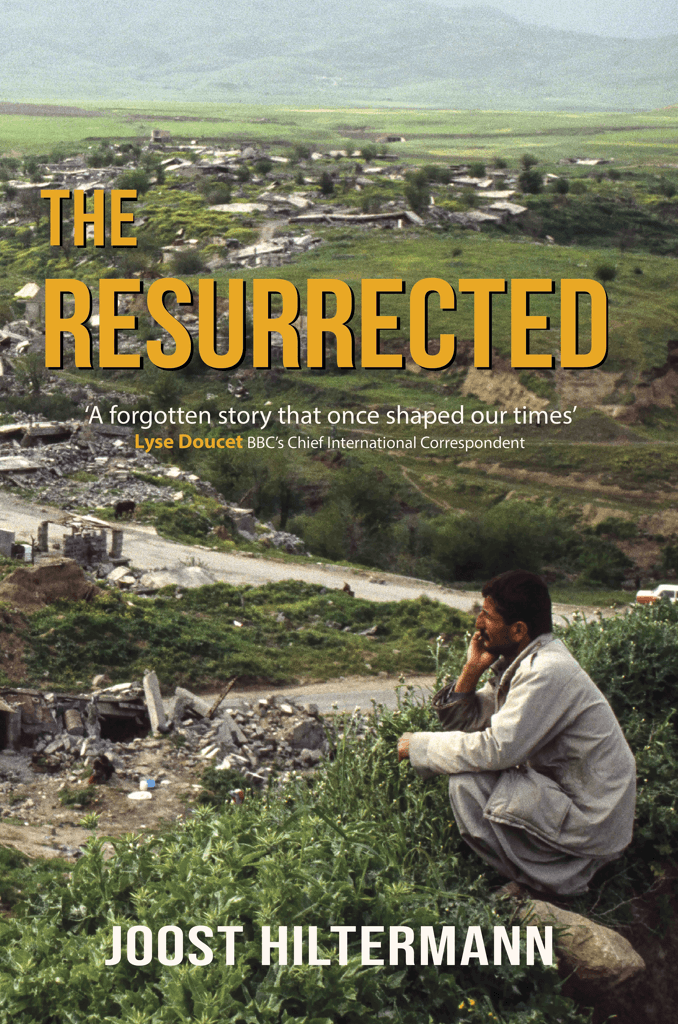
Joost Hiltermann’s new novel is a powerful exploration of the 1988 Anfal genocide, launched against the Iraqi Kurds by Saddam Hussein’s Ba’athist regime. It may have resulted in up to 100,000 civilian murders during what was officially a rural counter-insurgency campaign. The novel deals with both the devastating impact the Anfal had at the time and its traumatic aftermath for Iraq-Kurdish society. It does this through a fictionalised account of two young Kurdish men, Karwan and Kawa, whose real-life counterparts miraculously survived the desert killing grounds organised by Saddam Hussein’s forces. While The Resurrected is, therefore, based on a true story, the author remarks: “Parts of this story are true, others wholly the product of my imagination.” The style employed is more that of journalism than literary fiction, and The Resurrected aims to reach a wider general readership than strictly factual books.
There are a host of characters whose voices compete to give their own views, and the narrative point of view switches frequently. Hiltermann suggests in his Prologue that this allows
a throng of actors – perpetrators, victims, bystanders, and chroniclers – to interact as they jostle for prominence, each with a distinct, and distinctive voice, one no less important or legitimate than another.
The narrative is organised in a non-linear, deliberately fragmented fashion but each chapter has a location and date. As well as fiction, it draws heavily on memoir (Hiltermann was a main investigator for Human Rights Watch into the Anfal in the 1990s and is regarded as a prominent academic voice in the study of Iraqi Kurdistan); testimony and oral history (from both Kurds and Iraqis, as Hiltermann and others carried out many interviews in the 1990s and subsequently), and vast numbers of documents recovered from the Ba’athist regime who detailed their campaign in gruesome bureaucratic detail.
Karwan and Kawa were both deserters from the Iraqi army during the war with Iran (1980-1988). Captured by the Iraqi security forces, they are taken with many other Kurds in lorries to be murdered at night in the desert. Individually, they both “miraculously” escape when the prisoners, realising that they will all be killed, choose rebellion over certain death. It shows the desperation of a group of men knowing they are facing annihilation. Escaping into the desert, though almost all their fellow prisoners are killed, they both make their way to Kirkuk and freedom independently.
A Human Rights Investigator (modelled on Hiltermann himself) is a significant character throughout (referred to by Kurds as Mr Woost or Mr Juiced, one of many comic touches) and provides a western, outside perspective on what happens. Karwan and Kawa end up living in America, as the Investigator convinces the Clinton administration that they could serve as valuable future eyewitnesses to the horrors inflicted by the Ba’ath regime. One of the most moving parts of The Resurrected is Karwan and Kawa’s testimony in a packed Baghdad court against both Saddam Hussein and Ali Hassan Al-Majid in 2006.
The Investigator describes his first meeting in Kurdistan with Kawa:
I look at this man on the chair in front of me, this Kawa, impressed by his easy recall, his unflappable demeanour, his preparedness to be questioned repeatedly on the chronology and logic of his answers, his general agreeability. I have no doubts about him, a man who looked death in the eyes and returned convinced that life wasn’t so bad after all. He is also without visible emotion as I badger him with question after question about his village, its layout, the crops grown, the number of deserters it had sheltered during the war, the frequency of air raids, the army’s arrival, his detention, and the journey southward.
Hiltermann presents unexpected characters and viewpoints, some of which are taboo or seldom discussed in contemporary Kurdish society. Rafeek is a Kurdish “Adviser” [mustashar], a name given by the Iraqi government to leaders of pro-regime Kurdish tribal militias. During the Anfal, Rafeek and his soldiers collaborated with the Iraqi army to arrest Kurds and therefore (partly unwittingly) facilitated the Anfal. Rafeek is depicted sensitively through imagined, guilt-wracked therapy sessions after moving to America, as he struggles with very little success to find atonement for the results of his actions.
Ali Hassan Al-Majid (1941-2010), Saddam Hussein’s cousin, nicknamed “Chemical Ali” for his predilection for the use of chemical weapons against civilians and the Baath Party’s Northern Bureau Chief from 1987-1989, is also a character in The Resurrected. Two chapters are formed from the official American interrogation transcripts from Spring 2004. But he is also depicted as giving an imagined pep talk to his troops in Kirkuk, as well as addressing his Ba’ath party comrades, in a blend of creative non-fiction and traditional fiction. The Ba’ath officials and military officers who saw annihilating the rural Kurdish civilian population in bureaucratic terms as an administrative action to win their war against “saboteurs” abandoned fourteen metric tonnes of documentation about the Anfal, later used in their prosecution. Al-Majid’s testimony offers a chilling masterclass in denial, obfuscation and shifting blame, in the face of such overwhelming evidence, as he tries to wriggle out of responsibility (he was executed for crimes against humanity in 2010).
You know, this is why they call me ‘Chemical Ali’. Not because of Halabja or Suleimaniya. That wasn’t me. But because of Dohuk. In 1991. It was psychological warfare. We succeeded in weakening the saboteurs with words and bags of flour, and we saved the innocent people. I’m very proud of this. One of my best moves.
Despite the harrowing story of the Anfal, The Resurrected is engaging and affirmative on several levels. It is a very human story, rather than a political or scholarly account. The novel emphasises lived experience, emotional resonance, and accessible language in the tradition of “boots on the ground” journalism. Karwan and Kawa, the two young Kurdish men who survive against seemingly impossible odds because of a desperate gamble, are ordinary people, not heroic peshmerga (Kurdish guerrilla fighters). They show how human resilience can prosper after terrible trauma. In making new, successful lives as resourceful migrants in America, raising their families, and becoming part of their communities, they are still psychologically torn by the feeling that they have abandoned their homeland and culture in exchange for a better and safer life. Yet, they make the best of their situation.
The story of the Investigator with his anxieties, misgivings and sense of failure also depicts the ordinariness of people struggling to do the right thing among extraordinarily horrendous events, rather than any heroic stereotype. As he remarks soberly in the Epilogue (“Tyre, August 2016”): “What is my role in the story? What is my role other than to point out the small successes in a game in which almost everyone lost, or was lost?” Yet, as he also recognises, there is perhaps nothing more human than “a burning desire to bear witness and tell a story.”