“The Ryukyu islands” by Gregory Smits & “The Legacy of The Ryukyu Kingdom” by Takara Kurayoshi
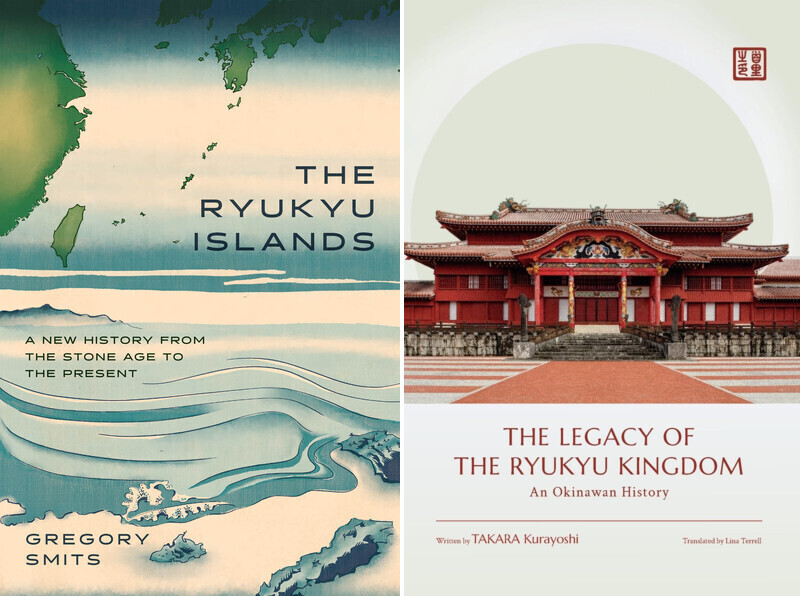
To start: a confession. Academics often speak of imposter syndrome—the sense that we lack real expertise on the topics about which are talking or writing. Although it’s largely a psychological illusion, there are situations in which it’s not completely wrong to say that we are imposters. When we teach college courses we have to cover a lot of ground. There is therefore a wide variety in the depth of knowledge we bring to the range of subjects we cover. For some, we are genuinely experts and can talk at length with authority; for others we are operating on a much thinner basic level of expertise. It’s not to say that what we say in lectures or classes is necessarily wrong, but rather that we are well aware that there can be less real understanding than we would like of the nuances underlying a single slide and its 3 bullet points. Over time, we can hope to expand the range of our in-depth knowledge and fill in the areas about which we can talk with authority. For me, reading Gregory Smits’s and Takara Kurayoshi’s books on the Ryukyu islands has been such a process.
I suspect that Smits in particular might be pleased at my above confession of ignorance—he frames the introduction to his book through a series of misconceptions which he is seeking to correct. The Ryukyu archipelago is often known by the name of its largest island, Okinawa, but it stretches from the southernmost point of Kyushu, one of Japan’s big four islands, all the way to the edge of Taiwan. Now split between two of Japan’s prefectures—Kagoshima and Okinawa—with an overall population of around 1.5 million people across about 50 inhabited islands, it has a complex history which can be seen in different ways. The people and culture of the Ryukyu, Smits argues, have been mostly shaped by Japan, but with influence from elsewhere across East and Southeast Asia, resulting in an identity that is both distinct and yet also comfortably within the range of what can be considered “Japanese”.Takara and Smits both give some space to the modern history of the archipelago, but their real focuses are on earlier periods. Although they were of limited potential for agricultural development, the Ryukyu islands found their real role in the pre-modern period as a key part of maritime networks of trade and exchange. While they were themselves a source of various goods—mother of pearl and sea cucumbers, for example—different islands in the chain also formed connections variously to Japan, Korea, China, and even South-East Asia, making possible exchange between all the regions. For example, various elements of the culture of the Ryukyu, such as gusuku fortifications and sacred groves can be traced to origins on the Korean peninsula, while Japanese influence was also distinct and important.The Ryukyu became one site associated with the wakō or wouko: “Japanese pirates” engaged in a range of activities including clandestine trade, piracy and human trafficking. Smits argues that the replacement of these pirates with lines of kings was the result, less of state formation across the archipelago, and more Ming Chinese efforts to reduce the illegal activities by binding the residents of the islands into the legitimate trade known to historians as the tribute system. The Ryukyuan “trade kings” were less the rulers of real states than they were a front, licenses for various groups to trade with China as formally recognized entities rather than to be hunted as pirates and vagabonds.Over time, real political power and formal institutions did emerge within the Ryukyu, but even then the nature of the state and sovereignty reveals a complexity and ambiguity in pre-modern statehood that challenges our simplified modern ways of understanding rule and diplomacy. In the 17th century, the Ryukyuan king, Shō Nei, lost a war against the Satsuma clan of southern Japan, falling under their control as a result. Still, the Ryukyuan kingdom did not die out: Satsuma took direct control over the northern islands, but left Okinawa to oversee those to the south. At different times, and with different audiences, the Okinawan king posed as a subject of Satsuma or the Japanese Shogun, or as an independent ruler in his own right, and highlighted or obscured Japanese and Chinese influences as the moment demanded. Maintaining these grey areas allowed the continuation of some of the trade connections which were the real advantage of the position of the Ryukyu.Uncovering this history has been the work of at least 150 years, with much of it coming in the last 50. In the early Meiji period, Ryukyu islanders such as Ifa Fuyu began to document their own histories and culture, even as the Japanese centre sought to assimilate them. Heir to this tradition of local historians, Takara Kurayoshi traces his experiences since the 1970s collecting writs of appointment—official documents charting the appointment and transfer of individuals to government positions. Still, uncovering the reality behind the early modern “theatrical kingdoms” requires sophisticated techniques of “reading against the grain”—reading official sources for more than their surface meaning. Moreover Smits augments these official documents with the Omoro Sōshi, a collection of Ryukyuan songs, as well as other poetry, and by contrasting Chinese documents and Japanese documents against native Ryukyuan ones to paint a more complex picture.In my lectures on early modern East Asia, I may still have only space for a few minutes on the Ryukyu, and a broad characterization of networks of trade and piracy. However, as a result of the close reading and scholarship of Smits and Takara’s research, and their enjoyable books, I will now have the confidence that I am, if not an expert, no longer an imposter.