“Time Will Pass Johnny” by Percy Herbert
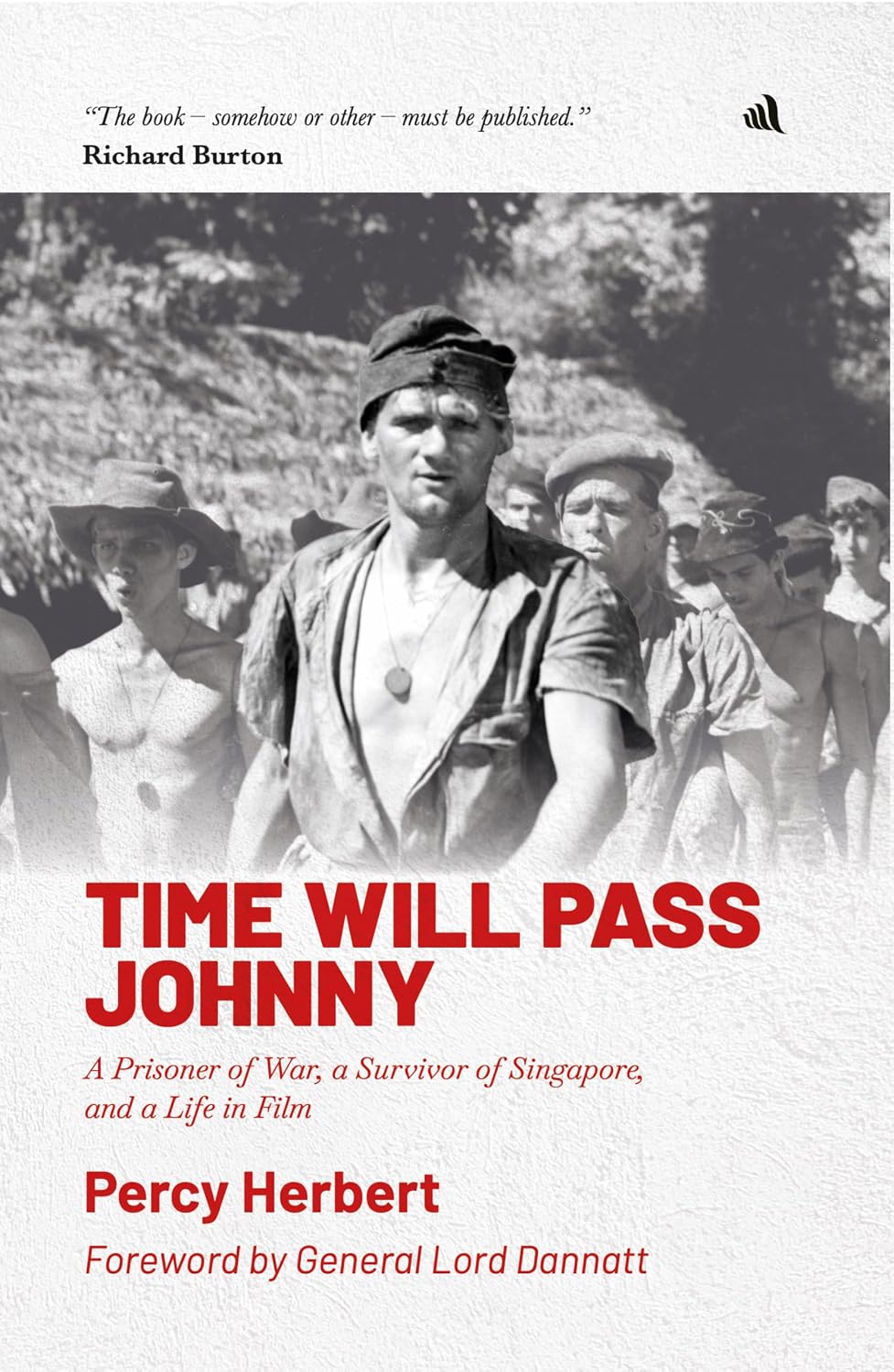
For anyone who grew up on British and Hollywood war films of the 1950s to the 1980s, Percy Herbert’s face is instantly familiar even if his name is not. He turns up in The Bridge on the River Kwai, The Guns of Navarone, The Wild Geese and dozens of others: the reliable “oh, that guy” of a golden age of war cinema. His posthumous memoir—published well over 30 years since his passing—sets out to close the gap between the recognisable face and the largely unknown man behind it, and for the most part it succeeds, though not always in the ways its subtitle promises.
As General Lord Dannatt notes in his foreword, a glance at Wikipedia offers little beyond the observation that Herbert “returned to London” after the war, a sentence that conceals three and a half years of Japanese captivity following the fall of Singapore in 1942. That gap is the memoir’s true subject, and its strongest material has surprisingly little to do with the film sets for which Herbert became known.
Herbert was an East End boy who cycled through an extraordinary number of jobs before the war and lived through the Blitz before ever enduring the hardships of wartime Singapore. That background feeds the book’s most persistent preoccupation: the British class system.
Herbert’s contempt for the officer class is only sharpened by surrender and captivity. Even inside the wire as a POW, the old hierarchies reasserted themselves within hours of surrender, guaranteeing that the long suffering squaddie would feel properly inferior. One Colonel Williams addressed Herbert:
You nauseate me. If you survive the war, I haven’t the slightest doubt that much of your civilian life will be spent behind bars. You are a born rogue and a knave, get out of my sight.
Plus all the mindless “left-right-left” so-called square-bashing marching exercises. And even confinement and punishments meted out by the British to their own in the little-documented Temple Hill penal camp area of Changi where errant POWs were harshly disciplined by their own side. The effect is of a prison within a prison, the class system reconstituting itself even as the men queued and bowed for a common enemy. “If ever men were in a situation where the fundamental importance of man’s equality mattered supremely, this was surely it,” he surmises.
Herbert’s account departs usefully from the standard shape of Singapore captivity narratives. Where most such memoirs settle into Changi and remain there, or ship off to the Thai-Burma Death Railway, Herbert survived the heinous Alexandra Hospital massacre, and spends a formative stretch in work camps on Blakang Mati—the small island now known as Sentosa, at the southern tip of Singapore This is a genuine point of departure in this crowded genre. His reflections on survival are among the book’s most affecting passages: “How close I came at times to sheer madness.” The commonly held view of Changi gaol as a comparative haven is reinforced by Herbert. Generally, if anything was available to the Japanese and POWs, Changi would have access to it. But this is all relative, of course.
These physical horrors ended abruptly with the Japanese surrender in August 1945, although the residual mental scarring would last a lifetime for the released prisoners, including Herbert.
For three and a half years it had been a time of total misery, of crushing degradation. Now suddenly it was ended … there wasn’t a peep of joy between the lot of us. It was as though we’d had a heavy injection of Novocaine.
A quieter thread concerns Amy, a pre-war attachment whose fate on Herbert’s return provides one of the memoir’s genuine narrative surprises, best left for readers to discover rather than be pre-empted here. The homecoming itself is rendered with unsparing clarity, London barely recognisable and Herbert himself unmoored: “What a bloody punch-drunk heap of rubble the East End was. My house was gone—as was the entire street.” The rigidity of the British class system, it turns out, survived the war rather better than the East End did.
The melancholic register shifts and lifts noticeably once Herbert discovers theatre post-war, gaining pace and warmth as his new vocation opens up. It is here that the book becomes frustrating: the decades of stage and screen work that made Herbert recognisable, including his role as technical consultant on The Bridge on the River Kwai, receive strikingly little attention, and readers hoping for backstage detail on a seventy-film career will come away wanting more.
As a caveat rather than a complaint, the prose written in the mid-1970s can feel clunky by contemporary standards, aged in a bottom drawer for three and a half decades.
That rough-edged quality makes more sense in light of the book’s own path to print. According to Herbert’s daughter Katrina Herbert Wood, a clinical psychologist, the memoir was written discreetly, hidden even from his family, its composition complicated by the very trauma it describes, and Herbert’s wife eventually had it privately printed rather than pursued through a publisher. While filming The Wild Geese, Herbert tested the waters by showing the manuscript to castmates Richard Burton and Roger Moore, who offered highly encouraging feedback but Burton warned of the “immense labour of editing and re-writing” that lay ahead of him, a task seemingly never undertaken due to Herbert’s busy filming schedule. Lacking, as Herbert Wood puts it, “access to proper leads” or “real back-up,” the book lay dormant for decades, until his daughter connected with publisher Stuart Leasor and the team behind the Fighting on Film project, finally bringing this version into print.
This is a memoir for readers drawn to the human cost behind familiar faces, and to the lingering half-life of wartime trauma within families.
That unpolished quality gains new meaning from an afterword contributed by Herbert’s two daughters, who offer a franker reckoning with “the real Percy” than the memoir itself attempts. “Living with my father meant living with extremes,” Katrina Herbert Wood writes. “The highs of creativity, humour, and passion; the lows of rage, depression, and absence.” Today we know it as PTSD. “Back then, it was simply ‘keep out of the way of dad’s moods.’” It is a moving, clear-eyed coda, framing the trauma of captivity not as something survived and set aside but as something that rippled on inter-generationally through a household decades later.
This is a memoir for readers drawn to the human cost behind familiar faces, and to the lingering half-life of wartime trauma within families. It will appeal particularly to those interested in the fall of Singapore, the class politics of the English military, and the private lives of character actors better known for the parts they played than the men they were.