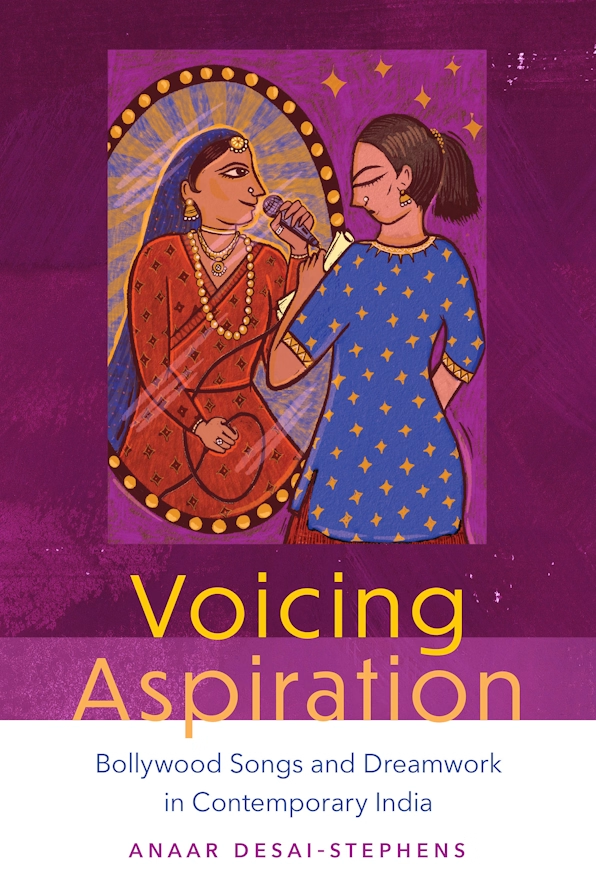
“Voicing Aspiration” by Anaar Desai-Stephens
Excerpted from Voicing Aspiration: Bollywood Songs and Dreamwork in Contemporary India by Anaar Desai-Stephens; reprinted with permission from Wesleyan University Press.
Envision a young woman in her mid-teens, so skinny and wide-eyed that she looks even younger, but right now filled with self-assurance as she stands in front of her bedroom mirror. It is midnight and in the Paying Guest apartment that she shares with other aspiring female singers, everyone else is asleep or just returning home from gigs across the city where they have attempted to meet people with the right connections. The girl stares intently at herself, a smile playing on her lips as she sings, “You tell me, should I desire you or not?” her voice confidently soaring into the upper register, the piano accompaniment to this pop song playing in her head.
This scene could be playing out in myriad global locations where young adults use pop songs as reflective surfaces to envision themselves, but we are in Bombay—or Mumbai—where this young woman has recently arrived to pursue her dream of becoming a professional pop singer. The song she sings, “Chaahun Main Ya Na,” is drawn from a recently released movie from the Hindi film industry, or “Bollywood,” as it has come to be known.
As she enters into the song’s higher section, she leans back and opens up her chest to declaim, “I’ll tell you this much: this desire isn’t a choice.” Her voice fills the small, plain room, heedless of the neighbors and the time. She has left her parents and sibling on the other side of the country—no more high school, no more tuitions, no more Ma to cook and clean—because she feels that “apne andar kuch hai; usme jo chiz hai.” She has something inside of her, something special, that will enable her to become a successful singer. When she sings Bollywood songs, she knows she has promise; isn’t that why she won those awards in school? But, more importantly, when she sings, she feels different. Singing these songs gives her a sense, or even sensation, of power, as if she can internalize a song’s story, conjure and spin it out so that others can feel it as well. Surely if she can meet the right people in the industry, they will sense this, too. She has journeyed here because, like so many other young people across India, she is certain of her potential and even more certain that she must act upon it: “this desire isn’t a choice.” Despite her short stature and wide eyes, she believes in herself and in her dreams. If she can become a singer of Bollywood songs—on the stage, in the studio, jahaan bhi—maybe she can stay here, alone, in this new city; maybe she can marry someone she loves; maybe she can send money home to help her parents, a housewife and a railway worker. Perhaps she can become this new passionate and persuasive person. Across a range of promissory spaces—reality music television shows, live concerts, recording studios, and, indeed, private bedrooms—young people are using Bollywood songs to aspire and dream. Singing Bollywood songs as a means of working on oneself, they seek to be enveloped in the atmosphere of dynamic possibility, incipient change, and mobility that saturates contemporary India.
What might the singing of Bollywood songs show us about “Aspirational India” and the practices of transformation it promotes? Why are Bollywood songs such potent tools in these projects of working on the self in this time of economic, cultural, and political change?
For the past century, Hindi film songs have circulated widely to function as India’s predominant popular music, creating a shared sonic landscape of social meaning across the South Asian subcontinent, the diaspora, and beyond. As film songs have moved across public and private spheres—initially through radio and LP, then on tape cassettes and CDs, and now via streaming apps and mobile phones—they have become centripetal forces for an affective community that has both united and transcended a national public sphere. Central to these songs’ appeal are playback singers, who have gained a distinct form of aural celebrity for animating song-and-dance sequences with their iconic and beloved voices. However, the work that these songs perform in offering moments of heightened emotional expression within Hindi films has attracted long-standing criticism that they are musical “opiates of the masses,” audiovisual vehicles for widespread projects of fantasy and dreaming that distract from the hardships of daily life. Yet despite this criticism, Bollywood songs have become potent mediums for personal and national refashioning following neoliberal market reforms begun in the late 1980s. The long process of economic, political, and cultural transformation referred to simply as “liberalization” has led to the reconfiguration of the Hindi film industry into the corporate trans-media culture industry known as “Bollywood.” In tandem, Bollywood songs have taken on new social and economic value such that the practice of “playback singing”—in which a highly skilled singer prerecords a song that is then “played back” to be “picturized” on actors who lip-synch and dance—is now seen as a site for the enactment of personal ambitions and as a stepping stone to wealth, fame, and upward social mobility.
The desire for effecting such mobility has been heightened in the context of “Aspirational India.” This term arose in mainstream political and journalistic discourse in the 2010s to describe the large youth population that came of age following liberalization (the so-called “aspirational classes”) and a resultant culture marked by desires for and striving toward upward social mobility. “Aspirational India” thus refers to a moment of significant social optimism, increasing geopolitical confidence, and concomitant destabilization, as individuals from across social locations attempt to embark on new life paths and to participate in the financial and cultural flows that mark globalizing, neoliberalizing India.
I sit in the Starbucks that is attached to the edge of the Mumbai domestic airport. Outside, taxis and rickshaws zip by to carry passengers into the thick morning traffic. Gauzy light filters in through a wide sunroof as waiters in starched black aprons and hats serve up caramel lattes and sandwiches to recently arrived passengers carrying briefcases and pulling small travel bags. This is my third or fourth time in this particular Starbucks, which has turned out to be a convenient place to meet busy elite members of India’s film, television, and music industries when they are willing to fit me in at the edges of business trips to other cities across the country. This morning, I am meeting with Rahul, who served as director and producer of the immensely popular reality music television show Indian Idol in its first three seasons. Rahul has just returned from a trip for his current job with the media and entertainment company Disney/UTV, and we are surrounded by other duos clearly engaged in business over coffee. I begin by telling Rahul that I am researching reality music TV shows in India and that I am interested in the role of these shows in relation to aspiration. “Aspiration has become such a buzzword,” I remark, and Rahul concurs, “It has.”
For the next hour and a half, we talk about Rahul’s work on the early seasons of Indian Idol and the changes he has observed in the realm of Hindi-language television and film, what people in Mumbai call “the industry.” As part of his current work supporting the youth-focused entertainment channel Bindass (a slang term meaning “cool,” “carefree,” and generally unconcerned), Rahul has gone to small towns to meet viewers, and he shares some of his impressions of this population. “They have a tremendous sense of confidence, a tremendous sense of confidence,” Rahul reflected. “Yes, they do think that the ‘packaging’ is better in Bombay—in terms of the way you dress, the way you talk—but it’s not an impediment anymore, being from a small town. Which it probably was ten years ago, in terms of your own self-esteem and thought process. Now, you can achieve whatever you want. Yes, maybe the guys in Bombay are a little more savvy and it will take them less time to …” Rahul paused to find the right words. “Get it. To overcome it, maybe,” he continued, glossing over what would be gotten and what needed to be overcome, before taking on the position of his rural youth informants. “But it’s not impossible for us anymore. So, there’s a tremendous sense of confidence”.
As we exited Starbucks, I quickly returned to the question of aspiration, asking why he thought the term had accrued such currency in the present moment. “India is more aspirational,” Rahul replied matter-of-factly as we parted ways, I walking to catch a rickshaw back home, he to grab a taxi to work in a corporate office complex in northern Mumbai. I remember being puzzled by Rahul’s comparative and quantified understanding of aspiration. What did it mean to be “more aspirational”?
“Aspirational India” is the latest in a set of branding monikers—“India Shining,” “India Rising”—that performatively mark India’s gradual ascendence on the world stage. As epitomized by billboards for language institutes anxiously noting “The World Speaks English . . . Why Don’t You?” and commercials urging viewers to “be the best version of yourself,” Aspirational India is awash in slogans that exhort the individual to improve, transform, and consume in service of pursuing their dreams, rather than adhering to their social place as configured by the intersection of caste, class, religion, and gender. Aspirational India has thus emerged as the most recent phase of India’s ongoing (neo)liberalization.