Beyond the Score: Performance, Power, and the Hidden Histories of Music in India
To open a European classical music archive is often to confront a mountain of scores. In this tradition, the written score has largely become the music—an enduring, material artifact that treats performance as a secondary act of execution. Yet, viewed globally, this absolute conflation of score and sound is an exception rather than the rule. Music is, fundamentally, an act of performance; it belongs to the air, the body, and the fleeting moment. This reality is particularly evident in the Indian subcontinent, where rich classical and popular traditions have historically thrived, training was oral and music was generated within a set of rules; written notation did not take hold in the same way. For the musical historian, this reality presents a profound paradox: How do we write the history of something ephemeral? If we lack the literal recordings of pre-gramophone music, how can we know what it sounded like, who played it, and how it shaped the emotional lives of its listeners?
These questions have to do with the intangible, what existed only fleetingly or no longer exists, as much as with what is still here; they have to do with how memory works, and who or what is considered important by the historians of emotion. But they also have to do with the tangible human body that plays the music or listens to the songs, and exists beyond the word. The contradictions of music—its simultaneous passive receptivity to cultural conditions and its intense active emotional power, the way that the ephemeral and invisible is produced by the physical bodies of the musicians and listeners—are the contradictions at the heart of the study of music as history.
Three recent books offer brilliant, creative pathways through this archival silence. By looking beyond traditional canons, Katherine Butler Schofield’s Music and Musicians in Late Mughal India, Radha Kapuria’s Music in Colonial Punjab and Terada Yoshitaka’s TN Rajarattinam Pillai reconstruct the vibrant, embodied histories of North and South Indian music. Working in a critical framework that also includes works by writers such as Janaki Bakhle and Amanda J Weidman, these authors demonstrate that while we may never fully recapture the exact acoustic vibrations of the past, we can read archival traces “against the grain”. In doing so, they elevate musical history into a vital study of performance—one that recovers the lived experiences, movements, and somatic labor of marginalized, non-Brahminical, and female performers whose bodies labored to create the ephemeral. This essay also extends, in relation to India, the ideas of Nicholas Cook in his 2013 book Beyond the Score: Music as Performance about the importance of the way in which music is presented.
Tracing the Ephemeral: Recovering Late Mughal Musical Worlds
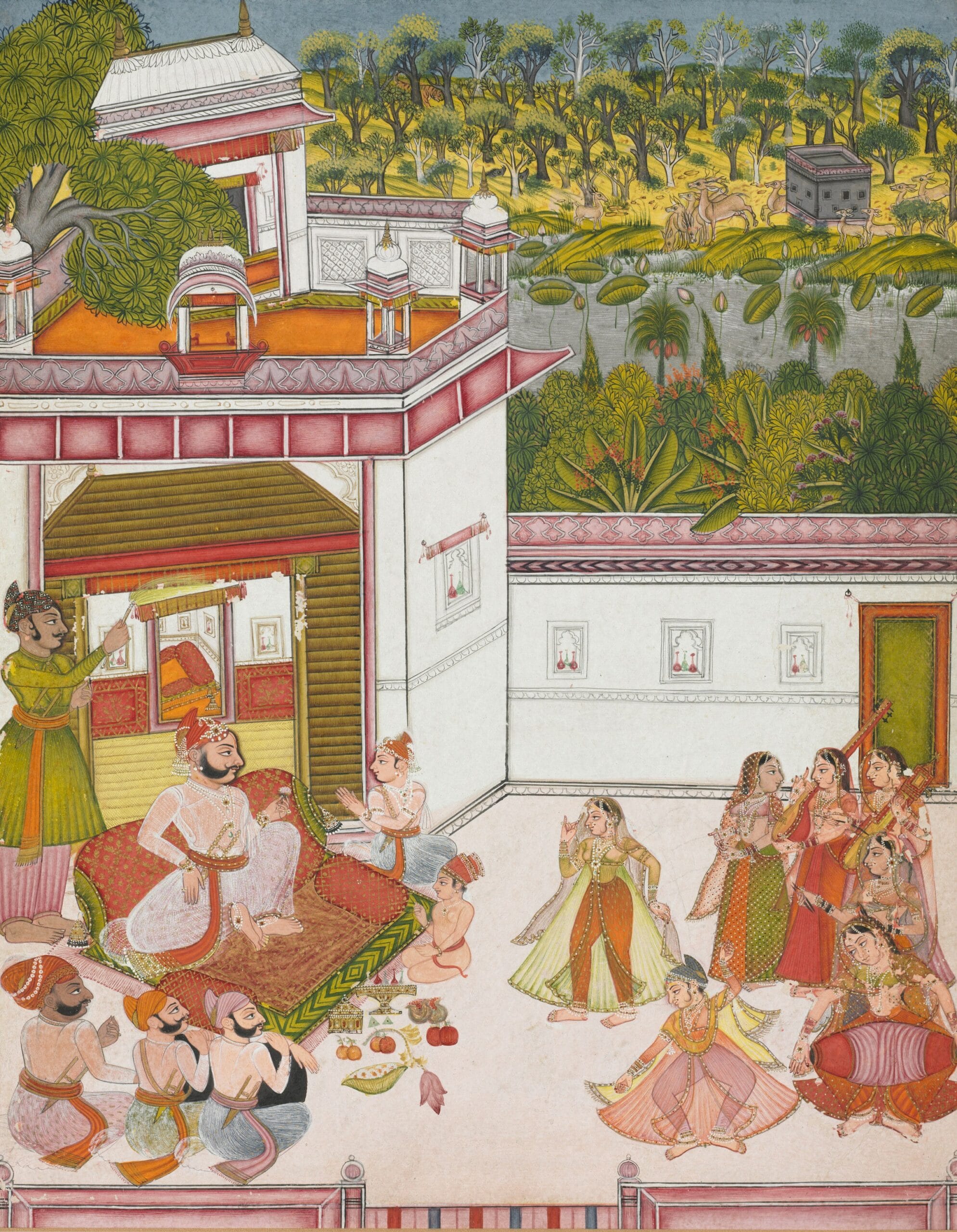
In Music and Musicians in Late Mughal India: Histories of the Ephemeral, 1748–1858, Katherine Butler Schofield, Professor of South Asian Music and History at King’s College London, seeks to understand the flourishing of writing about music during the century of Mughal rule that directly preceded British rule, looking at specific case studies. She bases her work on a vast, rich corpus of writings on Hindustani music that has mostly been overlooked to date, including Indian-language genres such as tazkiras (biographical collections) and genealogies, song collections, innovative musical notations, rāgamālā paintings and poetry, copies of old and the creation of new musical treatises, bureaucratic records, and ethnographic writings and paintings. Her research focuses on northern Indian cities such as Delhi, Lucknow, Hyderabad, and Jaipur, and incorporates texts written in a variety of languages, including Persian, Brajbhasha, Urdu and English. Schofield also makes a poetic argument for the power of music itself as a field of knowledge and power, offering arguments about the ways that despite its abstractions, this art can operate real-world effects on the listener.
Her work expands upon the framework of “tellings and texts”—extensively explored in the foundational volume Telling and Texts: Music, Literature and Performance in North India, edited by Francesca Orsini and Katherine Butler Schofield—which emphasizes that South Asian performance traditions can be dynamically reconstructed through the deep interplay between oral narratives and lingering textual traces. Schofield’s specialization is the significant body of Mughal knowledge production, which includes written and visual sources, as a body of work that exists alongside the writings of British subjects, and is equally valuable for the understanding of Indian history, but is far less known. During the period she focuses on, 1748 to 1858, Mughal texts, practices and philosophies existed in parallel with those of the British; Schofield chooses not to focus on the nature and extent of colonialism’s impact on the colonized—a subject that dominates historiographical debates—and instead give her attention to the Mughal texts themselves. During the period she studies, writing about music flourished, and these texts were preserved under the British Raj and beyond.
Picking up on the work of the philologist and historian of South Asia Sheldon Pollock, Schofield studies local Indian texts related to music, as part of the larger argument that India had a rich history of treatises and writings prior to the British that deserve to be better known. She makes the case that writing is an essential supplement to bodily performance, and that there is an enormous number of writings and visual records that have not yet been studied. She challenges the idea, present in work by colonial Indologists through to 20th-century scholars such as AH Fox Strangways, who emphasized the guru-śiṣya (teacher-disciple) system, that there is a lack of written texts or that musical tradition is predominantly oral; indeed, a major aim of her book is to demonstrate that top musicians, although they did not use musical scores, were not only literate but also wrote highly technical musical treatises, historical works and texts of music theory, and that a seamless continuity existed between theoretical and practical, written and oral knowledge. In this sense, she takes a traditional intellectual historical approach, starting primarily from texts, rather than non-textual sources. In doing so, she asks a critical question: “We drown in an ocean of musicians’ names, all of whom are centuries dead, and nearly all long forgotten. What are we supposed to do with all these names?”
Part of the answer, perhaps, is to chart the terrain of works, focused on the larger topography, which reveals who is remembered and forgotten. The absences, too, are part of the map. To that end, in addition to her dense and rigorously researched writing, her work also includes several complicated maps of families—the genealogies of guilds of hereditary musicians, gharanas, which are the basis of lineage in Hindustani music—and of ruling dynasties, trying to understand what was happening in Delhi in a century of upheaval, as the Mughal Empire gave way to the British Raj and hereditary, orally transmitted lineages were disrupted as families were separated and displaced.
The amount of detail can often be overwhelming, but Schofield herself is conscious of this, reflecting on how such intricate written records might preserve or obscure the fleeting moments they are written around. The experiential gaps often parallel those between studying an abstract work of music theory (an abstract pleasure) or reading the description of a performance (a vicarious pleasure), as opposed to enjoying the emotional pleasure of the music itself (a more direct emotional pleasure); it is not obvious how to directly access this latter moment of the music.
Schofield includes chapters on Khushhal Khan Gunasamudra, a 17th-century Delhi musician who appears in a tazkira; on the rivals Anjha Baras and Adarang; on the courtesan Khanum Jan and the memsahib Sophia Plowden in Lucknow; on Mahlaqa Bai and Khushhal Khan Anup in Nizami Hyderabad; on a Mayalee dancing girl and the East India Company in Rajasthan; on Miyan Himmat Khan and the last Mughal emperors; and on the end of the Mughal Empire and the “Scattering”, when many court musicians left Delhi, creating a need to preserve memory in the wake of this event. The chapters are portraits of different times and places in the North of India, focused on the Mughal period and its musical practices. The musical form that most fascinates Schofield and the musicians she studies is the raga, the iconic Hindustani musical form that at the end of Aurangzeb’s reign in the 18th century was also connected to Mughal and Rajput patronage, and was culturally identified with Hindu and Muslim courts of North India.
Her focus on Khushhal Khan Gunasamudra picks up the tazkira tradition to ask what the biography of a musician might reveal, or not; in doing so, she delves into the War of Succession—a civil war fought among the sons of the Mughal emperor Shah Jahan over who would inherit the throne—as well as wide-ranging sources such as Mughal Persian treatises on Hindustani music such as Miftāh al-Surod (Key to Music) and Rāg Darpan (Mirror of Raga) that became the foundation of Mughal music theory (ilm-i-musiqi, or musical science). The author of the tazkira, Inayat Khan Rasikh, writing at a fraught time of political change, chose to focus on the musician Khushhal Khan Gunasamudra from a time slightly before, when Mughal power was still strong and music was considered as having the power to change political destinies.
In the Mughal courts, music was entangled with political and supernatural power, with music respected for its possibility to affect the listening body as well as natural phenomena such as monsoon rains. Music was tethered to ideas of a central power and of astrology. For similar reasons, music was also associated with the erotic arts, but in the political context, it was seen as a “technology of governance”; the theory of harmony and balance dictating successful musical performance was identical to the theory underpinning Mughal political ideologies of sulh-i-kull and the balanced kingdom, based on the seven notes and the different personality types in different levels of the social hierarchy.
In later chapters, Schofield focuses on the lives of little-known musicians such as Khanum Jan, Anjha Baras, and Adarang, whose various rivalries had to do with matters like fame and the supposed pollution of the raga with the khayal form of qawwals. Schofield takes them as examples of how certain figures survive in the records, or don’t, based on what is written about them, even if it is negative (any press is good press!) and of how musical lineage was a matter of the most vital importance for musicians, especially in the wake of the violent collapse of Mughal cultural centrality at Delhi in the 18th century—often referred to as the “scattering” (shahr ashub); gharanas became more important as they offered a pedigree necessary to survive and reinvent oneself.
“Large-scale migration is why genealogies, biographies and song compositions had to be written down in this period, as well as new technical works on rāga and tāla—to remember,” she writes. A case of memory, and also self-reinvention; in this context, musicians clung to their genealogical lineage and musical line with whatever proof of their pedigree they could; and indeed sometimes even took advantage of the chaos to forge more illustrious lines for themselves—a pivotal moment in the history of today’s musical gharanas.
Schofield also writes of the personal interactions between Kashmiri courtesan Khanum Jan and the British memsahib Sophia Plowden at the court in Lucknow in the 1780s, when this city, in the wake of the “scattering”, had become a hub of cultural activity that drew inspiration from both Indian and European inputs. Here, she analyses Sophia Plowden’s private diary and the compilation of ghazals that she transcribed and arranged during this time, out of her admiration for the songs of the courtesan Khanum Jan; her manuscript includes details about fine pitch divisions (shrutis) and subtleties of playing, and compares the local qānūn to the five-octave harpsichord as a way of drawing it into a system of Western references more familiar to her. As Schofield extends the analogy: “Hindustani musicians had used scale temperaments derived ultimately from Pythagoras to tune Indian stringed instruments since at least the seventeenth century. This would have been another point of affinity with European harpsichord practices that made translation between worlds possible.”
In her chapter on Khushhal Khan Anup and Mahlaqa Bai, Schofield makes the case for the highly literate level of court musicians, speaking of the former as a “musician-scholar”. Anup’s compilation of songs Rāg-Rāginī and his treatise on music Tuhfat-al-Hind (a translation of part of Mirza Khan’s work) are excellent examples of this, providing the basis for family song repertoire and the knowledge of ragas that gave proof of status, so desired after the scattering, and the “passport into élite Hyderabadi circles” for Anup and his own family. Schofield then moves to discussing Mahlaqa Bai and her various patrons, “renowned across the land as India’s best female poet”, and her connection to Anup, who composed the Rāg-Rāginī for use in her performances and in dedication to their shared patron Chandu Lal.
The chapter on Mayalee, a dancing girl, shifts the discussion into the nineteenth century through an analysis of accounts from Sambhar Salt Lake (1835–42). Schofield notes that Mayalee preferred to be paid in salt rather than cash and interprets this practice as reflecting the social and economic world in which performers operated. Rather than treating salt simply as a market commodity, she suggests that its circulation was embedded in local customary rights and relationships of exchange. This reading also highlights a broader contrast between colonial and indigenous understandings of performance. British officials tended to record such transactions in fiscal or administrative terms, whereas, Schofield argues, they often failed to appreciate the social and cultural meanings attached to them. In support of this point, she draws on CA Bayly’s observation that British understanding was “weakest in regard to music and dance, the popular poetry of sacred erotics, dress and food,” aspects of life that lay at the centre of Indian social worlds.
Jaipur politics in the 19th century, including a period dominated by powerful women and even a Muslim courtesan, was marked by the importance of bhagtans (devotees), including the courtesans who performed in “ritual-auspicious functions”—an obligation to serve both state and deities that also came with a number of rights. In the case of the Sambhar Lake, this included a “faithfulness to the salt” (namak-halali), which sealed a reciprocal bond of loyalty and protection between Mayalee, the state she served, and her ultimate ruler, the god Govinddevji. As Schofield writes: “… as Gandhi realised, salt is a natural commons. Like air or water, salt is abundantly available in nature, and humans and animals need it to survive”. Schofield argues that the East India Company’s troubled administration of Sambhar Salt Lake exposes a fundamental misunderstanding of local salt rights. Rather than recognising a system of customary access and shared entitlements among the states and inhabitants of Jaipur and Jodhpur, British officials treated the lake as the basis of a state revenue monopoly to be controlled and taxed. The reports of Lieutenant Robert Morrieson, with their preoccupation with policing and illicit extraction, illustrate how colonial administrators attempted to impose this new understanding of the lake’s resources, with little regard for existing local practices. Schofield cautiously reads Mayalee’s preference for payment in salt as evidence that performance could be embedded in such local systems of customary exchange.
Drawing on the work of Miyan Himmat Khan and Mir Muhammad Nasir Muhammadi Ranj, co-authors of Asl al-Usūl (Foundations of Rhythm), Schofield argues that many features associated with modern Hindustani music took shape in the late 18th century, rather than emerging only with the early 20th-century reforms of VN Bhatkhande. She identifies important innovations in both raga and tala: new ways of classifying melodies according to characteristic motifs rather than shared scales, a reorganisation of rhythmic cycles around patterns of claps and waves, and an expanded role for the Delhi kalāwant and qawwāl lineages alongside older raga traditions. Schofield labels these developments as “paracolonial” because they unfolded during the period of British expansion but arose from indigenous musical communities and courtly networks rather than from colonial institutions.
In her final chapter, Schofield argues that older Indian ideas about music’s capacity to shape political authority and collective emotion, to “make kings” and to control the behaviour of the ruled, outlasted the decline of the Mughal empire and persisted into the 19th century. Although the East India Company had little interest in such concepts, the Delhi kalawant and qawwal hereditary musicians helped to preserve and transmit them as musical patronage shifted to new regional centres. Schofield also examines the work of 19th-century collectors of songs and musical manuscripts, whose search for the “auditory picturesque” both documented and transformed contemporary musical culture. At the same time, she identifies a widening gap between the prescriptions of classical musical treatises and actual performance practice, reflected in the growing popularity of instruments such as the sitar and tabla and of lighter vocal genres, including Persian and Urdu ghazals. Together, these developments suggest that North Indian music remained dynamic and adaptable, rather than simply declining under colonial rule.
Delhi’s musical life did not dissipate in the 19th century, but caste borders hardened significantly after the official colonial census in the late 1860s. The royal courts gave way to a more individual and family-oriented culture, where smaller family units fiercely guarded their song repertoires, musical lineages, and unique stylistic interpretations. She offers the Indian Uprising of 1857-58 (referred to by the British as the Mutiny) in Delhi as an explanation for why so much Mughal history was forgotten, as many musicians and patrons were killed or left entirely destitute without disciples.
Reading Schofield and her impressive scholarship, one gets a dense sense of the lively world of the Mughal courts, with their sophisticated forms of knowledge transmission between women, their friendships and rivalries, and their belief in music as a powerful influence on emotions and states, as well as a connection with the divine, or the divine beloved, through an intense yearning for a Creator from whom one is ever separated until the reunion of death. The fragility of memory is at the core of Schofield’s concerns, and her interest lies in how the written records shape what present generations know or do not know.
Her relation to textual knowledge is ambivalent; she suggests that in the written texts we have, we can conjure up lives and forms of being very different from their dry style, and yet she also argues that the music of those lost lives fundamentally escapes us. And though she suggests that more musicians were authors as well as practitioners of an oral teacher-student tradition, complicating the elite-written versus popular-oral division along with colonial versus local dichotomies, reading her work still leaves the bittersweet sensation that the technical treatises we have today are something like skeletons or fossils for the warm, breathing, richly perfumed musical bodies of an inaccessible beloved.
The tension between music’s fleeting performance and its enduring emotional and historical effects underpins Schofield’s wider project. Throughout the book, she asks how historians might recover experiences that vanish at the moment of performance: “Can we ever recapture the ephemeral experience of music once the performance is over?” and “How do we write histories of the ephemeral?” To frame this problem, Schofield turns to the doomed attempt of Orpheus to rescue Eurydice from the underworld, a motif she borrows from a pietra dura image above the Mughal imperial throne in Shahjahanabad, Delhi. The choice is nevertheless striking. Although the image formed part of the visual culture of the Mughal court, it remains rooted in a classical Western myth, and the book does not fully explain why this should provide the central metaphor for recovering South Asia’s musical past. Schofield’s broader point, however, is that music’s emotional force derives partly from its transience, and that its history can only be approached indirectly through the traces left in texts, images, material culture, performance traditions, and memory.
Yet Schofield also invokes the Sufi concept of the barzakh, the threshold between worlds, alongside the belief that a raga performed with perfect fidelity can momentarily narrow the distance between the living and the dead. The image offers a suggestive counterpoint to the Orpheus metaphor: rather than lamenting an irrecoverable past, it imagines fleeting moments in which absence may be bridged through performance and memory. Schofield’s treatment of the ephemeral thus reveals an ambivalence about historical practice itself, oscillating between the rational analysis of texts and a recognition that music’s emotional and spiritual dimensions may exceed what archives can fully capture. Yet the book ultimately demonstrates the power of historical scholarship. Through close readings of manuscripts, court records, and other surviving traces, Schofield reconstructs a rich history of Hindustani music at the Mughal courts and follows its transformations across the political and cultural upheavals of the colonial period.
Reconstructing the Silenced Body: Women and Bards in the Punjab
Mughal composers and female courtesans in North India, along with musicians from South India’s hereditary performing communities, are among the many figures whose histories can be more fully recovered by treating performance itself as a site of historical inquiry.
Music in Colonial Punjab: Courtesans, Bards, and Connoisseurs, 1800–1947 by Radha Kapuria, Assistant Professor of South Asian History at the University of Sheffield, explicitly presents itself as a social history of musicians with a focus on gender. A significant contribution to the history of women’s performance practices, the book treats culture as an embodied practice and argues that female performers occupied a central place in the ceremonial and political life of the Sikh court. As dancers, singers, and poets, they were not only able to fashion their own identities but also acted as important custodians and transmitters of cultural knowledge. To reconstruct these histories, Kapuria draws extensively on the colonial archive, reading its records both for the evidence they preserve and for the silences they reveal. In particular, she highlights the near absence of women’s own voices, as female performers were documented overwhelmingly through the observations and assumptions of male writers.
Kapuria begins by challenging long-standing stereotypes of Punjab as a predominantly rural and agricultural region defined by folk traditions and lively bhangra music rather than by sophisticated courtly culture. She argues that this image projects the cultural assumptions of the present onto the past, obscuring the region’s rich traditions of Hindustani art music and urban performance. In particular, she questions the sharp distinction between “classical” and “popular” culture, showing that court musicians and performers regularly moved between these worlds. Musicians associated with genres such as qawwali and other local performance traditions often received formal training in Hindustani music, while elite kalāwants studied and performed the classical raga repertoire. At the same time, Kapuria pays close attention to less privileged performers, including the mirāsis—hereditary bards—and the kanjris, dancing girls who performed in courtly settings. By tracing the interactions between these different communities, she reconstructs a more diverse and interconnected musical culture than conventional histories of Punjab have allowed.
A central contribution of Kapuria’s book is to foreground female performers in the history of Punjabi musical culture. As she notes, the project did not begin as a study of gender, but her investigation of marginalised musical communities such as the mirāsīs made questions of women’s participation and status unavoidable: “Women’s voices and their status in the realms of musical performance, dissemination, and reform thus feature as a central concern.” In Kapuria’s account of pre-Independence Punjab, women occupied a range of often competing social and musical roles. Courtesans played a significant part in the performance and transmission of elite musical traditions, while upper-class female reformers became prominent advocates of campaigns to reshape public culture in accordance with emerging ideals of respectability and nationalism. As these ideals gained influence, Hindustani art music increasingly favoured the figure of the educated, domesticated middle-class woman over that of the professional female performer. Rather than presenting this shift as straightforward progress or decline, Kapuria traces how changing conceptions of femininity, shaped by both colonial moral discourse and Indian social reform movements, transformed musical culture and reconfigured the social position of women within it.
Kapuria recovers the stories of the courtesans and other female performers who were central to the musical cultures of Punjab before colonial and Indian social reform movements reshaped expectations about women’s place in public life. (In her acknowledgments, quoting Simone Weil, she beautifully writes that “attention is the rarest and purest form of generosity”.) Focusing on the musical world of 19th-century Punjab and its transition into the twentieth century, Kapuria traces the hardening of anti-courtesan sentiment and the growing investment of Anglophone Indian middle-class elites in Hindustani art music from the 1920s onwards. As courtly systems of patronage declined, the social contexts of musical performance shifted: music became increasingly associated with devotional practice, educational institutions, and the respectable domestic sphere rather than the world of professional female entertainers.
In the late Mughal period, as Kapuria, like Schofield, notes, Indic and Persianate traditions of astrology and medicine attributed supernatural powers to raga music, with sound understood as capable of influencing nature and protecting human life. Music, song, and dance formed an integral part of courtly culture and political life, and women played a prominent role in their performance and transmission. As systems of courtly patronage declined and British colonial rule combined with religious and social reform movements, however, professional female performers occupied an increasingly uncertain place in public life. Court culture had created opportunities for women of relatively modest social standing to acquire artistic authority, economic independence, and access to elite networks, but emerging ideals of respectability increasingly confined women’s musical activity to domestic and devotional settings. Many Hindu, Sikh, and Christian reformers sought to distance themselves from the Mughal world of courts and courtesans in favour of new narratives of morality and purity, while Muslim reformers likewise promoted ideals of virtue and restraint that often discouraged women’s public performance.
Kapuria’s use of sources is particularly careful, drawing on a wide range of neglected texts from pre-colonial and colonial Punjab. These include courtly writings from the milieu of Ranjit Singh, British ethnographic accounts, and the publications of the emerging Anglophone Indian middle classes—sources that were overwhelmingly produced by men and by socially privileged groups rather than by the female performers and hereditary musicians who are the book’s principal subjects. Kapuria reflects on both the difficulty and the importance of recovering the lives of these marginalised performers from an archive that rarely records their own voices, reading official and elite accounts against the grain for traces of their experiences. By reconstructing the musical worlds that existed before and alongside projects of social reform, she highlights forms of performance, patronage, and emotional exchange as important modes of cultural production that have often escaped historical attention.
The book is divided into four chapters. The first examines the court of Ranjit Singh at Lahore in the early 19th century; the second explores projects of Islamic musical reform and their impact on the mirāsīs, Punjab’s hereditary communities of musicians, bards, and genealogists; the third investigates how colonial scholarship and religious and social reform movements reshaped ideas about Indian classical music and Punjabi cultural traditions; and the fourth turns to the princely courts of Patiala and Kapurthala, where systems of musical patronage continued to flourish outside the direct administration of British Punjab.
Ranjit Singh’s court provides one of Kapuria’s most compelling case studies. European observers often regarded female performers with suspicion, associating them with moral laxity and dangerous powers of seduction, and viewed the Sikh ruler as especially decadent because of his court’s large retinues of dancing girls, some of whom dressed in masculine attire and performed in ways unfamiliar to British audiences. Many of these courtesans also became his legal wives. Kapuria argues that performers such as the tawa’ifs and kanjris were far more than entertainers: they were influential cultural intermediaries who transmitted artistic knowledge, often between women, and played significant political and social roles at court.Kapuria studies these previous musical worlds and older spaces of music-making that existed before the logic of reform, and also the ways that the reforms indelibly changed them. The India-wide anti-nautch campaign began in the 1890s, when Hindu middle-class reformers denounced the practices of the Indo-Muslim aristocracy and lower-class labourers and peasants as immoral. Meanwhile, middle-class Punjabi Hindu women were expected to pick up several of the roles previously carried out by courtesans; as householders, they had to cook and clean for their husbands, but also perform for them, singing and narrating entertaining anecdotes upon their return from work. The ideal was a chaste, educated, domesticated woman who also dominated the arts, underpinned by an idea of purity.
A small but significant number of highly educated courtesans emerged as important literary as well as musical figures during the 18th and 19th centuries. Among the best known was Mahlaqa Bai (“Chanda”), the Urdu poet and patron who composed mystical verse and publicly recited her poetry in court. Schofield and Kapuria both draw attention to her career, while her wider literary significance has also been explored by Scott Kugle in When Sun Meets Moon: Gender, Eros, and Ecstasy in Urdu Poetry. Yet the opportunities for female authorship changed markedly during the 19th century. As Hindu reform movements such as the Arya Samaj and Sanatan Dharm Sabha gained influence in Punjab, women’s writing increasingly reflected new ideals of middle-class domestic respectability, exemplified by authors such as Mai Bhagavati, who fashioned themselves as virtuous wives and moral exemplars rather than as public performers.
The first female-authored musical treatise in the Punjab, Sangīta Prabhā, published by singer Devki Sud in 1934, offers self-conscious modernist understandings of being a Hindu performer of the devotional performing arts and underscores the supreme importance of the purity of “ladies’ homelife”, “reverence” and “sanctity”. Compilations such as Guranditta Khanna’s Change Change Punjabi Geet (Good Good Punjabi Songs) also became popular, offering neatly packaged versions of “beautiful and decent” bhajans. In this cross-religious period of reform—more conservative in its attitude toward gender roles in the 20th century, in some ways, than in previous centuries—some tawa’if performers were forced to adapt, reinventing themselves as recording artists and actresses for the gramophone, radio, and cinema.
The regional transformation that Kapuria traces in Punjab echoes the broader history of Indian music outlined by Janaki Bakhle in Two Men and Music: Nationalism in the Making of an Indian Classical Tradition (2005). Bakhle argues that modern Indian classical music was reshaped during the late colonial and early post-Independence periods by reformers such as VN Bhatkhande and VD Paluskar and later consolidated by national cultural institutions. In the process, hereditary Muslim musicians, despite their central role in the development of the tradition, were increasingly displaced by a vision of classical music as the preserve of educated, respectable Hindu society. Institutions such as All India Radio helped to popularise and standardise this new musical culture, promoting performers who embodied these changing ideals while marginalising older forms of patronage and performance.
It is fascinating that even in the reform movements, the popularity of music and storytelling in attracting converts was recognized. Kapuria looks at the Punjabi Zabur, a collection of bhajans and local ragas modelled as psalms, compiled by the Indian Christian Shahbaz. Punjabi women converts loved hymns and song, a passion mirrored by the passion of white missionary women for Indian music; here, Kapuria offers a more nuanced account of the infamous, oft-maligned “memsahibs” (white colonial women), recognizing their genuine interest in and writings on Indian music, and their labour to preserve it. One example she gives is Anne Wilson, whose writings provide the flavour of the colloquial missing in the more formal discourses of nationalist reformers, as for instance when she quotes her as mentioning the “macchi mar katan”, the local description of a sound that describes it as vibrating like a bird above water before it pounces on its prey.
Kapuria also examines Muslim responses to Punjab’s hereditary bards through the Muhammaduddin, a nineteenth-century reformist text in the qissa tradition that denounces the mirāsīs and associates their practices with Satan. Its author, Mirasinamah, sought to discipline and reshape the mirāsīs in accordance with emerging ideals of religious and social respectability. Yet, as Kapuria observes, the work is written in the colloquial idiom of the mirāsīs themselves, suggesting a close familiarity with the community it condemns. Since members of these communities often entered occupations such as policing and local administration, she raises the possibility that the author may himself have had a mirāsī background. Whether or not this can be established, the text reveals the complex ways in which reformist projects could draw upon the language and cultural knowledge of the very communities they sought to transform.
Kapuria complements her study of Ranjit Singh’s court with other courts at Patiala and Kapurthala. Unlike in the more independent Lahore, Patiala and Kapurthala were more directly controlled by the British, and more intensely experienced the move toward middle-class patronage and colonial forms of employment based on paperwork-filled application processes. As Lahore and Delhi lost importance in the musical world post-1857 due to political turmoil, Patiala became more important; but it was male musicians who predominated here, hired via bureaucratic practices based on recommendation letters, documentation of family lineage, and a new preoccupation with gharanas (classical musical lineages). They aspired to form part of a “newly masculinist and rigidly defined Sikh musical identity” by playing religious, devotional Sikh gurbāņī music and cosmopolitan Hindustani rāgadārī music in dialogue with the West. Meanwhile, female musicians became conspicuous in their absence from these archives. Kapurthala, another princely court in Punjab, was even more Westernized; there, European bandleaders were preferred, and the songs tended to be rāgadārī. Kapuria here notes the helpfulness of the archive, which precisely because this period was based on colonial bureaucracy, is full of letters, petitions, and other documentation from musicians seeking employment, useful in tracking historical changes.
Why has the richer and more fluid musical culture of Mughal and colonial Punjab been so readily forgotten? Kapuria suggests that the Partition of 1947 played a major role in this cultural amnesia, disrupting older networks of patronage and performance and obscuring the region’s shared artistic heritage. In this respect, her argument complements Katherine Butler Schofield’s emphasis on the disruptive consequences of the Uprising of 1857 for North Indian musical culture. More broadly, Kapuria shows that regional identities are shaped not only by political events but also by shared cultural memories and emotional attachments. Her study demonstrates the historical contingency of musical traditions, including the changing status of performers and instruments. The tabla and sarangi, for example, were once closely associated with courtesans and other socially marginalised performers, while the sitar and veena carried associations with elite Hindu culture. Even the gendering of instruments has changed over time: although the tabla is now strongly identified with Punjab and performed almost exclusively by men, early regional visual sources frequently depict women as its principal players.
Like Schofield, Kapuria observes that performance is “an inherently ephemeral artefact” and argues that musical labour in the Mughal courts was embedded in wider systems of patronage and gift exchange, in which artistic performance could serve devotional, social, and political functions at once. In many respects, her book continues the story begun by Schofield, tracing the transition from the late Mughal world into the 20th century. As Sikh, Hindu, and Christian reform movements sought to reshape religious and social life, the contexts in which music was performed and valued also changed. Courtly and community-based traditions increasingly gave way to forms of musical practice associated with devotional institutions, educational settings, and respectable domestic life. By reconstructing the place of Hindustani music in the regional courts and recovering the contributions of female performers, Kapuria reveals forms of patronage and social interaction that were later marginalised by both colonial and indigenous reformist narratives. Her account depends on reading against the grain of official and elite sources to recover voices and practices that were often excluded from the historical record.
Beyond the Page: Ethnography as an Alternative Archive
If Schofield and Kapuria rely primarily on written sources to recover marginalised histories, Terada Yoshitaka, Professor Emeritus at the National Museum of Ethnology in Osaka, takes a different approach. His methodology begins with ethnography, using immersive fieldwork to examine the legacy of the celebrated musician TN Rajarattinam Pillai and the Periya Mēlam tradition of South India, both of which have often been neglected in upper-caste histories of Indian music. This regional shift can be illuminated by Amanda J Weidman’s Singing the Classical, Voicing the Modern (2006), which traces how 20th-century Karnatak music was reshaped to meet new ideals of classical respectability through written notation, formal concert venues, and the elevation of a canon of authoritative composers. In the process, increasing prestige was attached to a disciplined style of vocal performance that came to embody educated, respectable musical culture, while the more embodied and socially diverse traditions of hereditary non-Brahmin performers—including the close interplay of voice, instrument, ritual, and physical performance—were increasingly pushed to the margins.
It is precisely this landscape of systematic social alienation that Terada Yoshitaka unpacks in TN Rajarattinam Pillai: Charisma, Caste Rivalry and the Contested Past in South Indian Music. Yoshitaka draws on an expansive, non-traditional variety of sources including sociological texts, newspaper advertisements, wedding announcements, letterheads, and field anecdotes collected from everyone from university academics to popular street musicians. The lists of performers, concert programs, letters, and personal notes written by performers collected by Yoshitaka could well have been permanently lost if not preserved as part of this valuable biography. The inclusion of such materials required Yoshitaka to painstakingly construct his own alternative archive, as these elements, which represent a powerful counternarrative to dominant Brahminical discourses, were completely absent from major state libraries. For this reason, his work operates as both intellectual and cultural history, but also as a distinct literary construction; in many ways, he has had to piece together the very source materials for his subject, a labour that dynamically accompanies the writing itself.
At the heart of Yoshitaka’s book is the question of why Periya Mēlam, a South Indian performance tradition that has long played a central role in the religious and social life of Hindu communities, has received relatively little attention in mainstream histories of South Indian classical music. Centred on the nāgasvaram, a double-reed wind instrument similar to the oboe, and the tavil, its accompanying barrel drum, Periya Mēlam is closely associated with temple worship and public ritual. Unlike Karnatak vocal music, which over the 20th century became increasingly identified with urban, upper-caste concert culture, Periya Mēlam is performed in temples and open processions, accompanying daily worship (pujas) and the festival journeys of temple deities (urvalams). Yoshitaka argues that this deep integration into ritual and community life makes the tradition indispensable for understanding South Indian musical culture as a whole.
The work here is based on Yoshitaka’s 1992 University of Washington doctoral dissertation, completed when he studied in the United States and grew passionate about South Indian music. He was approached by the publisher Speaking Tiger decades after the completion of the dissertation, suggesting that the contemporary academic field is finally receptive to his kinds of structural inquiries about the deep links between musical reception and social factors.
Yoshitaka’s work led him to study the key figure of TN Rajarattinam Pillai (1898–1956). The book covers the lifespan of this musician and runs through to the present, since it also includes later historical interpretations of Pillai’s work and the trajectory of Yoshitaka himself as a scholar from Japan studying South Indian music. The region covered by the book is Madras and the Tanjavur district, within the state of Tamil Nadu in South India. The purpose of Yoshitaka’s study is to produce a detailed ethnographic description of the Periya Mēlam tradition, examine the multiple conflicting interpretations of South Indian classical music traditions, and explore the highly ambivalent relationship between Periya Mēlam musicians and Brahmins.
The success of Pillai’s career speaks to many themes regarding the modernization of tradition and caste in the region. Yoshitaka chooses to focus on how Pillai’s “charisma” was based on his ability to appeal to different caste groups in vastly different ways. Pillai himself has become a site of contestation as interpretations are given to his attributes by different caste groups that wish to legitimate their desired positions and secure their identity; as Yoshitaka argues, the charisma of a musician is connected not only to the individual but also to the expectations of the society in which he or she is performing. His work forcefully recuperates a non-Brahmin perspective, noting: “From the point of view of non-Brahmins, the history of South Indian music in the twentieth century can be seen as the Brahmins’ continuous, and largely successful, effort to project themselves as authoritative practitioners of the entire tradition to the exclusion of non-Brahmin musicians.”
Yoshitaka presents the book not as a conventional biography but as what the publisher aptly calls “a pioneering ethnographic account”. Through the life and career of TN Rajarattinam Pillai, he reconsiders caste and musical culture in South India, focusing on the relationship between the prestigious Karnatak tradition and the often-overlooked Periya Mēlam performance tradition. Although both share the same broad musical foundations of raga and tala and are historically interconnected, Periya Mēlam has long occupied a less prominent place in standard histories of South Indian music. By centring Pillai, Yoshitaka demonstrates the artistic importance and enduring popularity of this hereditary tradition and challenges the tendency of upper-caste accounts to treat Karnatak music as the sole representative of South India’s classical heritage. Pillai himself emerges as a charismatic figure who won both elite critical recognition and a mass public following by carefully negotiating the expectations of established musical authority while remaining rooted in his own performance tradition.
The focus on popular forms of music and a creator whose life challenged the hegemony of Brahminical narratives about the state and religion—even if he was able to insert himself into elite institutions that awarded him—is a counter to forms of intellectual history that would ignore such performance phenomena as devoid of textual argumentation. Yoshitaka argues that Brahminical close analysis is needed to install certain figures into positions of power in the form of musical awards and the academy; in that sense, this ethnography focused on a single individual helps to close that gap, providing a non-Brahminical argument that positions Pillai’s work as a system of significant knowledge production with political, economic, social, and philosophical importance. If this vast source material is overlooked, appearing rarely in the Brahminical written sources that circulate in India itself, it is because institutional interest in the work is actively not prioritized, not because it is inherently inferior as a subject for history.
Focusing on one musician is not something usually done in ethnomusicological writing, which tends to focus on broader, anonymous social trends. Yoshitaka makes his case that Pillai’s charisma “sustains a dialectic relationship to both Karnatak music and Periya Mēlam music to the extent that his charisma is simultaneously constituted by and emerges out of the conditions of these two traditions” and that he is a mirror for the socio-economic conditions present in South Indian music culture and the “ambiguous and conflicting relationship between practitioners of these two musical traditions”. Pillai himself is thus more a symbol for social trends than the sole focus; he only gets his own standalone chapter considerably late in the book.
Pillai’s extraordinary reputation rested on several qualities: his mastery of dazzlingly fast passages, his ability to make the nāgasvaram imitate the expressive nuances of the human singing voice, his distinctive tone, his musical imagination (karpanai), and his remarkable gift for improvisation. His performances of the Todi rāgam were especially celebrated and frequently requested by audiences, while his playing also reflected an openness to influences beyond South India, including the shahnai tradition of Ustad Bismillah Khan. Pillai expanded the possibilities of what it meant to be a Periya Mēlam musician. He brought the nāgasvaram into the modern concert hall, adopted contemporary fashions such as a Western-style haircut and silk shirt, and entered the commercial film industry, acting, singing, and playing the instrument in the 1940 film Kalameham. In doing so, he helped to transform Periya Mēlam from a tradition closely tied to ritual performance into one that could flourish in new public and commercial settings.
In this context, Yoshitaka also discusses Pillai’s tumultuous personal life, such as his five marriages, heavy drinking, “excessive behaviour” and “extravagant” habits including a huge personal entourage traveling in first-class railway coaches, giant-sized diamond earrings, gold necklaces, personal letterhead featuring a large photograph of himself, and a grand, auspicious appearance that was appreciated at domestic functions. These stylistic choices were based on his desire to imitate, and often outdo, the customs and luxury habits associated with elite Brahmin musicians and wealthy patrons. Pillai self-identified as a sangita vittuvan (classical concert musician), a title associated with Brahmins, rather than a nagasvara vittuvan (nagasvaram ritual player), associated with the popular non-Brahmin castes.
Yoshitaka sensitively maps out caste categories in the region. The Isai Velalars, from Tanjavur district, are the hereditary originators and practitioners of the Periya Mēlam tradition. Brahmin stereotypes often paint them as corrupted, uneducated, and unsophisticated. Brahmins largely dominate South Indian classical music institutions. They root the Karnatak musical tradition, which began to flower in the Vijayanagara Empire (14th-17th centuries), in a Holy Trinity of Brahmin saint-composers from the early 19th century: Tyagaraja, Muttusvami Diksitar, and Syama Sastri, whose music was thought to cause real-world miracles such as opening temple gates, inducing rainfall, lighting lamps, or even reviving the dead.
Brahmins constitute the vast majority of Karnatak musicians and critics, but they are also, paradoxically, the main patrons and public of Periya Mēlam music. Here is a fundamental complication, since those of the Isai Velalar caste do not always frequent their own musical tradition in institutionalized formats; thus Brahmin artistic predilection for and patronage of Periya Mēlam music has been largely responsible for its material survival. Yoshitaka also mentions a third caste, the Marauttuvar jati, historically associated with the profession of barbering along with music, and located primarily in northern Tamil Nadu and Madras.
The interpretation of Pillai’s musical reception has been profoundly fractured by these caste categories. Those of Pillai’s caste group say he emulated Karnatak musicians to actively challenge the systemic inequality based on caste difference: “Many changes are thought to have been initiated by Rajarattinam Pillai with his keen sense of the unequal treatment of Periya Mēlam musicians, who were all non-Brahmins, by the heavily Brahmin-dominated Karnatak musicians and patrons,” writes Yoshitaka.
The Brahmin strategy with Pillai, argues Yoshitaka, is twofold: “Two complementary discursive strategies were taken simultaneously to neutralize Rajarattinam Pillai’s prominence which could threaten the Brahmin monopoly of Karnatak music: incorporation and alienation.” Whereas his musical self has been cleanly incorporated into the classical Karnatak music tradition, his non-musical self (seen as excessive, immoral, and corrupt) is discarded and attributed to the Periya Mēlam music tradition as a whole.
Yoshitaka argues that later accounts of Rajarattinam Pillai’s career often reflect broader caste hierarchies in South Indian musical culture. Admirers from Brahmin musical circles, he suggests, tended to emphasise Pillai’s connections with distinguished Brahmin teachers such as Tirukkodikaval Krishna Iyer while downplaying the formative influence of his hereditary Isai Velalar mentors, including Ammachathiram Kannusvami Pillai. Similarly, they highlighted his training in Karnatak vocal music but paid less attention to the sophisticated vocal pedagogy long cultivated within the nāgasvaram tradition itself, where students mastered pitches and melodic patterns through rigorous oral instruction before taking up the instrument. At the same time, traits that critics regarded as moral failings were often attributed to Pillai’s Periya Mēlam background rather than to his individual character. Drawing on interviews and ethnographic fieldwork among musicians and their communities, Yoshitaka uses these contrasting narratives to explore the ways caste and social status have shaped the writing of South Indian musical history.
His greatness is attributed to the circumstantial benefit from Karnatak music, while his habit of adopting Karnatak music performance practices is dismissed as childish and a result of a lack of formal education and behavioral training. Brahmins tend to marginalize his instrument itself; their religious literature mentions the flute, mridangam, and veena but systematically omits the nagasvaram and tavil, which makes it incredibly difficult for non-Brahmins to defend the sacred nature of these instruments on Brahminical terms. They also claim that the modern deritualization of the Periya Mēlam tradition, a supposed artistic debasement, is explicitly linked to moral corruption.
Meanwhile, the Isai Velalar and Maruttuvar caste narratives, according to Yoshitaka, tell a radically different story. Isai Velalars see Pillai’s decisions as an overt, courageous challenge to the Brahmin domination of music culture and systemic discrimination against them. Yet the subaltern castes are also in deep tension between themselves—Isai Velalars have historically seen Maruttuvar musicians as lower-status newcomers, part-time musicians who lack long dedication and are considered musically incompetent. To make an institutional place for themselves, Maruttuvars emphasize a single, unified nagasvaram tradition and legitimate themselves as practitioners in Pillai’s direct stylistic line.
Yoshitaka also considers the place of gender in the social world of Periya Mēlam. While the instrumental traditions of temple music are overwhelmingly male, women historically played an important role through the institution of the devadāsīs, girls dedicated to temple service who received extensive training in music and dance. The anti-nautch campaigns of the late nineteenth and early twentieth centuries, however, increasingly recast them as prostitutes, attaching a lasting social stigma to both their profession and their jāti. Yoshitaka further notes that Brahminical ideas of ritual purity shaped women’s participation in musical and religious life more broadly, with menstruation often regarded as a source of ritual pollution.
In recent decades there have been female musicians of immense importance, such as Madurai S Ponnuthayi. But her career was abruptly terminated by her husband’s death, as from that time she was considered ritually inauspicious at marriage ceremonies, virtually forcing her into early retirement—something Yoshitaka notes has occurred frequently with female performers. Female performers have had to take extraordinary care to seem pure, as seen in the conscious self-Brahminisation of legendary singer MS Subbulakshmi, who created the public persona of a traditional Hindu female saint of the past like Mirabai, markedly de-emphasizing her own devadasi heritage. Females are largely restricted to singing, and to a lesser extent play string instruments, but there have been rare exceptions, such as Kaleeshabi Mahaboob, a talented Muslim musician of the nadaswaram, and Tanjavur Pakkiri Ammal and Tanjavur Kalyani on the tavil percussion. (Percussion remains the least common instrument of all for females due to these physical taboos.)
For centuries, music in India has been attributed with intense power (sakti), as when it was documented as helping induce rainfall during a severe drought in the 11th century. The tradition of praising a deity in song also has a long history, dating to the early Bhakti movement in South India (6th-9th century CE). Nādam (sound) is of crucial importance in temple tradition, where it is considered to be a direct manifestation of the deity, god’s presence, pure feeling, a pulsation not to be translated into text; the deity is thought to make itself present in structured sound more than the physical stone image, and is associated with auspiciousness (mangalam). As Yoshitaka puts it, “the composer’s devotion and spiritual relationship with the deity can be transcended through time and re-experienced through its performance”. Periya Mēlam performances are often remarkably long, with extended sequences of structured sound, based in ragam and talam, broken by percussive noise that fills the structural breaks in the sequences.
The Periya Mēlam tradition today faces severe structural challenges, with its hereditary systems of training and performance under increasing pressure. Audiences have declined, and younger generations are often reluctant to enter the profession. At the same time, Periya Mēlam musicians and devadāsīs remain inseparable from Tamil cultural memory, evoking an older world of temple ritual and public performance. Yoshitaka further argues that patterns of temple administration and patronage have tended to favour other musical traditions over Periya Mēlam, contributing to its long-term decline. Temple engagements, however, remain vital for the survival of the tradition. Historically, they have been important not only as a source of income but also because they provide public exposure that leads to more lucrative private commissions for weddings and other ceremonies. Yet funding for these performances has dwindled, with fewer opportunities and inadequate remuneration for musicians, placing additional strain on an already vulnerable musical culture.The ideal type of the saintly musician now faces the modern dilemma of being caught between the need to project the image of this pure ideal type and making a living in a capitalistic modern world, even as they continue to hold a ritually sanctified status as god’s servants. The popularity of commercial film music also has a massive effect. Non-Brahmins now tend to prefer film songs over classical music, a trend that Periya Mēlam musicians deplore, writing that they consider it the source of the decline of classical music among the general public.
There have also been significant changes in the technologies and styles of Periya Mēlam music. Microphones have become ubiquitous, as in Karnatak music, which was not previously the case in Periya Mēlam, where amplification was considered unnecessary because temple music was already played extremely loudly. The microphone has led to a much more compressed, crooning style in music, since it picks up nuances without the need to project across an open courtyard. There has been an associated change in the instrument preferred, moving to a nagasvaram with a lower pitch that is more intimate than the high-pitched nagasvaram previously used (some elder Periya Mēlam musicians claim the previous high-pitched nagasvaram had much more inherent power to affect or incite religious emotions than today’s lower-pitched version).
The clothing used has also shifted markedly toward Western wear, as opposed to the traditional shirtless appearance; Western wear has also been associated traditionally with upper-class Brahmins and Karnatak concert music. Pillai, as a highly successful Periya Mēlam musician, adopted many Karnatak strategies, and thus associated himself with Brahmin aesthetics. As Yoshitaka argues, “Both the use of microphones and the modern attire were the direct imitation of the practice in Karnatak music.” He also emulated Karnatak music in his choice of accompaniment, believed to have been the first nagasvaram player to perform to the accompaniment of the violin, mridangam, and tambura—the standard Karnatak classical format.
Beyond the hierarchies between Karnatak and Periya Mēlam, there are rigid hierarchies even within Periya Mēlam itself. The nagasvaram oboe is considered superior to the tavil drum, even affecting payment splits and the spatial arrangement of the ensemble—where musicians get the privilege to physically sit—despite the absolute importance of the drum: “The talam is played to mark the structure of rhythmic cycles, also known as talam. In fact, the talam is a term signifying a musical instrument and a musical function alike.”
Indeed, it is percussion that gave Periya Mēlam its original name, since the melam was a double-headed drum, which is also the name for entertainment related to temple activities offered to the deity; Periya Mēlam translates directly to “big drum”. Percussion tends to be most associated with the popular; there are no prominent Brahmin professional tavil musicians. In recent decades, the lowering of the pitch of the nagasvaram has given greater structural importance to the tavil player, and the drum has begun to be appreciated for its melodic along with rhythmic qualities, giving more space for extended solos. The North Indian parallel to the tavil is the tabla, whose melodic solo qualities have more recently been internationally appreciated in artists such as Zakir Hussain.
Yoshitaka includes three supplementary articles in the book that deepen these arguments. “Effects of Nostalgia: The Discourse of Decline in Periya Mēlam music of South India” is about how Brahmins put more emphasis on idealized textual memory, and how the past is used for the manipulation of the present, as “nostalgia with its potent ability to make asymmetrical power relations appear natural and innocent is an effective means of subjugating non-Brahmin practitioners of South Indian music.” “Tamil Isai as a Challenge to Brahminical Music Culture in South India” is about the music academy Tamil Isai Sangam established in 1943, which questioned why Tamil songs were given little importance in Tamil-speaking areas, bringing attention to the politics of language, given that Sanskrit and Telugu are traditionally seen by Brahmins as the only suitable languages for high art. Activism in favor of the Tamil language, and the proposal of various regional saint-composers in Tamil beyond those accepted by Brahmins, forms a direct challenge to the idea of music as representing a spiritual universalism beyond mundane human activities; this “universalism” almost always results in a Brahmin default.
Yoshitaka argues that the use of English, and the framing of written discourse as formal history, also makes Brahmin scholars and musicians the default favoured collaborators for Western academics abroad, perpetuating certain elite interpretations and the unique emphasis on the Brahmin Trinity of composers. “The Circular Flow of South Indian Music and Dance” discusses the importance of Non-Resident Indians (NRIs) and diaspora Indians, arguing that cultural flow is far more complex than the idea of an authentic India from which culture radiates outward into weaker versions abroad; analysing events such as dance debuts (arangetrams) in London or California’s Bay Area with significant and active Indian immigrant populations, he proposes models based on more complex loops where Indian culture takes new forms abroad that feed directly back into Indian regional institutions.
Yoshitaka suggests several crucial areas of further research. The discussion in his book is confined to music culture in Madras and Tanjavur, in central Tamil Nadu, and omits the Cinna Mēlam (dance accompaniment) tradition, another popular tradition which could be studied alongside Periya Mēlam. There remains a fierce historical question of whether the nagasvaram and tavil are indigenous to the southern region, or whether they were introduced as an extension of the North Indian surnay tradition by wandering medieval musicians—a matter that has been deeply politicized by Dravidian nationalists. He also mentions that Periya Mēlam (associated with Hindu temples) is also performed by some followers of Islam, an intriguing example of the religious and cultural mixing prevalent before the 20th century.
Indeed, caste categories, religions, and indigenous and Western influences have always been far more fused than modern purists would suggest; for instance, the European clarinet was introduced to South Indian temple music by a regional king fond of Western culture, Sarabhoji II (1798-1832), and the foundational musical exercises of Purandaradasa, a 15th-century composer, are used identically in both Karnatak and Periya Mēlam music training. Yoshitaka also mentions a number of other charismatic composers whose work would merit a similar social study, such as Papanasam Sivan and Veena Dhanammal; some of the non-Brahmin attempts to co-opt Tamil compositions or language to establish their own music culture as Dravidian nationalism attempt to make Sivan a secular saint.
The extensive archival notes at the end of his text are fascinating, a poetry of history in itself with brief mentions that could branch off into studies of their own: Yoshitaka mentions the documented existence of female pipers at the Vijayanagara royal court reported by Portuguese travellers in the 16th century, for instance, as well as the fact that several players of lower-caste backgrounds historically learned to play the flute with their nostrils to avoid contact with saliva, since they were considered ritually polluting by Brahmins, and that indeed the flute itself was considered a lowly popular instrument until Sarabha Sastri elevated it to the status of a Tamil Brahmin concert instrument. Yoshitaka’s study, from start to end, is an example of immense curiosity and love for performance culture; from his position as an empathetic outsider, he views the gaps in the historical narrative of a region, and with structural dexterity builds another story.
Musical History as the Staging of Performing Bodies
The authors discussed here all take up the foundational question of how to study music as history, whether by focusing on older texts, descriptions of past performances, or the charismatic performer him or herself. Music, linked to entertainment and devotional practices, underpins real livelihoods and directly influences emotions and realities; it is far from a mere cosmetic adornment in everyday life. The question of what to do with the textual tradition requires supreme subtlety; there is an inherent risk of restoring a certain elitism through the argumentative move that popular musicians were in fact more cultured and literate than they appear, but to complicate the elite and popular divide also sheds fascinating light on the “translators” of musical tradition and their forms of understanding, creating and recreating forms of knowledge. The local realities of the Punjab, Delhi, and Tamil Nadu come through with their different layers of religions, co-existing realities, and artistic languages, in which the liminal figures of wandering bards, poets, and dancers are key, moving between and translating complex realities.
Schofield and Kapuria draw on written sources such as Mughal musical treatises and British colonial records in entirely new ways to provide a richer account of the Islamic courts and the female courtesans important before and during British colonialism and the resurgence of conservative, nationalist, Brahminical Hinduism. They focus on Hindustani music in the northern regions of India, telling of the richness of the Mughal courts before and simultaneous with British colonialism, with the former beginning the story and the latter extending it to tell of how reform movements radically changed this reality in the 20th century in a way that particularly affected women. The new dominance of the nation-state and institutionalized Hinduism created a figure of the ideal wife adept at the domestic musical arts that stood in stark contrast to the independent female performer of the open courts. Both of them also successfully resuscitate the female figures of the courtesan and the memsahib.
Yoshitaka turns to a mixture of non-written and written sources to produce an immersive ethnography of a non-Brahmin figure incredibly popular in South Indian history yet with little trace in the official written archive, basing his study around the vital idea of charisma. He focuses on the completely different context of the south of India, drawing attention to its class-divided society and the overwhelming prevalence of Brahminical practices, as well as the effects of 20th-century structural changes in technology, and the way that one specific popular musician crafted a political space within this reality. The south of India merits far more study, as do its realities of gender, as it is clear that in the world portrayed by Yoshitaka, women also have had a difficult time making their way as female performers. The division of classical music (associated with Hindu Brahmins) and popular music (associated with other castes) is questioned and complicated; Brahminism and vocal Hindustani music remain at the center of musical studies in India, and these works also take it as a primary focus, even while drawing critical attention to the other kinds of music that have existed and still exist.
All of these writers approach history through an analytical lens that centers on the performing body to draw out new social class, caste, and gender perspectives. Music is a major form of knowledge production within a social environment, which is not created and enjoyed in isolation, and in different ways Schofield, Kapuria, Weidman, and Yoshitaka all make the case that the performance of music can transmit knowledge of non-Brahmin, non-colonial subjects in parallel with written colonial sources. In doing so, they incorporate elements such as lists of performers, photographs of ancient instruments, personal letters that describe a performance, and remarks made by musicians or the public, which have survived in colonial or private archives.
To do so requires a dextrous narrative talent to trace a throughline through these scattered materials. To study Indian music beyond the colonial or Brahminical stories requires creative strategies to access different materials and alternative archives, beyond those that are most easily accessible, held by those who have traditionally controlled and circulated knowledge. This is a challenge worth embarking upon, to understand what the musical performances were doing with sound, where it was being performed, with whom and for whom, accompanied by what visuals and with what reception—perhaps understood as a form of magic, a form of cultural connection, or a gift, beyond the elusive melody itself. Studying the social elements of performance and the physical bodies of the performers, beyond composition and technical aspects, raises questions of how to understand broader themes of social class, caste, and gender when studying musical knowledge.
Music has the power to create tremendous emotional effects—on the listening public, on the musicians themselves, and even, according to some philosophical traditions in India, on astrological, natural, and human proceedings. And yet music is also, in many ways, a reflection of the structures of taste and power in the societies where it is created, involving questions of exposure to sounds, and access to instruments, training, audiences, and funding. These social factors depend entirely on caste, gender, race, and other factors. Even if sound can be viewed as a pure manifestation of the divine, and its performances as a gift to the gods, it has also been linked to earthly powers, people, and places, with discourses linked closely to the state.
The idea of what tradition is considered to be shapes the way that music has been written about and understood as part of a religious or popular context. In a country with as long and complex a history as India, in which multiple layers of history have shaped the way that cultures have come into contact and understood their pasts, music is, despite its lack of words, by no means “universal”.
Taken together, these three books raise larger questions about how the history of music should be written. How might historians recover traditions that were transmitted primarily through performance and oral teaching rather than through written texts? How can we reconstruct the lives of musicians who left few records of their own, especially when the performances themselves have vanished? Schofield, Kapuria, and Yoshitaka each offer different answers, drawing on court records, colonial archives, ethnography, oral traditions, and material culture to illuminate musical worlds that have often escaped conventional histories. Their common insight is that music is more than a written composition: it is a social practice embedded in bodies, communities, rituals, and acts of memory. By expanding the range of sources available to the historian, these books recover performers and traditions that have too often been overlooked and show that the history of Indian music cannot be reduced to a canon of celebrated texts, composers, or elite institutions.
How should historians approach musical performances that were never fully captured in written form? What sources can recover traditions transmitted through memory, oral teaching, ritual, and embodied practice, especially when the performances themselves have vanished? The three books considered here suggest that the history of Indian music cannot be reconstructed from musical treatises and written records alone. They direct attention instead to the musicians who performed, the audiences who listened, the social settings in which music was made, and the communities that preserved these traditions across generations. In this sense, music serves not only as an object of historical study but also as a way of understanding broader questions of social life, cultural memory, and political change.
In recent decades, digital audio and video files have made popular music more available to us than ever before. Some historical performances by TN Rajarattinam Pillai, for instance, can be easily found online. Access to recording technology also means that some popular musicians have been able to record their songs, which would have been unthinkable previously. Even so, the musical historian remains vital to provide a contextual, human story that breathes life into this digital information. In the era before sound or video recordings, such as that described by Schofield, clearly written sources and active imagination are necessary to conceive of what music and musical performance were like; but even now, with millions of files at our disposal, interpreting the visceral languages of the stage requires an analytical sensitivity dedicated fully to the flesh, blood and physical labour of the artist.
Works Cited
Bakhle, Janaki. Two Men and Music: Nationalism in the Making of an Indian Classical Tradition. Oxford University Press, 2005.
Butler Schofield, Katherine. Music and Musicians in Late Mughal India: Histories of the Ephemeral, 1748–1858. Cambridge University Press, 2024.
Cook, Nicholas. Beyond the Score: Music as Performance. Oxford University Press, 2013.
Kapuria, Radha. Music in Colonial Punjab: Courtesans, Bards, and Connoisseurs, 1800–1947. Oxford University Press, 2023.
Kugle, Scott. When Sun Meets Moon: Gender, Eros, and Ecstasy in Urdu Poetry. University of North Carolina Press, 2016.
Orsini, Francesca, and Katherine Butler Schofield, editors. Tellings and Texts: Music, Literature and Performance in North India. Open Book Publishers, 2015.
Terada, Yoshitaka. TN Rajarattinam Pillai: Charisma, Caste Rivalry and the Contested Past in South Indian Music. Speaking Tiger Books, 2023.
Weidman, Amanda J, Singing the Classical, Voicing the Modern: The Postcolonial Politics of Music in South India. Duke University Press, 2006.