“Bombay Tabloid” by Kersi Khambatta
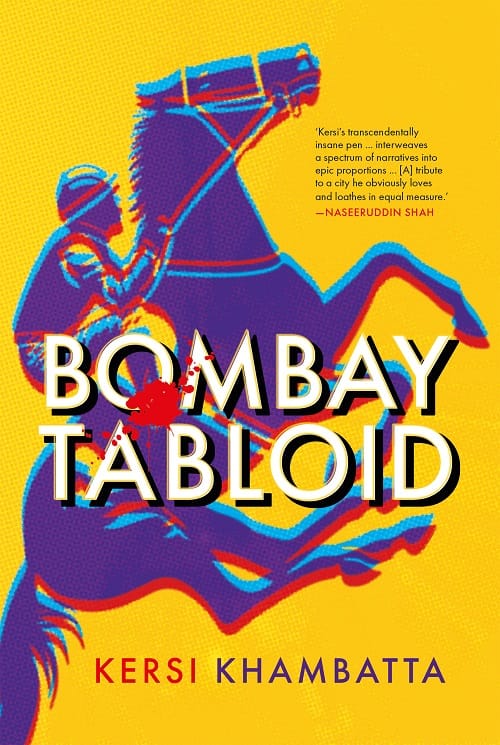
At the center of Kersi Khambatta’s Bombay Tabloid is Cyrus Kerman, the son of an Iran-born bakery owner, and his lifelong entanglement with Devika Wright, a beautiful Anglo-Indian dancer and model who later becomes a lawyer. Cyrus falls in love with her twice.
Their story unfolds between two traumatic periods in the city’s history. The first is the communal violence of 1992–93, following the demolition of the Babri Masjid in Ayodhya by a Hindu nationalist mob. The second is the November 2008 terrorist attack, when ten gunmen from the Pakistan-based Lashkar-e-Taiba struck several locations across Mumbai and killed 166 people. These events locate the story in time; they are not what the novel is primarily about.
As a teenager, Cyrus accompanies the older Rumi Dubash into Kamathipura, Bombay’s historic red-light district, during the 1992 riots. There Rumi betrays Zainab, a young Muslim woman who has rejected him but agreed to meet Cyrus, offering her to Hindu rioters in exchange for safe passage. Cyrus’s attempt to protect her ends in gunfire and Zainab’s suicide; Rumi’s police-officer father covers up the incident and threatens to frame Cyrus. Rumi later becomes Cyrus’s stepbrother after their parents marry. Years later, Cyrus tricks him into accepting a losing horse-racing bet, and Rumi retaliates by setting the gangster-bookmaker Naveen Yadav on him. Three men subsequently ram Cyrus’s motorcycle and beat him into a coma. He wakes with almost no memory of his previous life. When he meets Devika again eleven years later, he does not recognize her—and falls for her all over again. Her work representing abused women attracts threats from violent men. After receiving a potentially terminal diagnosis and finding a hidden handgun, Cyrus becomes a vigilante.
A parallel story follows Altaf, later known as Dalip Singh, who enters Bombay as a stowaway, finds work as a restaurant valet and is mistakenly arrested during the 2008 attacks. He later claims to have been the “eleventh man” in the 2008 Mumbai attacks—an additional member of the terrorist cell beyond the ten gunmen known to have carried them out. The confession is false, concealing a private motive that the novel reveals much later.
That is the story. Finding it beneath Khambatta’s prose can sometimes take work.
Bombay Tabloid reads as though somebody has fed the author espresso, cocaine and the collected slang of South Bombay. The voice is hyper-caffeinated, coked up to the gills and determined to entertain at almost any cost.
The tone is established in the prologue, set in 1997, two years after Bombay was officially renamed Mumbai. Khambatta explains that the new name honors Mumba Devi, patron goddess of the city’s indigenous Koli fishing community. But he is just as interested in the horror this caused among Bombay’s Anglophone elite. While the right-wing government had “flexed muscle and thundered” that the city would henceforth be called Mumbai, the old-money set suffered “existential meltdowns” at the prospect of becoming Mumbaikars and entering a “bewildering, hostile, déclassé future”.
The mockery cuts both ways: at the politics of imposing the new name and at the genteel classes acting as though Bombay had been stolen from their drinks cabinet.
The city’s journalists, meanwhile, are growing restless because April 1997 has failed to produce a suitably lurid catastrophe. No collapsed flyovers, derailed trains, murderous lovers or burned-out slums. “Life isn’t cheap here, brother, it’s free,” the narrator observes. “Take it. So where were the nuttos, the psychos, the whackadoodles?” In this city, catastrophe is both lived experience and entertainment.
Khambatta’s prose rarely settles down. When Cyrus leaves his mother’s home—and Philomena, the domestic worker who has shown him more tenderness than his family—he releases “an asteroid belt of grief, ejecting chunks of jagged, stone-heavy sadness through a strangled windpipe.” Elsewhere his eyes are “hurling out solar flares in the dark.” Mumbai in summer is “as hot and stinky as a workman’s stained underwear.”
His descriptions are maximalist by design. Consider the gangster Parvez Shaikh’s mouth. Every tooth “seemed to have a genetic code of its own”; there was “no teamwork” among them. His gums become “a battered, eroded shoreline,” while the teeth are “haphazard monstrosities” resembling “jagged blunt spikes, defences against a breach.”
Some readers will love the escalation. Others may wonder whether one or two of those images would have been enough. But there is no mistaking the voice. Khambatta’s prose comes at you fully formed and with the volume turned up.
The chapter titles include “Don’t Teach Your Grandpop How to Fuck,” “The Sensei of Scumbaggery,” “The Choot’s Lament” and “I Suddenly Like You, Let’s Fuck.” A recently widowed woman is told: “All your life you’ve lain with a Parsi. Go, get an Italian lover, go to Africa and get yourself a well-hung Masai; if nothing, go local, fuck a South Indian, a Sindhi, a maka-pao.”
In Cyrus’s diary, the Parsis are Zoroastrians who fled Persia before “the hordes of Islam.” The Sassanid rulers, he claims, had grown so decadent that they were “munching grapes while eunuchs finger-banged them,” while the invaders arrived with horses, swords and “world-domination eyes.” History is not allowed to retain much dignity here.
Nor is the profanity limited to dialogue. “Fuck”, “cunt”, “choot”, “chutiya”, “madarchod” and “behnchod” belong to the narrative voice itself. They convey aggression, hierarchy and male intimacy, while puncturing the pretensions of policemen, gangsters and the upper classes.
Once Cyrus starts killing, his confidence returns and his relationship with Devika revives. She knows nothing about the murders or his diagnosis. “The realm of lies,” he says, “it’s a kingdom, a country with its own laws, flag and currency. I live in it. I know its streets and back alleys. I’m fluent in its idioms and grammar. I wrote the guidebook to that fucking thing.” The profanity completes the cadence. Cleaning up this book would be like deodorizing Bombay.
That same Kamathipura sequence best demonstrates how Khambatta’s humour operates. As communal violence gathers outside and corrupt policemen search the brothel, Helen stages a noisy pantomime of sex to conceal Zainab hiding under the bed. She moans, bangs her backside and slaps the wall while the naked, humiliated Cyrus stands several feet away. His used condom finally “slithered off like some alien worm and plopped to the floor.” The scene is frightening, obscene and ridiculous at the same time.
Later, a corrupt policeman lectures the women about Gangubai Kothewali, the legendary madam who had gangsters such as Karim Lala and Haji Mastan “by the balls”. When Jawaharlal Nehru supposedly advised her to abandon her “base, immoral” profession and marry, she replied: “So marry me then, Mr Prime Minister.” The narrator immediately reminds us that Nehru was known for his philandering ways. Nobody remains on a pedestal for long.
The geography feels very real to anyone who knows the city. Rumi’s flat overlooks the Oval near Churchgate Station. Cyrus and Devika meet outside Churchgate, reconnect at Leopold Café on Colaba Causeway and later live in Colaba. Marine Drive recurs throughout the book.
Within that South Bombay geography, the music identifies an even smaller subculture—one I grew up around and recognize immediately. Afro Celt Sound System, Kula Shaker, Ozric Tentacles and the Dandy Warhols mingle with Iron Maiden, Metallica and Loreena McKennitt. Music also becomes a form of recognition between Cyrus and Devika. At a dive called the Hovel, where Cyrus helps assemble the playlists, she recognizes Billy Cobham’s “Stratus,” suggests Steely Dan and singles out “Kid Charlemagne,” the opening track on The Royal Scam. When the song plays later, she knows every word and air-drums its rhythmic changes. Cyrus realizes that they share a musical vocabulary from which Rumi is excluded. This was never the soundtrack of Bombay as a whole, nor even all of South Bombay. It belonged to a small, English-speaking, Western-music-obsessed urban tribe, and Khambatta gets its tastes and enthusiasms exactly right.
But the excess eventually becomes exhausting. Almost every paragraph wants to be the funniest, filthiest or most metaphorically inventive paragraph in the book. The riffs and digressions repeatedly interrupt the story, while different characters sometimes sound like variations of the same articulate, foul-mouthed narrator. It can be difficult to disentangle the plot from the author’s out-of-control exuberance.
That exuberance is also what makes Bombay Tabloid distinctive. This is not cool, minimalist noir. It is a sweating, swearing, horny and furious Bombay tragicomedy, irreverent about power but sentimental about love, food, music, animals and damaged families. The novel could occasionally use a sedative. But once sedated, it might no longer be Bombay Tabloid.