“Cold Mountain Zen” and “The Narrow Road of Oku”
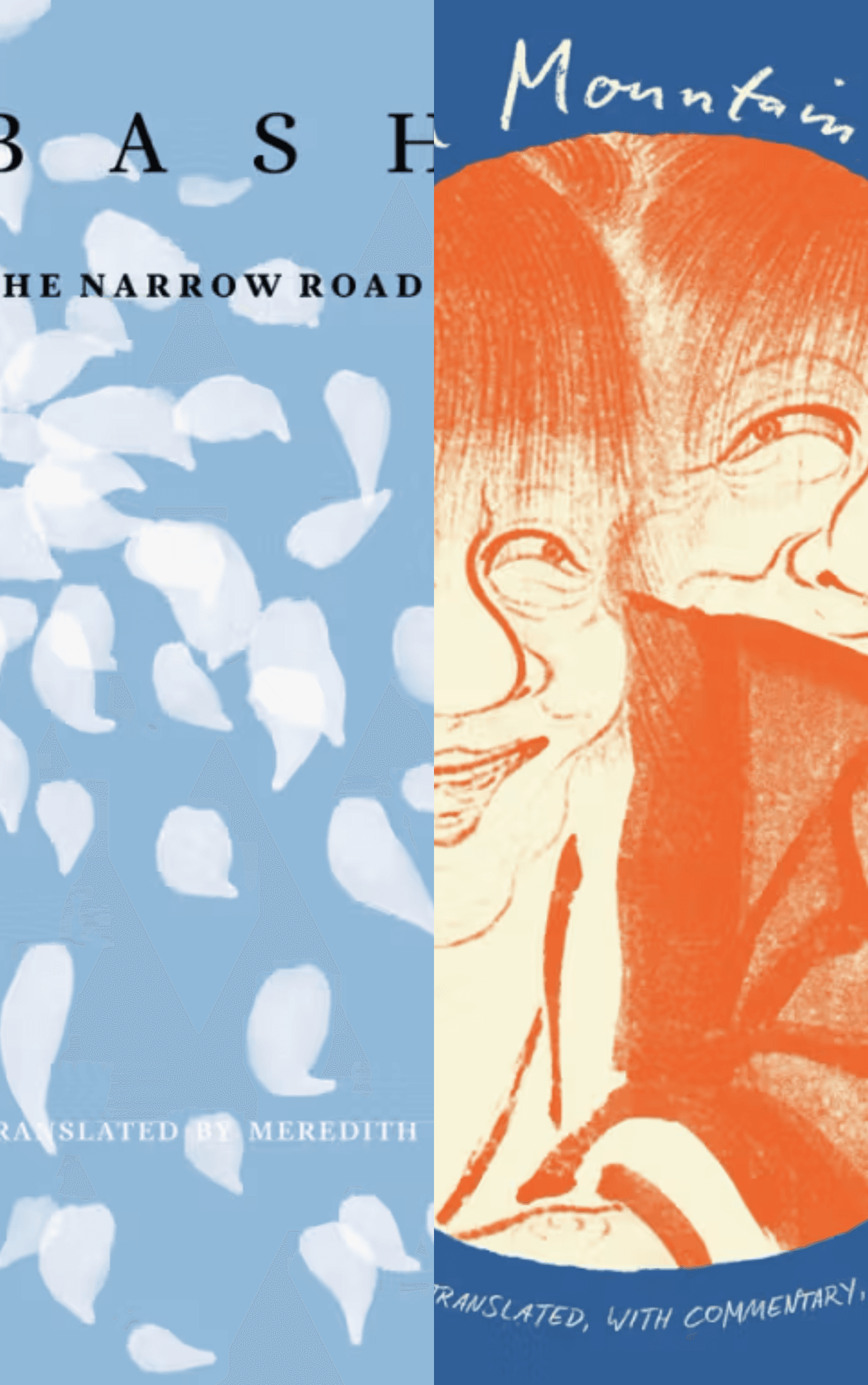
The poetic tradition of China has historically found a warm welcome in Japan, and both cultures draw on a common well of poets, religious currents, and sacred texts. It is thus fitting that two new volumes by essential poets from each country should be published nearly side by side by New Directions. The first, Cold Mountain Zen, brings together new translations of Hanshan’s poetry with writings about the poet by Japanese authors, all translated by Hiroaki Sato. The second volume is a new translation of Bashō’s The Narrow Road of Oku, translated by Meredith McKinney.
Hanshan, who lived in the 9th century, is a semi-legendary figure of Chinese poetry and Buddhism known for his life as a remote ascetic dwelling on Cold Mountain, where, it is said, he carved his poems on trees and rocks. Cold Mountain Zen includes a short story about Hanshan written by Mori Ogai and an account by Ryūnosuke Akutagawa. The first introduces an early account of Hanshan and his friend Shide (another renowned poet) and provides a glimpse of their eccentric, world-flouting habits. Akutagawa’s account, on the other hand, humorously reports the author seeing Hanshan and Shide wandering around modern Tokyo, perhaps as an allegory for the eternal relevance of these poets and of older traditions more generally. Together, these additions to the collection provide interesting insights into the poet’s legacy, his reception in Japan, and his ongoing significance.
Hanshan’s poetry in Sato’s translation breathes with a stunning, limpid directness and simplicity even as it evokes the poet’s complex reflections on worldly vanity and transcendence. The selection is filled with references to the “dusty” world of human affairs, where status, wealth, and anxiety distract us while time slips away:
Human life exists in a dusty darkness
exactly like a worm on a tray.
All day it moves round and round,
without leaving the tray.
It can’t be divine or immortal
with cares and troubles interminable.
Years and months flow away like water,
and in a flash you are an old man.
In contrast to the world of dust below, Hanshan takes refuge in Cold Mountain, the central image of the collection. The mountain is a place of spiritual transcendence, from which the poet can see things clearly. “Who knew I’d be out of the dusty world, / ride a cloud to come south to Cold Mountain?” he asks. Far above the illusions of the world below, reality is encountered directly. There, he contemplates “only white clouds, / utterly silent, above dust and dirt” and escapes “to live outside the phenomena forever.” Yet the mountain is not a static place, for “the route to Cold Mountain does not end,” and the trees sough of their own accord, in their own slow life.
Cold Mountain is also a place of inner contemplation. This becomes especially apparent in the fact that the name Hanshan itself translates as “Cold Mountain,” which the poet takes advantage of:
People nowadays look at Cold Mountain,
and all say, He’s nothing but deranged.
My face has nothing to attract people’s eyes,
my body is draped in nothing but rags.
My words are things others do not understand,
others’ words are things I do not say.
For all this I say to those people on the streets:
just rise and come face to face with Cold Mountain
To read such poems is to do precisely that, to rise above the world, for a moment, to face the melancholic serenity of Cold Mountain.
Bashō’s The Narrow Road of Oku, written some seven centuries after Hanshan lived, is deeply tied to landscape and dedicated to poetic directness. The book recounts a journey taken by Bashō, a student of Buddhism (though not a monk) who lived in seventeenth-century Japan and who is renowned as one of the country’s greatest haikai (later termed “haiku”) poets. The work is a combination of prose and poetry, and the former provides the context for the latter.
The text has been translated into English many times, a fact which reflects the many layers and nuances of Bashō’s art. McKinney shows how even the title can be rendered in numerous ways, from “The Narrow Road to the Deep North” to “The Narrow Road to the Interior”, all of which evoke real but different sides of the Japanese phrase. Luckily, such difficulties have not prevented McKinney from producing a lovely, flowing translation that surely does much to capture the beauty and depth of the original.
Bashō seeks to distill his experiences into an essence. He describes his understanding of poetry in a comment on a poem by Saigo: “All of the landscape is contained within this poem. The addition of a single word would be like adding a useless extra finger to a hand.” The more elaborate, though frequently beautiful, prose descriptions of the journey thus find their fulfillment in the condensation of Bashō’s verse. Some lines evoke entire landscapes, such as
Komatsu, charming name—
wind in the small pines
bush clover, plume grass
Others speak of loss and melancholy, as when Bashō parts from his travelling companion, Sora:
Today the sad dew
washes from my pilgrim’s hat
those words We Walk Together
Others still speak of impermanence, of the flowing course of history and time that washes away even legendary deeds and heroes. Describing the enshrined helmet of a once-great warrior, Bashō writes,
The pity of it!—
beneath his helmet
a cricket chirps
These poems, variously melancholic and reverential, earthy and contemplative, all find their place not just as a part of Bashō’s account of a single journey, but in a larger tradition itself written onto the landscape. The world Bashō travels through is one charged with poetic significance. He encounters rivers, gates, shrines, mountains, and other places where famous poets travelled or which they described in their work. His journey is thus a conversation with the poets who preceded him and the poems that live, through tradition, in the places he visits. Bashō ties his own poetic legacy to these places both in describing them and in writing poems about them. Like Hanshan writing on the stones and trees, Bashō writes himself into the landscapes as he goes. Yet he knows that both the world he describes and his own poems are also a part of nature, which is ever flowing away, and he ends his book with the beginning of another journey. These final verses are a farewell to the reader and a fitting epigraph to the beauty and melancholy inherent in the impermanence of all things, including verse:
Like a clam
torn from its shell I part
in departing autumn.
Though the world and landscapes described by both Hanshan and Bashō are gone, their poems remain. And if the themes of their verse are not eternal, they at least have not disappeared: the vanity of the world, the stillness of the inner self, the consolation of nature, the fleetingness of life. If Akutagawa can see Hanshan wandering in modern Tokyo, then we can meet both him and Bashō in our own cities, our own landscapes, and listen to what they endeavored to say. These new volumes offer an invaluable chance to do just that.