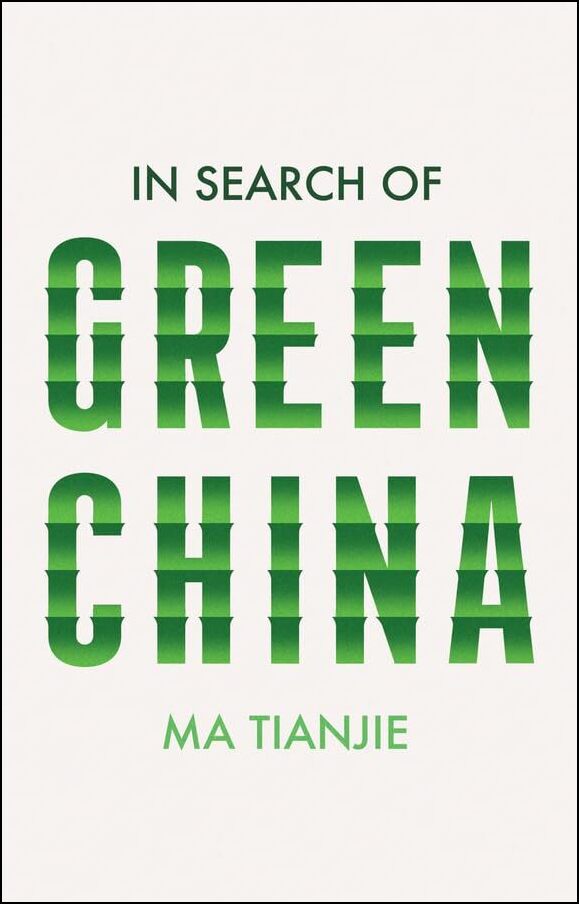
“In Search of Green China” by Ma Tianjie
In In Search of Green China, Ma Tianjie traces how China has achieved impressive net progress towards its environmental goals, including cleaner air and water, and hard targets for peak greenhouse gas emissions, while at the same time closing the political space that once allowed citizens, NGOs, and journalists to shape that progress. The result, he suggests, is a greener China whose achievements are real, but whose silenced civil society leaves its environmental future more brittle and less just—even if some in Beijing would argue that fewer voices have made environmental policy more coherent.
Ma writes from inside China’s environmental world, drawing on years at Greenpeace and China Dialogue to show how the country’s turn toward what leaders now call “Ecological Civilization” emerged from specific battles, people and ideas. He follows the evolution from Deng-era “growth at all costs” to a system in which peak carbon, pollution controls and ecological “red lines” appear in five-year plans and top-level speeches.For many Western readers, a “green China” crystallized around 2014, when Xi Jinping and Barack Obama jointly announced China’s first target to peak greenhouse gas emissions; paving the way for the Paris Agreement and signaling a deliberate shift toward a “more sustainable development model”. Throughout the book, Ma credits this shift not only to top-down decisions but also to a prior generation of scientists, activists, journalists, and reformist officials who reframed nature as a strategic national asset essential to China’s survival.The early chapters of the book recover a period when citizen activism and investigative journalism could still alter the course of development. In the chapter called “The River”, Ma profiles Huo Daishan, who quit his job to document cancer villages along the Huai River, where unregulated industrial discharges had turned water into a lethal threat. Huo’s patient documentation and petitions helped push the State Council to incorporate environmental impact assessments (EIAs) into development planning in 1996, an early sign that citizen efforts could help reshape policy tools.The chapter entitled “The Dam” offers what Ma seems to proffer as a near-perfect example of a healthy civil society influencing major decisions. Plans to dam the Nu River—one of China’s last major free-flowing rivers and part of the “Three Parallel Rivers” World Heritage site—were backed by a formidable “development bloc” of the National Development and Reform Commission (NDRC), Yunnan officials, and Huadian Power, who saw hydropower as a way to win China’s promotion tournament for growth. Against them, an unlikely coalition formed: State Environmental Protection Administration (SEPA) official Mu Guangfeng, radio host and NGO leader Wang Yongchen, and Yu Xiaogang, sociologist at Yunnan Academy of Social Sciences. In addition they were aided by journalists, international NGOs, and ethnic Lisu, Tibetan, Naxi, Yi, Bai, and other peoples whose villages stood to be flooded.Through EIAs, media campaigns, local organizing, academic convenings, and international pressure, they forced a reconsideration of the project, and Premier Wen Jiabao ultimately halted the dams, pending further study. The Nu remains undammed today. Ma treats this as a high-water mark: an environmental coalition able to mobilize public opinion and expert scrutiny, and a central leadership still willing to listen.Yet the victory for the river came at a steep price for those who defended it. Wang was pushed into “recommended” retirement by China National Radio, mocked by nationalistic development advocates as “superstitious” and “pre-modern”. Mu Guangfeng was sidelined within SEPA, and Yu Xiaogang’s treatment was even harsher. The sociologist’s engagement with dam-displaced people, especially his efforts to connect Nu River villagers with peers in the Lancang River basin worried Yunnan officials. Yu was fired and subject to constant police surveillance, his former colleagues were forbidden to work with his NGO, Green Watershed, which encountered difficulties with permit renewal.Ma links this pattern to a broader ideological turn after events like the 2004 Ukrainian Orange Revolution, as Chinese environmental NGOs were increasingly portrayed as tools of foreign interference. The idea that protecting nature could be foreign-manipulated made environmentalism vulnerable to nationalist attack even as its policy goals gained ground.In the chapter entitled “The Smog”, Ma turns to the era of Xi Jinping’s rise, when China’s level of air pollution in big cities drove public anger. The 2013 Airpocalypse, as it was styled by international media, prompted unprecedented promises from the top. Xi framed his approach as environmental populism—“If the people are demanding, we must respond”—and early on, green NGOs, state media, and social media activists embraced the opening. Ma Jun, Deutsche Bank’s chief economist for Greater China, kicked off a side project that aimed to outline a framework for economic structural adjustment that would bring down PM2.5 particles to healthy levels. Less heavy industry, more services, fewer cars, more EVs, etc. As a banker he thought along structural lines, creating incentives for an industrial shift. His policy prescriptions became more influential when he moved from Deutsche Bank to become the Chief Economist for China’s Central Bank in 2014. Groups like Greenpeace built city air-quality rankings and pollution maps, helping to concentrate pressure on major emitters, while viral memes kept PM2.5 pollution on the national agenda.This hopeful moment culminated in renowned TV reporter Chai Jing’s documentary, Under the Dome, a self-funded exposé of the human health costs of pollution, with significant input from a large group of civil society leaders and environmental experts. Chai implored the public to participate in improving air quality. She urged citizens to join organizations such as Friends of Nature, one of the best-known and China’s first environmental NGO. The documentary garnered some 200 million views within days, and urged citizens to join NGO groups like Friends of Nature. It was abruptly censored five days later, without explanation, and its association with international environmental organizations was turned into a liability in an increasingly “ideologically adverse” climate.Ma argues that as Xi elevated “Ecological Civilization” and set ambitious climate and pollution targets, he also moved decisively to reclaim ideological control over the public sphere. A 2013 crackdown on Weibo influencers, a 2014 creation of a Leaders Group on Web Security to “coordinate and direct the CCP’s internet strategy,” and a restrictive 2015 foreign NGO law all tightened the boundaries of permissible participation. Institutions once seen as future pillars of environmental governance—the press, NGOs, even EIA proceedings that invited public comment —were told to hew closer to the party line, focus on positive stories, and forced to navigate growing bureaucratic hurdles.However, Ma does not deny—or downplay—the scale of China’s environmental achievements. He credits officials such as Xie Zhenhua and Pan Yue with pushing EIAs into law, championing indicators that account for ecological limits, and later crafting climate diplomacy that produced the US-China Joint Agreement and China’s pledges to reach peak emissions before 2030 and reach carbon neutrality by 2060. China has deployed renewables at unprecedented scale, launched a national carbon market, and used aggressive administrative measures to drive down harmful PM2.5 pollution and shutter some of its dirtiest capacity.Grassroots groups like Friends of Nature, Ma notes, still try to act as local “carbon watchdogs”, but find their input largely ignored, especially in newer arenas such as industrial capacity controls overseen by agencies with little habit of engaging civil society. In the chapter called “The Incinerator”, we see that local voices raised over the issue of dioxin pollution in residential neighborhoods have largely been stifled as waste-to-energy has been incentivized with attractive feed-in-tariffs and classified as “green”.As Ma puts it, the regulatory model that once “incorporated strong public oversight gave way to one that bypassed it.”Running throughout the book is a quiet but unmistakable sense of loss. Ma returns to the Nu River to show how, by 2016, the vibrant coalition that had once stopped the dams had shrunk under waves of ideological and regulatory purges. He describes rising “nationalistic mobilization” against climate researcher Jiang Kejun who showed how China could strategically wean itself off coal, and public figures like Chai Jing, whose links to international partners made them easy targets for accusations of “self-castration” or foreign collusion.Ma himself has not been spared: China Dialogue, where he worked, was ultimately forced to close its China office under the restrictive climate for NGOs. He is clear that China’s green transition has been messy and contested, tugged between a development bloc that “stubbornly refuses to acknowledge nature’s biophysical limits” and reformers who see nature as a finite civilizational asset. What has changed, in his telling, is not the importance of environmental stewardship but who is allowed to argue for it, and how.To those who might argue that the current regime’s hard-nosed strategically-driven policies “work” at a society-wide level (without input from civil society), Ma’s book offers a rejoinder. Without room for independent watchdogs to provide feedback, outspoken officials, and mobilized citizens to catch errors or adapt to shocks, how durable—and how just—can China’s green future be?