“In the Margins of Empires: A History of the Chicken’s Neck” by Akhilesh Upadhyay
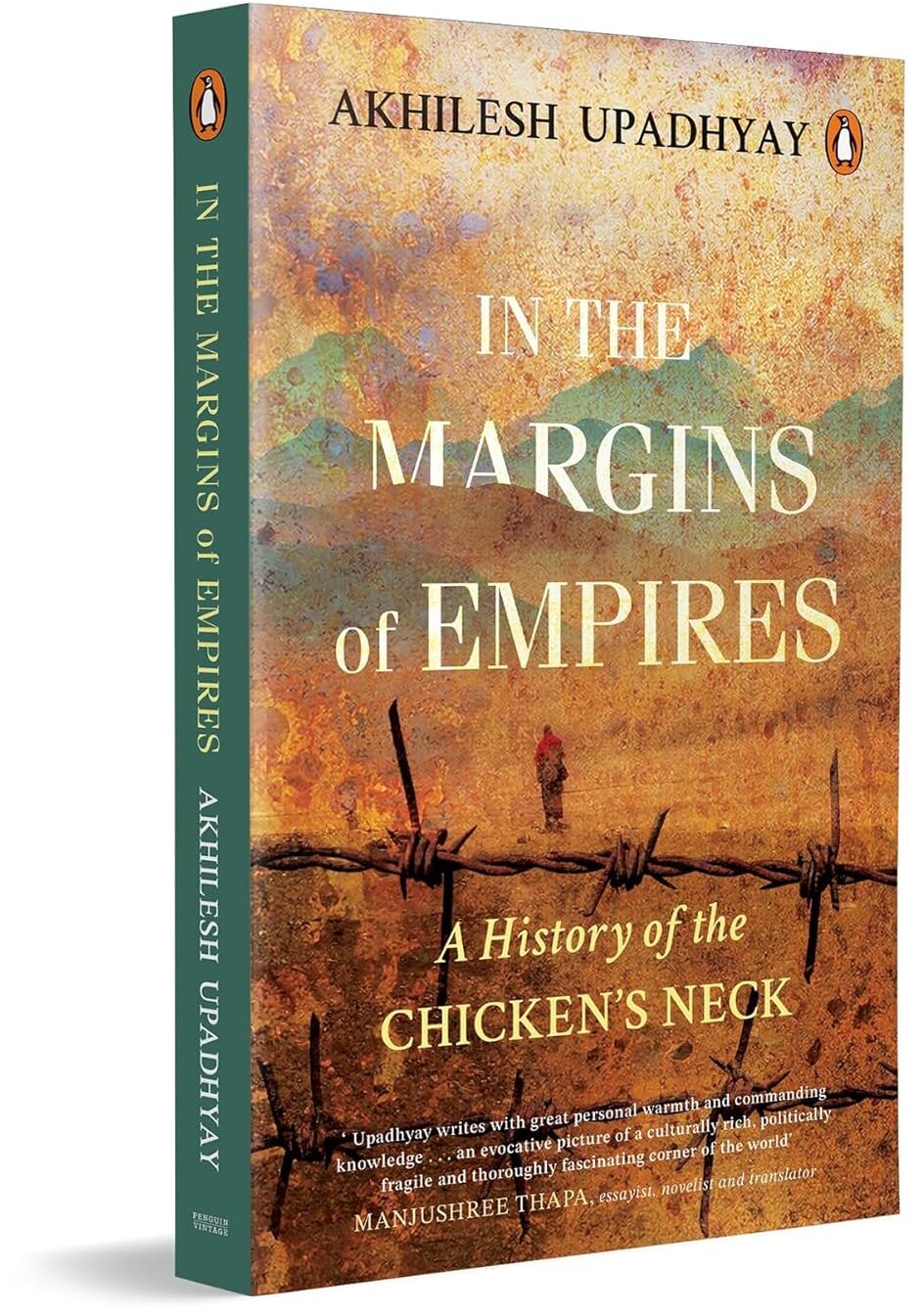
The “Chicken’s Neck”, or Siliguri Corridor, was created in the aftermath of Partition. Just 22 kilometres wide at its narrowest point and roughly 60 kilometres long, it connects India’s northeast to the rest of the country. Bordering Bangladesh and Bhutan and with China in close proximity, security theorists have long worried that this strategically vital region, could be severed and India’s northeast rendered landlocked in the event of conflict. In some sectors, Indian and Chinese troops are stationed just 30 metres apart, the closest proximity anywhere along the entire Sino-Indian border. How this strip of border was created, and how it has been shaped by recent politics, is the topic of In the Margins of Empires: A History of the Chicken’s Neck by Akhilesh Upadhyay.
Upadhyay, a veteran journalist and former editor of the Kathmandu Post, approaches this geography not from the viewpoint of generals and policy makers stationed in national capitals but of those who live on the ground. Growing up on the Nepal-India border, he knows that the reality of borderlands is fundamentally different from that proclaimed in distant political centres. The book begins with the open Nepal-India border, where crossing into India is a daily reality for many, for shopping, education, healthcare, or access to Indian transport links. Upadhyay draws on early personal experiences of traversing borderlands, later supplemented by his travels as a journalist across India and into Tibet. Throughout, he emphasises the experiences of local people “at the periphery, politically, and geographically”.Historic, fluid cultural and economic exchanges were first disrupted with partition and the rigidities of modern nation-states. Older patterns of mobility and exchange have been reshaped, constrained, and redirected by the enforcement of new borders. Communities also navigate often illogical policies dictated by policymakers in capitals hundreds of kilometres away. They can see “their livelihoods disrupted by faraway power struggles and land demarcations, with no say in the process.” Despite these borders, they remain connected. In the border town of Siliguri for example, live people from Nepal, Bangladesh, Bhutan, and India, whom a mixture speak Hindi, Nepali, Bengali, Marwari, Maithili, Bhojpuri, Rajbanshi, Kamtapuri, Lepcha, and other languages.Partition was not the only rupture. In the early 1950s, China solidified control over Tibet, hardening the Indian-Chinese border. Then a decade later, the 1962 Sino-Indian War, crystalised border tensions, which continue to animate security calculations around the Siliguri Corridor. Sikkim’s merged from an independent kingdom to India’s twenty-second state, followed in 1975 and receives careful treatment in the book. New Delhi had long sought influence over Sikkim, and protests and “political instability in Sikkim provided India with an opportunity to assert further control.” Following a referendum abolishing the monarchy and ending the Chogyal dynasty, Sikkim joined India. Akhilesh explains how this event caused panic in Nepal, tapping into long existing fears of incorporation into India, existential anxieties that persist to this day in Nepal.These transformations reshaped political geography across the eastern Himalaya. The book also traces how Kalimpong in West Bengal emerged as a hub for trade, education, and, briefly, for the Tibetan resistance. It recounts the activities of the Tibetan guerrillas, who became known as the Khampas, in northern Nepal, launching raids into Tibet. Yet the resistance failed to make a meaningful dent in CCP rule. The US backed efforts failed in part because of poor management and insufficient CIA support, and in part because expectations of resistance were unrealistic compared to the scale of CCP consolidation. Limited food and medicine, heavy losses to Chinese troops, and disruption to local communities in Mustang also eroded local support. After Nixon’s overture to China, the Khampa movement was disbanded.Politics is expressed through many ways, including language. The Gorkhaland movement in Darjeeling, Upadhyay explains, sought respect for the language and identity of Lepchas, Nepalis, and Bhutias against perceived marginalisation by Bengali elites from Kolkata. Nepali language literature, Upadhyay suggests, served as a bridge for disparate Nepali speaking hill communities in Sikkim and Darjeeling. He discusses works such as Fatsung by Chuden Kabimo which help show how many people in the northeast are not seen as “Indian” in the cultural sense of northern Hindi speakers; yet these Nepali speakers are not necessarily Nepalis from Nepal. They exist in an “uneasy space” in between.The book ends by looking to the future. Much of South Asian politics, Upadhyay predicts, will either reverberate through this corridor or originate from it, in a “mosaic of hedging and dependency with additional ambiguity. Whether the eastern Himalaya becomes a buffer of peace or a battlefield of proxies will depend not only on great-power strategies but also on the agency of the smaller states navigating it”. As he warns, “the coming years will be pivotal in determining whether the Siliguri corridor remains India’s gateway to Southeast Asia, [via northeastern India’s border with Myanmar], or becomes a chokepoint susceptible to strategic encirclement.”