“Light Year” by Jennifer Wong
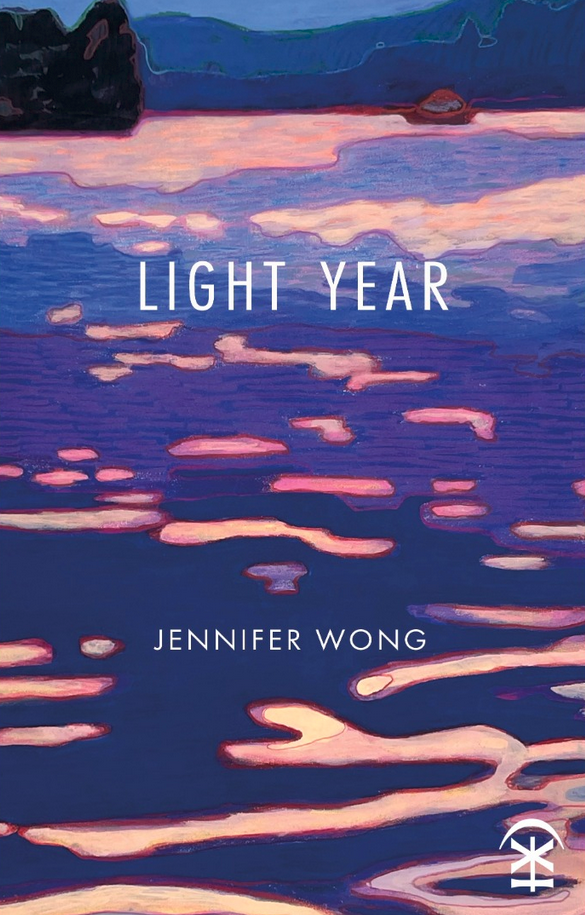
Jennifer Wong’s Light Year is a meditation on separation and exile, tracking the concerns of other authors of the Hong Kong diaspora. The title is especially appropriate for the theme: a unit of measurement that calculates distance through the optics of speed and time. Indeed, the poetry focuses on the geographical distance between the United Kingdom, where the poet currently writes from, and Hong Kong, where she grew up. That distance is layered by the generational gaps between the poet and the rest of her family. Over the course of four sections, the two sides of the equation, time and space, become interlinked, then inextricable.
The epistolary poem “Time Difference” represents this duality. Addressed to the poet’s mother, it expounds on the double meaning of the phrase to establish the distance, physical and emotional, in the mother-daughter relationship:
The difference between us has changed. When we are having our breakfast coffee and pastries, you’re slurping wonton noodles.
Often, after dinner, I thought of you and wanted to call you. By the time you wake up with a cup of the strong pu-er tea, I’m already asleep.
If you’d read my poems, you’ll see yourself in many of them, and all the places we’ve been to.
Mirrors are where I try to find you.
And you might even ask me why, after what seems like a whole lifetime.
“If you’d read my poems” is both an invitation and a challenge. Poetry as the proposed mode of conversation, one that might bridge the distance, has been ignored so far—the poet’s vocation dismissed. In turn, the “mirrors” can refer to how that poetry reflects their relationship, or more intimately reveals the physical similarities between mother and daughter.
That generational gap extends beyond the immediate family. In her poem, “Hong bak nam tarpaulin bed, 小姑娘, 饺子, 馒头”, Wong again speaks to her Mother, this time reminiscing about her grandmother. They trace her migration southward,
We called Grandma and her neighbours villagers, who trekked for weeks on an impossible journey, province after province, arriving at this city where people clacked their tongues in Cantonese.
I would sit cross-legged on the red-and-blue tarpaulin bed on the verandah, until the blush of sunset completely covered the hillside.
Sometimes you’d sing Teresa Teng’s song to us. In such beautiful Mandarin, heavy with your accent. She died young. In Hong Kong, you missed speaking Mandarin, the familiar sound of 小姑娘 and 馒头, terribly.
The expression of the dialects, as transliteration or translation, reflects the poet’s linguistically-fractured family. Cantonese-inflected Chinese only appears in its transliterated form, “Hong bak nam,” then translated as “red-and-blue,” while the Mandarin retains its simplified foreignness. In a recent interview, Wong explained how her childhood was
Punctuated with frequent and regular monthly visits to my maternal grandmother, who lived on the other side of Hong Kong, at the end of the Tseung Kwan O line. My maternal grandmother could not write, could not walk easily, and spoke Mandarin. So the matrilineal side feels emotionally close to me but physically far away, and full of gaps.
While most of her poems could be considered free form, Wong does, in one instance, take inspiration from the structure of the recipe in “Recipe for acceptance”. The form itself is a deliberate play on traditional female roles in the kitchen, and provides the perfect space for her to examine the expectations set upon Chinese women:
Serves 2
Ingredients
2 tablespoons of filial piety
3 cloves of calmness
Perfection, finely chopped
400g politeness, minced
A teaspoon of logic
Paired with the list of ingredients is an equally witty and unreasonable method, which includes: “Accompany mum on her daily trips to the wet market” and “Whatever you do, don’t leave her behind”. That fraught mother-daughter relationship once again comes to the fore, pressing the point that this recipe, as written in the first line, means to serve two.
Written in a deceptively simple style, Light Year is an engaging body of work that opens up one end of the conversation without demanding a response. Although not entirely bridging the distance, Wong’s careful examination of family proves that, if one has read the poetry, her reflection is clear and sympathetic.