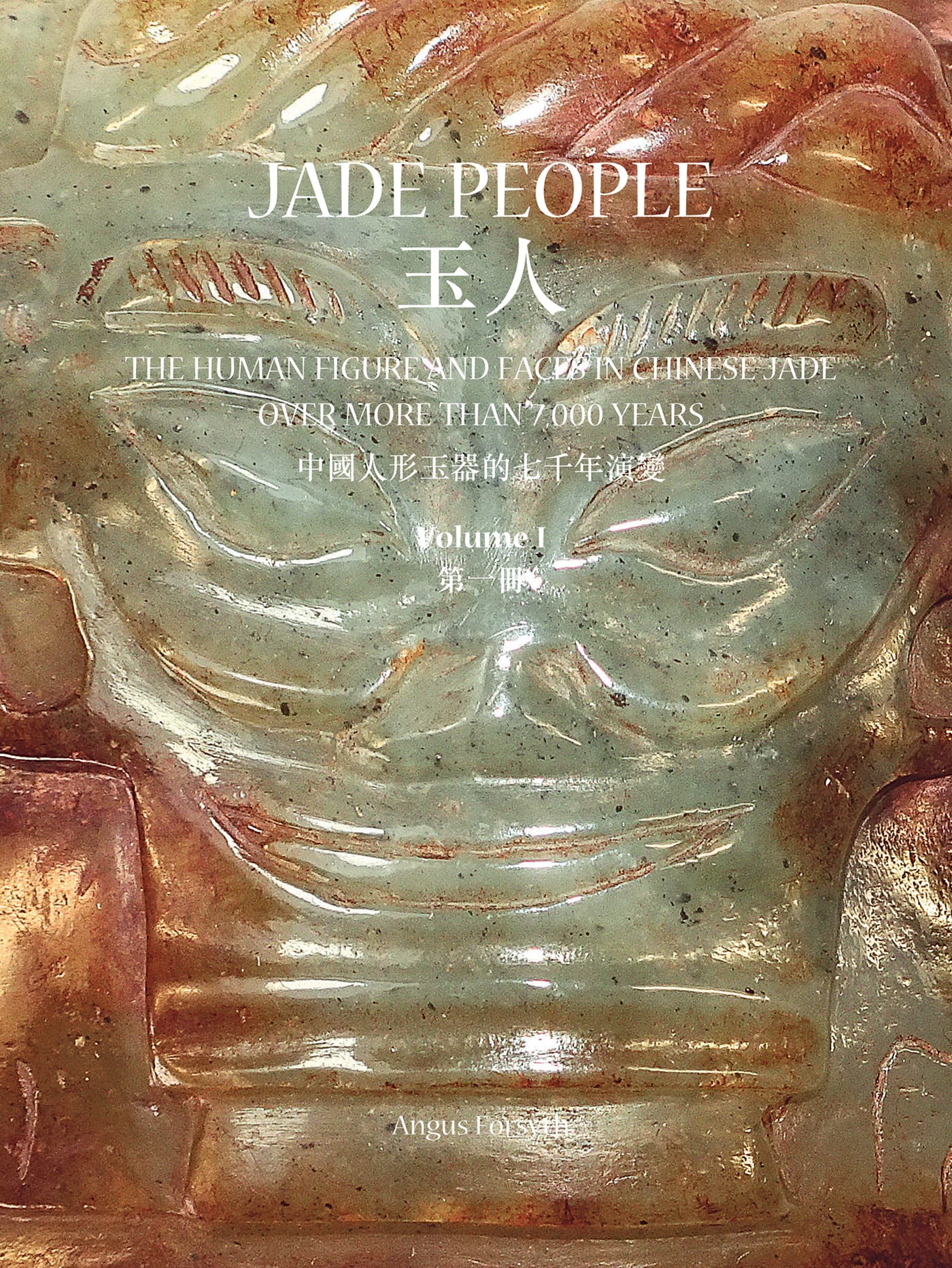
“Jade People” by Angus Forsyth
Among the earliest examples of sculptural art are representations of the human figure, like the 25,000-year-old Willendorf Venus discovered in Austria in 1908. In western art, fascination with portraiture and anatomical realism were features of the earliest sculptures around the Mediterranean, from Nefertiti and King Tut to Roman emperors and Greek gods.
This important volume—the first of a four-part series—asks what we can learn from Chinese representations of the human face and figure from an early and little understood era, much later than the Willendorf Venus but well before the era of the Greek philosophers and Roman Republic.
Angus Forsyth, the author of Jade People, uses his own extensive jade collection to address this question. Volume 1 covers the Chinese Neolithic to the beginnings of the dynastic era, roughly 8,000 to 3,000 years ago. The late Shang dynasty was nearly contemporaneous with the reign of King Tutankhamun and had also discovered the use of bronze metallurgy. But its approach to the human face and figure were startlingly different, embedded in a much older tradition in which anatomical realism and portraiture were far less evident, and conjecturally, less important within the early civilisations of China than the West.
One of the reasons for these differences was the material used. While the Chinese had access to alabaster and marble resources, as well as clay, it was not until much later, starting in around the third century BCE with the Han dynasty, that they began to use these materials to create realistic representations of the human figure.
Why not? is an obvious question which Forsyth does not answer, but it could have to do with an early fascination and use of jade during China’s Neolithic period proper, from 7,000 to 1,700 BCE, when settled communities began tilling rice and millet in different parts of the area today unified as the People’s Republic of China. One jade expert, Elizabeth Childs-Johnson, calls this period China’s “Age of Jade”, when jade was used both for ritual and practical purposes, like weaponry and plows.
Forsyth’s book includes introductory chapters on ancient art of the Paleolithic (the Willenburg Venus) and how pastoral settlements in China made possible the introduction of a class of jade-working artisans. He also explains some of the constraints of working in jade, a material much harder than marble, which is abraded using harder materials, generally quartz crystals on strings, drills and disks. This made production of two or three-dimensional jade objects a lengthy and arduous task for the artisan.
It was not until the introduction of bronze metallurgy in around 2,000 BCE that China’s artisans began to produce more intricate surface decoration and complex shapes, as bronze tools replaced bone and string. While bronze is also significantly softer than jade, it is more durable and easier to mold into precision tools, which, like their less robust predecessors, were used with abrasives in order to shape the raw material of jade pebbles into art.
Once Forsyth has gotten the explanatory material— which is available elsewhere—out of the way, he gets into the main subject, an illustrated journey through his collection of jade figures organised chronologically and by culture. China in the Neolithic period can be thought of as large and small settlements in contact with each other but, like pre-Roman Europe, following different ceremonial and social pathways. That these cultures used jade means that some elements of their cultural affinities and pathways have been preserved, unlike whatever they may have produced in biological materials like wood that degrade easily.
What we learn about the human figure in this volume is that it was seen largely in a ritual context. Many of the figures are beaked, hold serpents or ritual objects, and have limbs that fuse with figures of birds, tigers and other animals. Forsyth believes that the religions of China’s deep past were similar to shamanistic beliefs that persist in Siberia and China’s far north in Heilongjiang province. The specific cultures are identified from archeological excavations as well as stylistic unities— Hongshan in northeastern China to Liangzhu in the Yangtze River delta to Lingjiatan, Qijia, Longshan, Erlitou or Shang, Sanxingdui and the closely related Jinsha. Forsyth addresses each of these in turn, using pieces from his collection to show how the representation of the human face and figure evolved. The art includes images of foreigners, and in his helpful analysis, Forsyth explains how differently shaped eyes became one of the principal ways to differentiate Han Chinese from other ethnic groups.
Some of the earliest images in the collection date from around 5,000 B.C.E., and are roughly shaped pebbles of human faces), 5.5 cm to 9 cm in height with tunnel holes drilled on the reverse side and may have been used as pendants. The pebbles are of nephrite, the type of jade predominantly used in China at least until the 18th century, when the emperor Qianlong’s successes in expanding territory of the Qing empire opened up jadeite trade with Myanmar.
For neophytes to jade, jadeite is the most familiar type of jade from its contemporary use as jewelry. Nephrite is a different mineral composition, imported in large quantities to central China from Xinjiang in the west from the Western Zhou dynasty forwards. In the period under review in Vol 1, jade was mined locally, from deposits that have long since been exhausted. Forsyth explains these differences, as well as the intersection between the introduction of bronze technology and the craft of jade, which is inherently shaped through abrasion rather than carving in the manner of wood or marble.
The effect of the use of bronze tools in the last period covered by Vol 1, the Shang and its near contemporary Jinsha culture, is dramatic. Raised lines in surface decoration and rounded rather than squared off modelling made possible a new level of artistry and expressive treatment of the human form. All of a sudden, we move beyond ritual to real people rooted in their societies beyond religion. An elegant, highly polished image from late Shang of a man with hands bound behind his back and an expression of fear on his face shows the expressive range of these early jades. Shang royalty engaged in human sacrifice and this small image shows empathy with the victim. Given the material and the cost of producing any such item, it is an indirect proof that acts of ritual sacrifice were accompanied by emotion, not just on the part of the victims but also their observers.
Among the images in Vol. 1 is a 38 cm-high figure from an earlier period. A male figure, as most of the Neolithic human images are, he holds a club and an object generally known as a zhulong or pig dragon, in proportion as high as the man’s chest. Forsyth describes its provenance as Hongshan period (4,700 to 2,900 BCE), named for the earliest excavation of a site in Chifeng, Inner Mongolia, in 1935, carried out by Japanese archeologists. The dragon’s pig-like snout and serpentine, coiled body are closely associated with these and later excavations, but their use is unknown. The figure holding the pig dragon is unique in published literature, as are many of the other pieces in Forsyth’s collection.
The pig dragon, together with another image typical of Hongshan, the “C” dragon, for its typically elongated body in the form of a C, also snouted, are seen as ancestral images of the Chinese dragon. Throughout recorded history in China, dragons have been seen as beneficial, imaginary beings, in contrast to their predatory and demonic image in the West. Forsyth has several human figures holding pig dragons and C dragons, illustrating how they might have been used in ritual performances of the time. Whether or not they were seen as friendly creatures, the objects clearly inspired awe. The male figure seems clearly to have a role as a spiritual practitioner, possibly using his club the way Zen monks use their keisaku to wake sleepy students.
The jade art of ancient China is as electrifying and little known as the arts of Africa or the South Pacific were to collectors in the early 20th century. Partly because of the vast size of Forsyth’s collection even when contained to the niche of human or humanoid figures, and its uncanny range, many of these images test the boundary of what is commonly perceived as Chinese. They reflect a set of ancient jade working societies whose cultural contexts can only be imagined from these strange, haunting and evocative forms.
Jade People is not an easy read, but for other collectors and, to some extent, those new to the subject of ancient Chinese jade, Forsyth provides a guide to the foundation of the art. These early representations of people are realistic without being anatomically obsessed, and situate the human form in league with nature and the spiritual world. Thus, Vol. 1 of Jade People becomes an exploration of Neolithic Chinese psychology and religion well beyond simple representation.
Almost all the photographs are of pieces from Forsyth’s Peony Collection and taken by himself, according to the introduction. Unlike many books by collectors (perhaps intended to set up their collections for sale by providing details on previous owners and comparable pieces from auction houses or museums), Forsyth provides little or no context in terms of their acquisition or parallels in other collections. One of the most ambitious jade collectors globally, Forsyth has previously published books drawn from his collection of images of Bactrian camels in jade, Ships of the Silk Road (2018) and Celestial Beings and Bird-Men (2020). There may be some overlap between the latter and forthcoming volumes of Jade People, but here Forsyth is sorting his enormous collection by singling out human and humanoid images in jade.
The book is likely to be controversial among collectors, because of the range of the collection, particularly the Hongshan figures, which are more varied than pieces found in established museum collections or auction sales and, like the standing Hongshan man on the cover, are astonishing and unique.
But it is impossible to be rigidly academic about the range of jade associated with any one of China’s Neolithic cultures, beyond carefully monitored archeological excavations. Collectors use a range of methods, starting with microscopic analysis of tool marks and broad comparison with published works, to assess provenance. Unlike ceramics and biological materials, there is no hard and fast means of dating jade once it has left the ground. Particularly with the most ancient jades, most have survived because they were used as burial objects.
Since the 1990s, excavations at Niuheliang and other sites in Inner Mongolia and Liaoning province have expanded the resources of museums and collectors in Hongshan jade objects, as well as the other cultures that make up Forsyth’s Vol 1. The frenetic infrastructure construction of late 20th century and 21st century China has surfaced extraordinary new findings that constantly refresh our understanding of the variety and depth of the cultures that made up the Neolithic age in China, let alone the dynastic traditions, also scattered across the landscape we know as modern China. As Forsyth continues his monumental series on the human form in Chinese jade, expect more surprises.