Old post
This post was published before January 2026. Some links, images or other content may no longer display or work as originally intended.
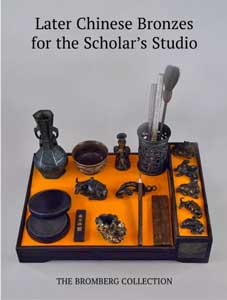
“Later Chinese Bronzes for the Scholar’s Studio” by Paul Bromberg
Most people “collect” stuff, but Paul Bromberg is a “collector”, the difference being that he proceeds with intent and purpose, focusing on a relatively narrow group of objects. Bromberg is now on at least his fourth collection:
At the end of 1997, my wife, Siripun, and I moved from Hong Kong to Bangkok. We then were in the fortunate and enjoyable position of together amassing three separate collections of Thai art over the next twenty years—Bencharong porcelain; Thai silverware; and porcelain tea sets made in China for Siam.
Not quite satisfied, he “always wanted to start a collection focusing on an aspect of Chinese art.” This can, as a glance at auction estimates will indicate, be a costly pastime. But
one day early in 2018, I came across and acquired a charming 19th century bronze ‘qilin‘ scroll weight. At that time I did not know anything about it, but found the item highly attractive in terms of its aesthetic and tactile qualities. I immediately began researching later Chinese bronze paperweights and found that, despite advances in scholarship over the previous thirty years, these objects still appeared to be underappreciated and consequently remained affordable, especially when compared to porcelain or jade from a similar period.
Although it contains a pair of (heavily-footnoted) essays, one previously published, and a couple of brief prefaces, Later Chinese Bronzes for the Scholar’s Studio is for the most part a catalog of the resulting collection of “smaller items typically used in the Chinese scholar’s studio: beautiful yet utilitarian, whimsical yet practical, archaistic yet not archaic.” The collection features 122 later Chinese bronzes, primarily from the Ming and Qing dynasties. These include various kinds of paperweights (in the form of animals, mythical beasts and people), brush rests in the shape of mountains and dragons, brushpots, incense holders and burners, seals and other items for, and found in, as the title has it, “the scholar’s studio”.
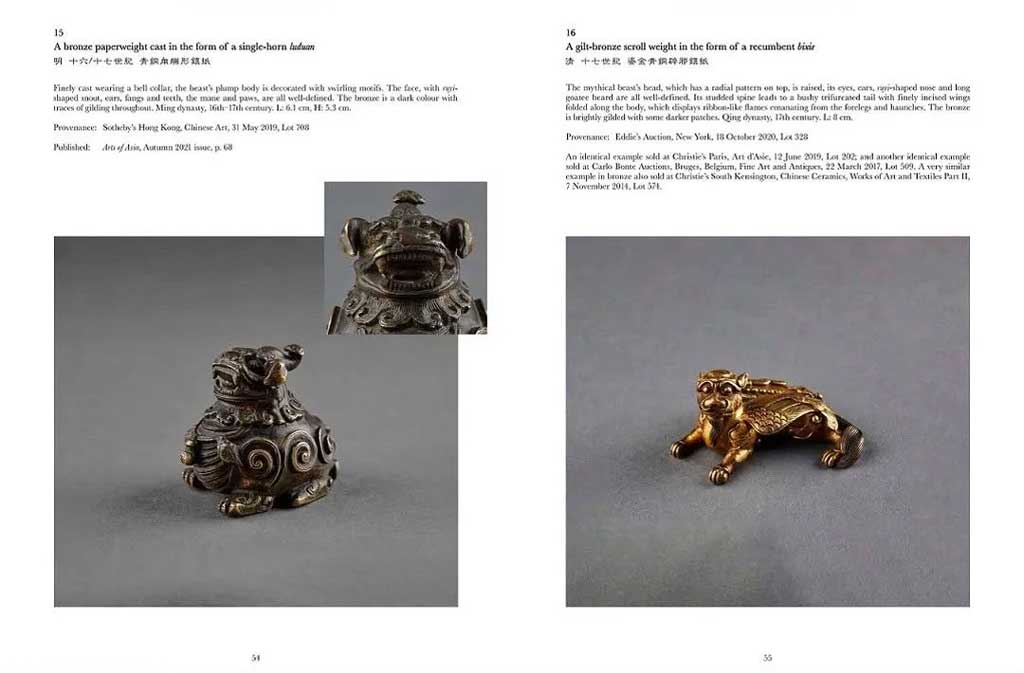
The result is in aggregate probably as much about collecting as the collection (as interesting as that will undoubtedly be to cognoscenti). One suspects that many of these relatively small pieces look better—as do other such collectibles of roughly similar size as antique coins or netsuke—in the excellent photos than they do, or would, in a display case. In further emphasis on the act of collecting, the text accompanying each photo is often as much about provenance as description.
The “later” in “Later Chinese Bronzes” has a whiff of the apologetic about it, perhaps a bit like “Victorian Silver”.
Until thirty to forty years ago, little attention had been paid to later Chinese bronzes, i.e. those bronzes dating to the approximately 950-year period from the Song dynasty (960-1279) to the end of the Qing dynasty (1644-1911): bronze objects from this period were thought not to have been as greatly prized by Chinese scholars and collectors compared to the classical bronzes produced during China’s great Bronze Age, lasting from circa 1700 BCE to the end of the Han dynasty (206 BCE-220 CE).
This seems somewhat unfair, for “later”, in the Chinese context, is nevertheless usually still decidedly old, at least compared to these pieces’ European counterparts, which might somewhat ungenerously be labelled bric-à-brac. These, on the other hand, are objets d’art on a human scale, meant to be handled, yet with more than a patina of erudition.


You must be logged in to post a comment.