“Madame Chrysanthème” by Pierre Loti
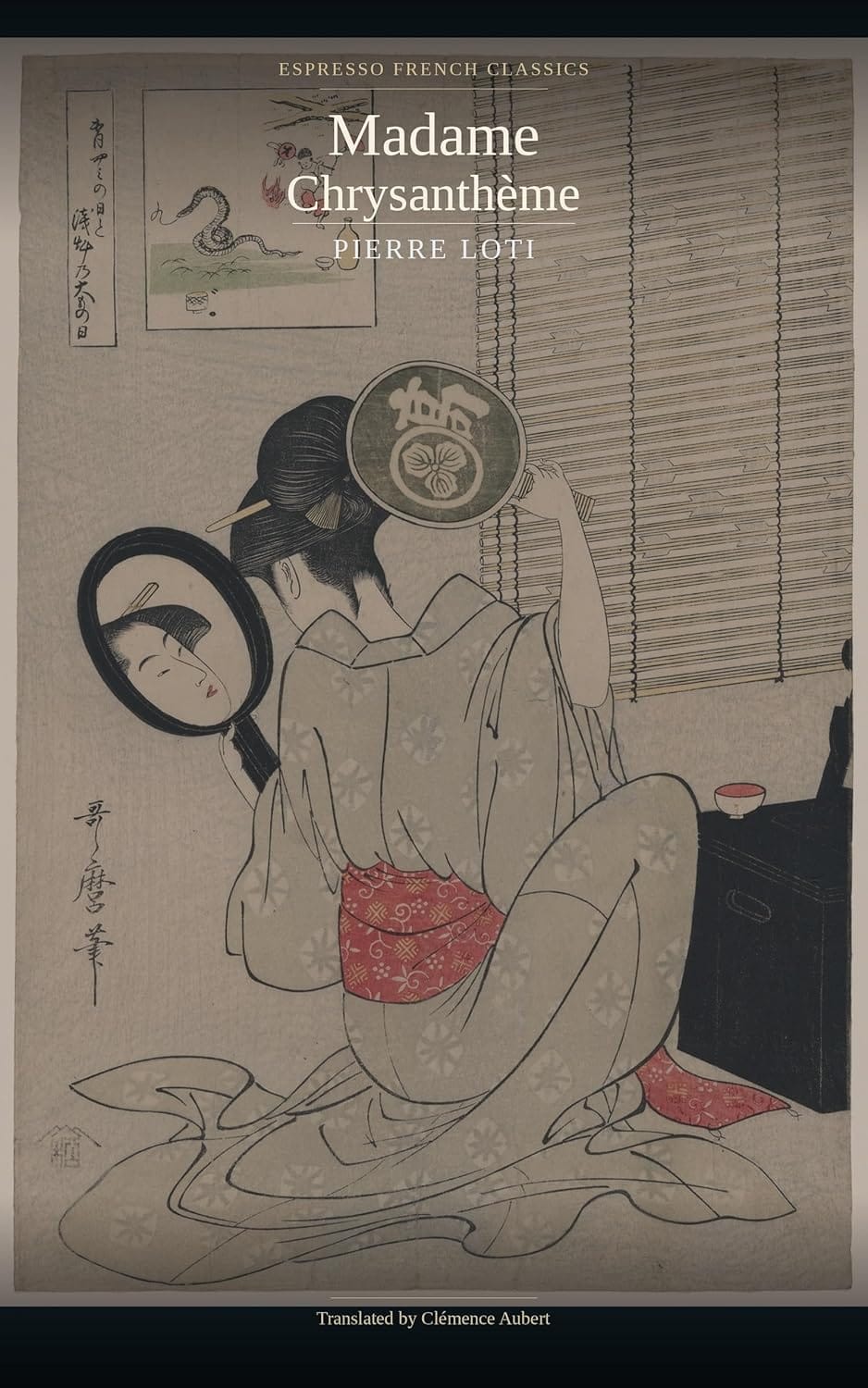
French literature has had an outsized influence on Italian opera. Rigoletto, Manon Lescaut, La traviata, Tosca, L’elisir d’amore, La bohème and even Turandot all have French antecedents. Less well appreciated is that Giacomo Puccini’s iconic Madama Butterfly is ultimately, if indirectly, derived from a now obscure French novel.
Pierre Loti’s 1887 Madame Chrysanthème—-just released in the first formal English translation in well over a century, just in time for its 140th anniversary—is one of those novels, like Prosper Merimée’s Carmen or Henri Murget’s Scènes de la vie de bohème, that have, at least in English, been largely eclipsed by the opera derived from it; when one does get around to reading the book, it is hard to ignore the feeling of Mimì or Don José looking at the pages over one’s shoulder. Cio-cio San is here easier to shake off, for Madame Chrysanthème bears only the faintest resemblance to Puccini’s heroine, due no doubt to the round-about way the story reached him.
Madame Chrysanthème was an immediate hit, racing through 25 editions in its first five years. French composer André Messager put it on the opera stage as early as 1893. Puccini’s 1904 opera, however, is based on the eponymous play by American playwright David Belasco who in turn got it from an 1898 short story by John Luther Long, who claimed his story was based on tales from his sister, the wife of an American missionary in Nagasaki. Publisher Idara Crespi takes it as writ, in her introduction, that
Long’s 1898 short story “Madame Butterfly” drew heavily on Loti’s plot and setting, the naval officer, the temporary wife, the Nagasaki harbor…
The actual forensic evidence is a bit inconclusive, but since Long’s story came out a year after the English translation of Madame Chrysanthème by Laura Ensor, this might be one case where post hoc ergo propter hoc is not a fallacy.
Chrysanthème is not the tragic Butterfly, nor is Pierre (thank goodness) Pinkerton, despite both being naval officers. In the novel’s most cited passage, Pierre returns to say good-bye before he ships off to China, and finds his erstwhile wife testing the coins he has left her in payment:
With the competence and dexterity of an old money-changer, she feels them, turns them over, tosses them onto the floor and, armed with a small hammer made for the purpose, makes them ring vigorously against her ear…
There is neither love nor deception here, merely a commercial transaction.
The book is constructed with a multitude of short chapters, 56 to be exact, few longer than a vignette. There is little by way of plot. Pierre, a naval officer, decides upon disembarking, that he will avail himself of a temporary marriage for the months he will be in Nagasaki. He and Chrysanthème live together (except when he is needed aboard ship), mostly uneventfully: there are festivals, lots of rain, mice, cats; they get photographed and rummage for bric-a-brac; she is an accomplished archer. If they have sex, it is not apparent. He never really takes to her. His friend Yves does however; the idea that she prefers his friend and that he might do something about it provides the only (albeit slight) dramatic tension in the narrative.
Loti’s claimed that Madame Chrysanthème was “the journal of one summer of my life, unchanged—not even the dates”; there was indeed a journal, but the novel is more what one might today call “auto-fiction”. In tone, it reads much like some travel-writing of the period, for example, Loti’s countryman Alfred Raquez: wry, observant, often self-deprecating yet prone to what later would be labelled orientalism.
The perhaps fictional Pierre, indeed, seems to have found the experience, on the whole, to be tiresome. Assuming that the book is indeed autobiographical in origin, why did Loti (whose real name was Julien Marie-Julien Viaud and, apparently, of enigmatic sexuality) go through with the marriage? One suspects he had a book in mind from the beginning. This was not his first rodeo: the similarly (at least semi-)autobiographical Aziyadé was about a Circassian slave in Ottoman Constantinople, and Le Mariage de Loti, set in Tahiti, indicates that Loti was no stranger to “marrying” local girls (the latter novel was the inspiration for the opera Lakmé, which debuted in 1883, two years before Loti disembarked in Nagasaki). That Loti was simultaneously a naval officer and a successful author seems curiously unremarked upon.
Madame Chrysanthème, then, comes across as something of a bagatelle. Indeed, in his introduction to the Duchesse de Richelieu, Loti says as much:
Please receive this book with that same indulgent smile, seeking in it no moral weight, dangerous or wholesome — as you would receive a droll vase, an ivory figurine, some outlandish absurdity, brought back for you from that astonishing homeland of all outlandish absurdities.
The novel is, in short, a period piece, and in some—perhaps many—ways distasteful. Pierre refers to Japanese as monkeys and calls them grotesque. He thinks of Chrysanthème as an object, and eschews any real attempt to know her as a person. This edition’s introduction would have us believe that Loti himself was similarly shallow; I (possibly naively) am not altogether convinced. There are hints of appreciation:
I smile inwardly at the memory of certain so-called Japanese salons cluttered with bric-à-brac and hung with coarse gold embroideries on export satin that I have seen in the homes of fashionable Parisian ladies. I would counsel these persons to come and see how the houses of people of taste are kept here — … A meticulous, excessive cleanliness; white mats, white wood; an extreme apparent simplicity overall, and an incredible preciosity in the infinitely small details: such is the Japanese manner of understanding interior luxury.
Pierre, furthermore, while largely indifferent to Chrysanthème, seems to connect with Oyouki, his landlord’s daughter and “Chrysanthème’s inseparable Companion”. The day before he departs for China, there is a moment of tenderness between Pierre and Chrysanthème: the first and only. Is it real? The at least partly fictional Pierre concludes the next day, when he returns to make his adieus and find Chrysanthème testing the silver coins with a little hammer, that it was not. But human nature is complicated and Loti was a talented writer. The wry, detached and often supercilious European in Asia who hooks up with a local girl is a type that appealed, and still does, to readers of a certain strain of popular fiction.
Both publisher Crespi and translator Clémence Aubert give an impression of having had to hold their noses during this project. Aubert writes in her “note” that “The Orientalist register is not a problem to be solved. It is the material.” Crespi makes a point of concurring that “The Orientalism must be rendered faithfully.” While those were the times, it’s nevertheless worth noting that literary pushback came almost as quickly as Messager’s opera. An illustrator with knowledge of Japan, Félix Régamey, published Le Cahier rose de Mme Chrysanthème (The Pink Notebook of Mme Chrysanthème) in 1894, which tells the story from the perspective of the Japanese protagonist and is scathing about Loti himself.
In their respective introductions, Crespi and Aubert justify the new translation—as if it needed justifying—by taking withering aim at Ensor, the translator of the only “translation worth reading”, dating from 1897. She committed the apparently heinous crime of using the past rather than Loti’s present tense, as Loti did. Poor Ms Ensor is no longer around to respond. But this raises the question of what translations are for and whether linguistic faithfulness per se is the overriding consideration. Driven to go back and take a quick look at Ensor’s version, I found it’s not so bad. Aubert’s is closer to the original but Ensor’s quite readable rendition contains enough of “Loti’s racial vocabulary” to leave the modern reader (if not necessarily Ensor’s late Victorian audience) suitably discomforted.
Madame Chrysanthème seems hardly to be read in French anymore; why re-release this evidently morally and culturally fraught work, then, in English? In the wider world of French literature, this question might be harder to answer, but as far as Asia is concerned, as an early and formative work of a genre that is still with us, it deserves an up-to-date translation. Aubert’s insistence on accuracy is today and in this context entirely appropriate. And Loti, whatever his faults, was a good writer: his descriptions of Japan are indeed “luminous” as publisher Crespi puts it. Literary history, like life, is complicated.
And for those who love Puccini, Madame Chrysanthème, however far removed it may be from his opera, is at least certainly far better than Belasco’s play.
