“Masters of Sleep” by Zhu Ye
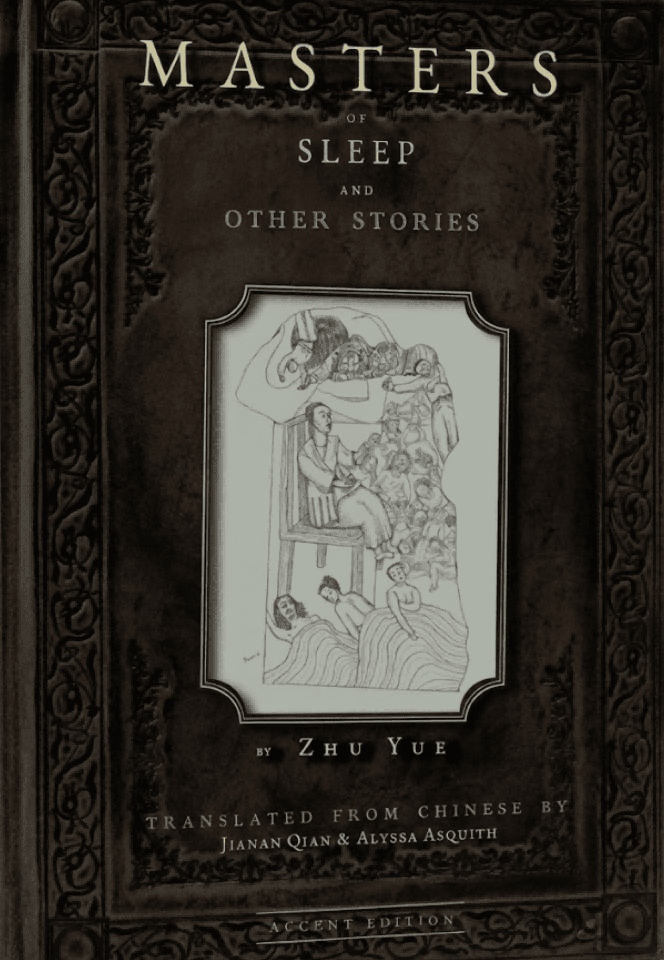
Masters of Sleep by Zhu Yue, a Beijing-born author with both a legal and philosophical background, is one of three published collections of short stories, and the first translated into English. Translated by Jianan Qian and Alyssa Asquith, it is an esoteric, ironic book. Some stories read as if written in the Victorian era. Others are set years ahead into the late 21st century. The structure of each story also varies considerably from the others: a summary of a novel is followed by a transcript of a conversation, then a series of notes. Several stories follow a more linear plot, but even those are filled with eccentric characters, the whole collection including spies, samurais, and a girl with no eyes. What runs throughout this eclectic group is absurdity, paired with a straight-man style that grounds the book, even across impossible realities.
The book is cut into three sections. The first, “Enigmas”, evokes the curiosity its name suggests. The story “The Private Museum of Miss Margaret” establishes the dry humor by describing the museum that holds all the artifacts of Miss Margaret’s life, down to the clothes, the hair, and the fluids. The story sharing the title with the book, “Masters of Sleep”, is a series of portraits: accomplished professors and daredevils who push the definition of extreme sleep. One such master, Baron Pasfield, was described as:
the first to transform the art of sleep into a religion. His basic doctrine was “to live a double life.” The doctrine is mysterious, but this is the general meaning: in waking life, one’s dreams are often remembered only in scattered fragments; after death, however, one’s dreams are remembered with great logic and clarity.
As the titles of Zhu Yue’s stories and the names of his characters would suggest, the plots are not necessarily set in China, and when they are, the stories retain a similar absurdity. In “Running”, the protagonist believes himself to suffer from bandy legs, and finds a doctor who offers an incredible cure:
“I used to have that, too,” she said. “But then I had my surgery—they drilled two holes into my buttocks—and now I can lift my leg over my head.” As she said this, she stood on one leg and brought the other up to her chest.
The humour can be rather blue. The layered story, “The Erotic Time Machine”, follows a writer as he imagines a time machine that requires the injection of sperm into the engine. The success of the humour lies in the fact that Zhu Yue never relishes his own jokes, and the absurdity is quickly taken in stride.
“Quandaries”, the next section of the book, reads just as ironic, and remains rather hard to discern from the first. After all, a difficult quandary can cause a vexation similar to that of an enigma. Enigmas unsolved are effectively quandaries too. The principal distinction is that each Enigma is normalized by the convincing realism of each story. However, the quandaries that arise from the second section are not resolved at all, even at the stories’ conclusions. For example, in “The Wise Emperor”, a eunuch must carefully rouse the Emperor from his slumber by lifting his eyelids.
His task is extremely difficult, and he must be patient and observant. If his timing is wrong, the Emperor will cry out “Sha!” The royal guard will run in, drag the eunuch outside, and behead him.
Another eunuch moves his head. A third arranges the flowers. The last of the eunuchs interprets the Emperor by placing his ear on the Emperor’s belly button. But one day, the Emperor gives a deadly task: “each of them must tell a story; he who fails to tell a good story will be killed.”
It is a narrative structure immediately reminiscent of the One Thousand and One Nights, except the eunuchs are killed in quick succession, and with them gone, the Emperor himself cannot function —hence the quandary. However, the motives behind the emperor’s task, why he remains unsatisfied by his courtiers, remain unanswered questions, inheriting the enigmatic undercurrent of the previous section.
The third section, “Fables”, plays on both Chinese and western stories. “My Poor Girlfriend” takes the romantic tropes of a tragic farewell and applies the grotesque, with the girlfriend’s fingers morphing into noodles, her head of hair left with only twenty-three strands, and eyes depicted as “crustacean”.
Carefully withdrawing her noodles from my hand, she caressed my forehead with them. I held her face—it had swollen to twice its size—to kiss her lips, but she refused. (Her lips had also been removed, actually. The surgeon had implanted dentures, which had previously belonged to the old man in the opposite bed. He had died of lymphoma.)
At the story’s conclusion, Zhu Yue dates it: “August 11, 2005 (Qixi Festival, Chinese Valentine’s Day)”. By mentioning the Qixi Festival, which is tied closely with the folktale of the Cowherd and the Weaver Girl, the author evokes and subverts China’s folklore tradition. Other stories too refuse to follow the tropes determined by the fable genre. Lessons are difficult to identify. Anthropomorphic animals do not embody values that might establish a set of morals.
The stories are perhaps more enigmatic than anything else. The absurdity is not impenetrable, but even the most careful reading would require extrapolation, a risk encouraged by Zhu Yue’s clear prose and good humour, and at times rewarded with revelation.