“Oil Wars” by Guy Laron
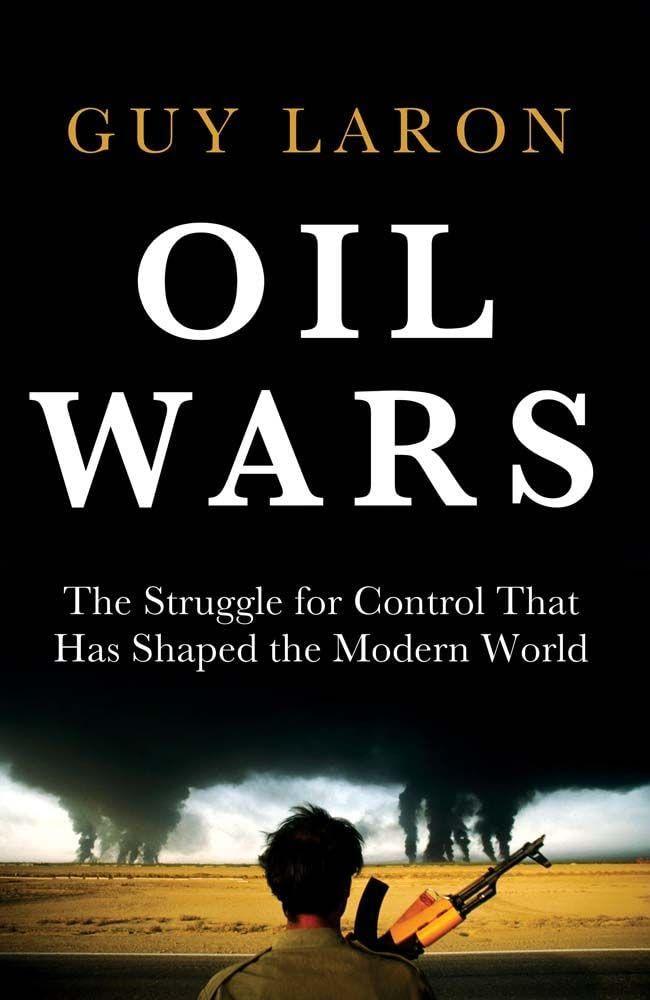
The “wars” in the title of Guy Laron’s new history of the past century and a half are as much metaphorical as literal; few readers will need much convincing of his thesis that “energy is one of the core instruments of geopolitics.”
There is much to be said for Laron’s adopted lens. Oil provides a somewhat different unifying theme to a period and geography that has been gone over many times before. Although Laron dips in and out of places as far afield and Trinidad and Indonesia, he focuses on what he calls “the gas station region, an arc stretching from the Caspian basin in the north to the Persian Gulf in the south.” Baku is placed together with Abadan and the Arabian Peninsula.
Between 1885 and 1945, the northern half of the gas station region dominated, and the oil fields of Baku supplied much of Eurasia’s energy needs. But after World War II, the southern half surged ahead. The discovery of giant fields in Iran, Iraq, Kuwait, and Saudi Arabia shifted the center of gravity to the Persian Gulf.
One might take issue with some aspects of his framing—of the geopolitical centrality of oil in this particular region as opposed to others—but at the very least this focus allows for a coherent and, in Laron’s hands, very readable book that in many ways stands in for a global historical survey of what one might dub “the long 20th century”. It helps immensely that Laron has a keen eye for the interesting individual and illustrative anecdote. 19th-century Baku, for example,
sat atop vast reserves of hydrocarbons. Gas seeped from the Caspian seabed, sometimes so forcefully that ships capsized. At times the gas caught fire, creating dancing blue flames on the waves of the Caspian Sea. On land, gas percolated from the ground, creating flames that burned endlessly. This drew the attention of Zoroastrians, adherents of an ancient Persian faith. Known as “the fire-worshippers,” they built their temple at the village of Sourakhany, about 10 miles from Baku. Unbeknownst to them, the gas burning brightly in the middle of their temple was a sign that it was sitting atop one of the world’s biggest oil fields.
The book’s extensive dramatis personae runs from the Nobels and Rothschilds through Sergi Witte, Chaim Weizmann, Calouste Gulbenkian, Churchill, Morgenthau, Lloyd George, Nassar and Ibn-Saud, and includes political leaders, spies, bankers and oilmen.
In this regard, the earlier sections on the early development of Baku and the machinations up to and after the First World War might prove of more general interest than later periods which have been more widely covered and which readers (some of them, anyway) will have lived through. In between the flourishes of great-power politics and hardball business dealings are realisations which, while hardly obscure or unsurprising, are nevertheless striking. One is how pre-Revolutionary Russia was a powerhouse of the global energy business, giving America’s Standard Oil a run for its money. Another is how the current statelessness of the Kurds is a result of an oil play for Mosul.
For Kurdish leaders, the Ottoman Empire’s fall had opened a fleeting window. The 1920 Treaty of Sèvres seemed to codify their hopes for an independent Kurdistan. But those aspirations collided with British oil strategy… Mustafa Kemal’s Turkey rejected Sèvres and demanded Mosul’s return… By 1926, after years of suppression, Turkey agreed to drop its claim. The League of Nations awarded Mosul to Iraq. Turkey received some oil royalties. The Kurds received nothing. Their fate, like their land, had been folded into the empire’s energy grid.
There are many reminders of the folly of assuming the continuation of the status quo. When the pipeline to Haifa, decades in preparation, was finally inaugurated in 1935—accompanied here by a photograph of High Commissioner Sir Arthur Wauchope and Sir John Cadman, “the architect of Britain’s Middle Eastern oil empire”, both resplendent in top hat and tails—that empire was just a decade from its sell-by date.
While understandable, Laron’s focus on this particular region of Eurasia results in some lacunae. While Hilter’s push towards the oil fields of the Caucasus and the Battle of Stalingrad are covered in some detail, the role of the oil embargo on Japan in 1941 in precipitating the attack on Pearl Harbor is not mentioned; the world might look very different had that not happened. Hormuz figures in the epilogue; Venezuela does not.
Laron concludes the epilogue by noting:
These days, the geography of the gas station reasserts itself. The Russia-China energy alliance—forged in infrastructure rather than sentiment … represents the most serious challenge to American dominance since the Soviet disruption strategy of the 1970s. The fracturing of the post-Cold War global energy market into rival blocs, each secured by the pipelines and naval forces its patrons can build and defend, is not an aberration. It is a return to the state of affairs that the unipolar moment briefly suspended. The axes of oil remain, quite literally, the lines along which global power moves.
Plus ça change, perhaps, although one wonders whether this decade might instead be one of oil’s last hurrahs. China seems, to most observers’ surprise, to have dodged the recent supply chain interruption, while renewables and EVs look to put an increasing dent in the demand for oil as an irreplaceable commodity. In some ways, Oil Wars can be read as a sequel to David Chaffetz’s Raiders, Rulers, and Traders: The Horse and the Rise of Empires which described the millennia-long dominance of the horse in Eurasian affairs. It was petroleum that brought this epoch to an end and he wrote that: