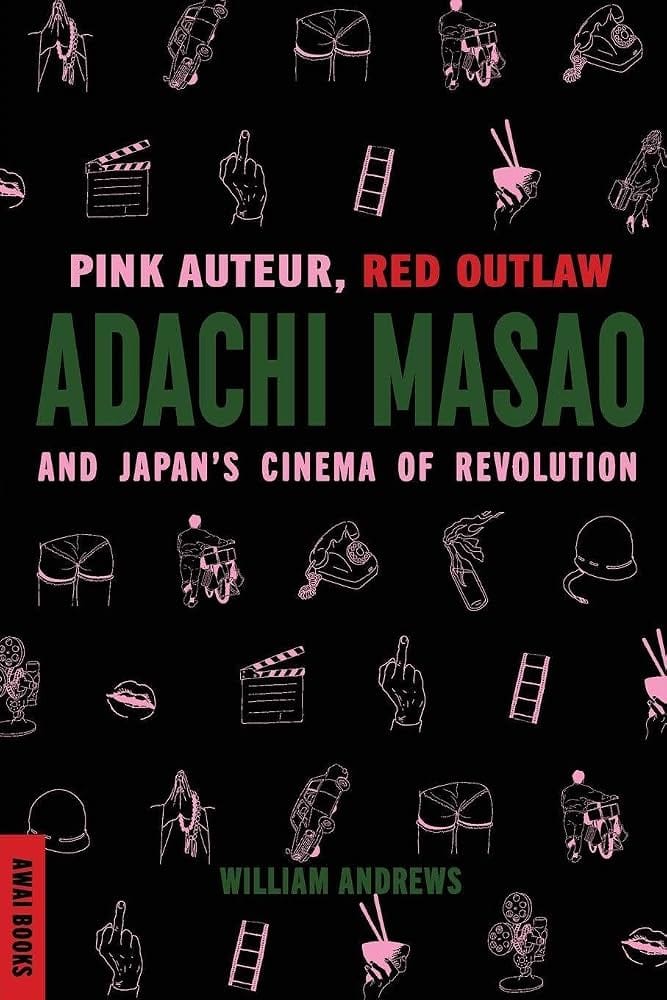
“Pink Auteur, Red Outlaw: Adachi Masao and Japan’s Cinema of Revolution” by William Andrews
There is an irresistible temptation to read filmmaker Adachi Masao’s life as if it were itself a movie. A Japanese New Wave filmmaker disappears into Lebanon, becomes associated with the Japanese Red Army, spends decades in exile, is imprisoned, and eventually returns home as one of the most controversial figures in postwar Japanese culture. It is a story that threatens to overwhelm his actual body of work.
William Andrews’s Pink Auteur, Red Outlaw: Adachi Masao and Japan’s Cinema of Revolution accomplishes something far more profound than simply retelling that extraordinary life. It patiently strips away the mythology surrounding the “terrorist filmmaker” and restores Adachi to where he belongs: among the most original formal innovators of postwar cinema. The revolutionary, Andrews suggests, is ultimately less interesting than the filmmaker who spent six decades asking what cinema itself could do politically.
That distinction proves crucial. Today, the Japanese Red Army survives largely as a historical curiosity, one among many revolutionary organisations whose ambitions were vastly greater than their real-world influence. The movement occupies a tiny corner of 20th-century political history. The films, however, remain startlingly alive. Andrews wisely understands that Adachi’s lasting importance lies not in militant politics but in a radical rethinking of cinematic language.
The early films reveal this almost immediately. Bowl (1961), made in the shadow of the failed Anpo protests against the renewal of the US-Japan Security Treaty, scarcely resembles conventional political cinema. A young man murders his mother, yet the village quietly absorbs the violence into ritual. The crime is denied, memory suppressed, normality restored. Andrews convincingly reads the film as an allegory for postwar Japan itself, where collective trauma disappears beneath ceremony and social conformity. Blood stains rice bowls and hands, funerary processions continue with mechanical calm, and rebellion is finally swallowed by the very society it sought to disrupt. Politics is present everywhere, yet almost never spoken aloud.
Even more revealing is Closed Vagina (1963), whose deliberately provocative title promises exploitation but delivers something stranger. Andrews shows how Adachi transformed a rare medical condition into an exploration of fractured identity, bodily alienation, and psychological imprisonment. Sex in Adachi’s cinema is rarely erotic. It is biological, awkward, unsettling. Bodies become sites where social contradictions announce themselves.
That sensibility found its fullest expression in pink cinema.
Outside Japan, pink films continue to suffer from misleading translations like “softcore pornography”. Andrews dismantles that misconception completely. Working alongside the equally uncompromising Koji Wakamatsu, Adachi turned what was ostensibly commercial exploitation into one of the freest laboratories of cinematic experimentation anywhere in the world. The tiny budgets that confined these productions also liberated them. With little studio interference, filmmakers could experiment recklessly.
Films such as The Embryo Hunts in Secret, Go, Go, Second Time Virgin, Violated Angels, and Sex Jack remain shocking today, though not for the reasons their titles might suggest. Andrews demonstrates that these films use sexuality less to provoke desire than to expose domination. Rape, confinement, humiliation, obsession, and violence become ways of examining authority itself. Their stark black-and-white photography, sparse interiors, abrupt editing, and almost theatrical performances create works that feel suspended somewhere between nightmare and political allegory.
The rooftop setting of Go, Go, Second Time Virgin, for instance, strips the world down to an almost abstract stage where brutality and tenderness coexist uneasily. It is simultaneously exploitation cinema and its own critique, refusing viewers either straightforward titillation or comforting moral distance.
The intellectual center of Andrews’s book, however, is AKA Serial Killer (1969), the film that produced one of postwar cinema’s most original theoretical ideas: landscape theory, or fūkeiron. Landscape theory sounds forbiddingly academic until Andrews translates it into plain language.
Rather than reconstruct the psychology of teenage murderer Nagayama Norio, Adachi and critic Matsuda Masao retraced his movements through Japan. The camera lingers over railway stations, apartment blocks, industrial zones, highways, smokestacks, anonymous streets. The killer himself is largely absent. Andrews explains that the film asks viewers to study not the criminal but the environment that produced him.
The premise still feels radical more than half a century later.
Political power does not exist only in parliaments or police headquarters. It is embedded in ordinary space. Factories, roads, housing estates, and anonymous urban landscapes silently shape consciousness long before ideology enters the picture.
Adachi himself expressed the idea memorably: “The enemy is only the landscape.” It is a wonderfully provocative formulation. The real antagonist is not an individual villain but the social environment itself. Most political films identify people. Adachi asked audiences to look at pavements, railway lines, suburbs, and industrial wastelands instead.
This is also where Andrews most clearly explains what Adachi meant by insisting that form itself was political. Politics in film was never simply a matter of inserting revolutionary slogans into dialogue.
Conventional cinema, when it deals with history at all, tells us that history is driven by individual choices. Adachi repeatedly rejected that assumption. His fractured narratives, uncomfortable silences, documentary textures, and obsessive attention to place encouraged audiences to think structurally rather than psychologically. The way a film looked became inseparable from what it argued.
Not every experiment succeeded. Andrews is refreshingly honest about the unevenness of Adachi’s output. Some films remain deliberately rough, almost antagonistic toward conventional ideas of craftsmanship. Others survive more as fascinating documents than enduring works of art.
The biography itself occasionally mirrors that excess. Andrews’s determination to reconstruct every political faction, underground journal, artistic collective, and personal collaboration can become dense, particularly for readers without an extensive background in Japan’s New Left. Yet this thoroughness ultimately serves his larger purpose. Adachi was never a solitary auteur. His career emerged from a remarkably fertile ecosystem of filmmakers, critics, poets, photographers, activists, and artists who constantly borrowed ideas from one another.
Perhaps the most revealing line in the entire book comes from Adachi himself, reflecting on the experimental VAN Film Science Research Centre where so many collaborations began: “Everything started from VAN.” That simple remark captures Andrews’ larger argument. Great artistic movements rarely emerge from isolated genius. They grow out of communities willing to dissolve the boundaries between disciplines.
In the end, Pink Auteur, Red Outlaw is not really about whether Adachi’s politics were right. History has already answered many of those questions. The revolutionary organisations that once seemed poised to change the world became historical footnotes. Andrews’s achievement is to show that Adachi’s cinema asks larger, more enduring questions. How does architecture shape consciousness? Can landscape become ideology? Can film reveal systems of power that remain invisible in ordinary life?
Those questions feel no less urgent today than they did in 1969. By rescuing Adachi from the sensationalism of his biography, Andrews has given us something richer than the story of a radical filmmaker. He has restored one of cinema’s most uncompromising formal experimenters to his rightful place in film history.