“The Courtesan, Her Lover, and I” by Tarana Husain Khan
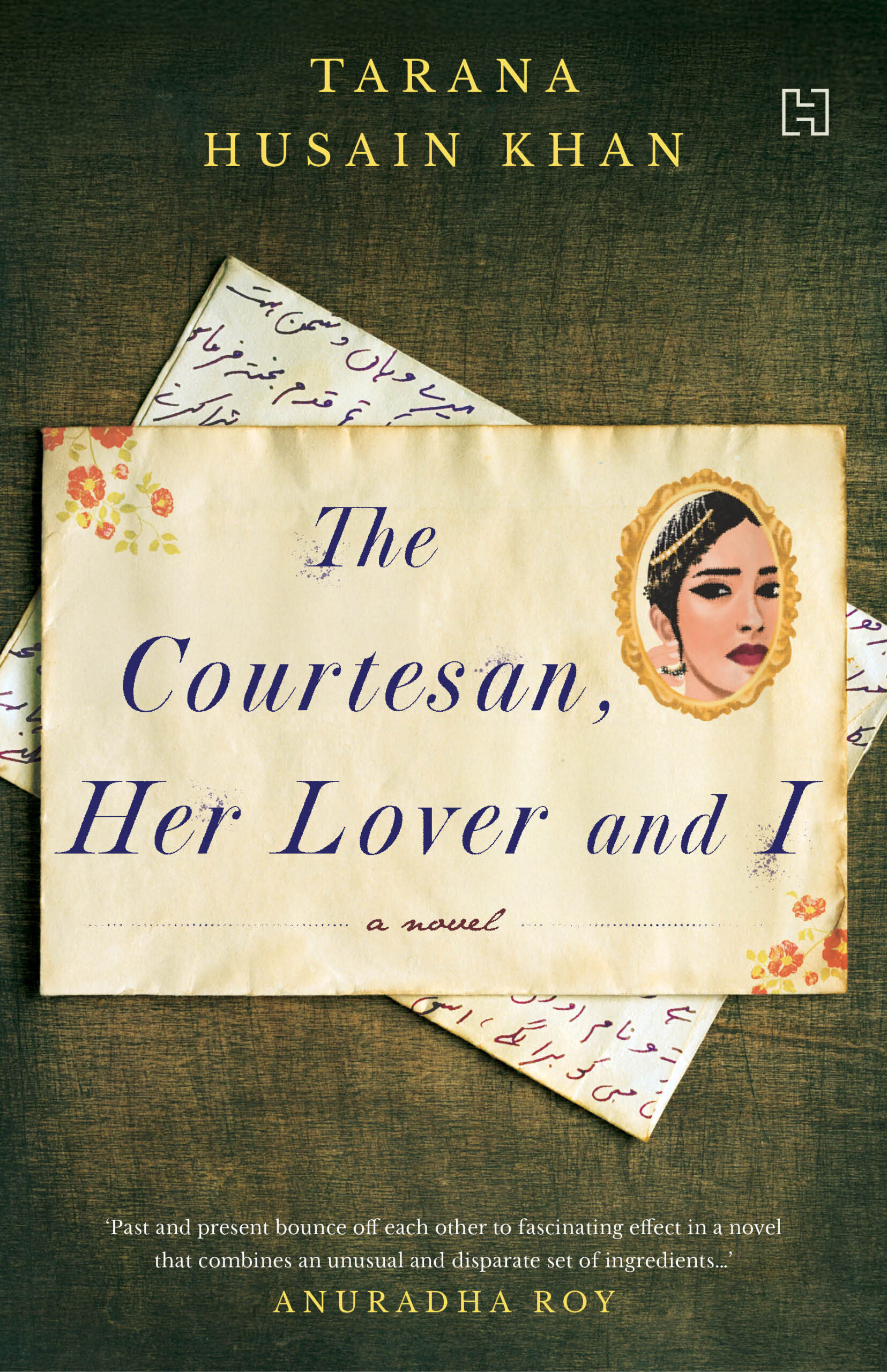
In modern day Rampur, aspiring writer Rukmini finds herself fascinated by the life of Munni Bai Hijab: the real-life 19th-century courtesan and poet whose voice and achievements were eclipsed by her love affair with and role as muse to the great Urdu poet Dagh Delvi. As Rukmini begins researching and transcribing Hijab’s untold story, she perceives parallels to her own struggles to be taken seriously as a writer, her anxieties as a wife and mother, and her budding romance with her research partner Daniyal.
The dual protagonists in Tarana Husain Khan’s The Courtesan, Her Lover, and I— two women separated by hundreds of years—exist in conversation with each other across time, creating rippling, repetitive narratives that add a richness and breadth to the story. The narrative is split between Rukmini in the present day and Hijab in the past. Hijab’s chapters are written in the second person, with Rukmini addressing her directly while documenting her story. This creates a deep sense of intimacy between the novel’s two narrators, a conversation in which Rukmini attempts to return control of the narrative to the woman who was erased from it. Hijab’s briefer storyline—with an immersive specificity of detail about the royal courts of Rampur and the mercurial world of the tawaifs— is often more compelling and vividly realised than Rukmini’s. In that way, Rukmini’s narrative, while significant, acts as somewhat of a framing device to Hijab’s story, with the present becoming secondary to the past.
The novel dissects how we interact with the past, whether it’s our own past or history itself, seeking out patterns and parallels in order to make sense of something that’s often nebulous. Khan, herself preoccupied with the process of writing historical fiction, uses Rukmini as a vehicle to explore how one goes about fictionalising a historical figure, particularly one whose story is filled with blank spaces. Rukmini describes this as “shedding my skin again, snake-like”, an unmaking of the self that is an apt metaphor for the process of writing of any kind. She agonises over how to transform the story of a real-life person into a satisfying fictional narrative without allowing her modern voice, preoccupations, and perspectives to overwhelm her subject’s.
But the more she becomes invested in Hijab’s story, the more Rukmini becomes disheartened by the direction the story is going in. “I’m writing,” she bemoans “a lust story. So banal, so transient.” She recognises her own need for Hijab’s history to reveal some profound meaning. As suggested by the second person narration, she has become confidant as well as historian, and these dual roles often come into conflict. While navigating the letters exchanged between Dagh and Hijab, Daniyal and Rukmini find themselves debating the nature of their relationship, shifting from fact-finding questions to personal ones. “Did Dagh really know Hijab, or did he love an image of her?” Rukmini wonders. The ambiguity of Dagh and Hijab’s relationship, as student and teacher as well as lovers, mirrors the changing face of Rukmini and Daniyal’s relationship as their romantic attraction grows. The more Rukmini recognises parallels between herself and Hijab, the more she identifies with her, and the less impartial she becomes.
Another parallel, and one of the novel’s chief concerns, is the erasure of women from history and particularly literary history. Hijab’s position as lover and muse to the more well-known Dagh overshadows her own career as a poet, something which resonates strongly with Rukmini, who also struggles to have her writing be taken seriously by the men in her life. Just as Hijab leaves an unhappy marriage to pursue Dagh, who trains her in the art of poetry, Rukmini is dissatisfied with her stagnated marriage with her inattentive husband Faraz and drawn to Daniyal, who encourages her writing ambitions. Rukmini’s own mother abandoned her husband and child for a lover, and her friend Shezray leaves and then returns to an abusive marriage for the sake of her child. The cyclical, repetitive nature of these narratives, mirroring the past and present, reinforces the questions Khan poses throughout the novel about the place of women in history, and links the past and present storylines into a dialogue with one another rather than as two separate narratives.
The past comes alive throughout the novel, often creeping into the present. The novel is sprinkled with lines of Urdu verse and letters exchanged between Dagh and Hijab, fleshing out the historical period through the lens of its literature and writing. But Khan interrogates and often de-romanticises the reality of being a poet’s muse, by giving a voice to the otherwise invisible feminine presence that has occurred in love poems from Petrarch to Ghalib, the “she” and “you” who is praised and lamented but never really a person in her own right. Hijab is angry rather than flattered when Dagh publishes a masnavi in her honour, pointing out that it hurts her reputation as a high-class tawaif by revealing that she betrayed her patron for a clandestine lover. She is humiliated by how Dagh showcases their intimate moments, stating “Dagh had unclothed you in the eyes of the world,” almost likening his writing to a kind of prostitution. At the same time, her new-found status as Dagh’s muse elevates her position among the competition from younger courtesans, while simultaneously diminishing her own poetic achievements. “The masnavi had entwined your name with Dagh’s for posterity,” Hijab reflects, suggesting that this fame is a double-edged sword. Her name is immortalised through Dagh’s writing, but she only exists in relation to him.
Towards the end of the novel, Rukmini visits Calcutta and explores the old haunts once occupied by Hijab and her family, superimposing images of the past onto sites in the present. In the act of writing history, past and present become one. Rukmini’s retelling of Hijab’s story, though it lacks what she views as a satisfying conclusion, becomes a reclaiming of an overshadowed narrative which puts the otherwise silenced Hijab at the forefront of the story.