Old post
This post was published before January 2026. Some links, images or other content may no longer display or work as originally intended.
“The Indian Caliphate, Exiled Ottomans and the Billionaire Prince” by Imran Mulla
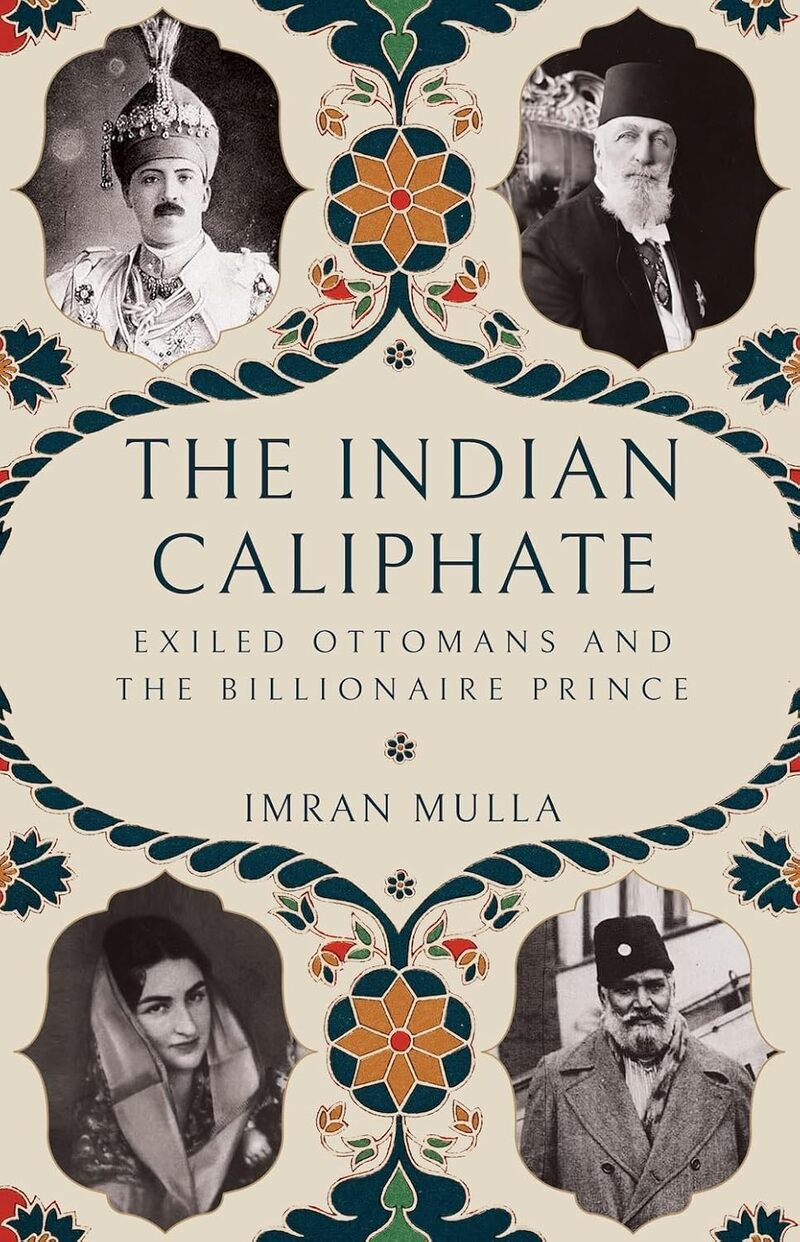
You come across them in used book stores, with their fading, cloth covers, their saccharine prose, with black and white photos of palaces and tennis courts. These are the memoirs of princesses from the house of Muhammad Ali of Egypt, of Zog of Albania, or the Dogras of Kashmir. It’s easy to forget that behind the overthrow of these sad, sentimental royal exiles, major political and social forces were at work: Imran Mulla’s The Indian Caliphate takes what would otherwise have been a trite tale of dethroned dynasties and brings to life the passions and controversies that stirred the early 20th century, and which have not really calmed down even in our own.
Mulla relates the fall of the 600-year old Ottoman dynasty in 1923, attempts to revive the Islamic Caliphate through a marital alliance between the last Ottomans and the Nizams of Hyderabad in India, and their own, subsequent downfall in 25 years later.The book is full of “aha” moments.
For a history full of court intrigues and backroom stitch-ups, the history of the afterlife of the Caliphate contains many surprises. Though we may be familiar with the rough outline of the story, including the rise of Mustafa Kemal Atatürk, the Khilafate movement in India, and the marriage of an Ottoman princess to a scion of the Asaf Jah dynasty of Hyderabad, we will learn many uncanny details in this narrative, that leaves the reader rubbing his eyes and sighing, “did this really happen like that?” The book is full of “aha” moments.
Many 19th-century observers saw India as the epicentre of the Muslim world. It was the most populous Muslim country, and its cultural prestige cast a shadow over older Islamic centers like Istanbul or Cairo. As Sam Dalrymple pointed out in Shattered Lands, Britain’s Indian Empire included much of the Eastern Coast of Arabia, and so stood more in the center of Islam than today’s Republic of India, or even today’s Pakistan. Even British imperial statesmen acknowledged the fact that the empire was as much a Muslim polity as a Hindu, let alone a Christian one.This made relations between the Ottoman Empire and the British Empire fraught. The Ottoman Sultan held the role of Caliph of Islam. Though in the heyday of the Mughals India’s Muslims had paid scant attention to this, by the 19th century the figure of the Caliph loomed larger and larger over the subcontinent. When the Ottoman Empire declared war on Britain in 1914, the threat of an uprising and a holy war haunted the British. Surprisingly, Indian Muslims did not mobilize against Britain during the war—many served bravely in France, Mesopotamia and Palestine. After the war, however, mass protests rocked India in support of the Caliph, based on fears that the British planned to overthrow him. Mulla notes that many Hindus joined these protests, for support of Islam against the British was seen as a legitimate anti-colonial struggle that concerned all Indians. The Khalifat movement, as it became known, was India’s first modern, mass call for political independence.Another surprise: the leader of Turkey’s resistance to the British, Mustafa Kemal, originally planned to maintain the Caliphate. He even asked the Ottomans for a princess in marriage. He only changed his mind about this when he saw just how much soft power the position entailed. He could brook no co-ruler in his new, modernizing Turkey. His abolition of the office left the Indian Muslims in an embarrassing position, especially when the Turks argued that their National Assembly assumed the powers of the Caliphate.Mulla’s story foreshadows many of today’s conflicts.
Mulla’s story is especially compelling as it foreshadows many of today’s political conflicts. It certainly confirms William Faulkner’s dictum that “the past is not even past.” We experience, through his narrative, how connected this globalized world of 1920 was. Protagonists are equally at home on the Bosphorus, the French Riviera, Oxford or Karachi. The emergence of public opinion brought Hindus and Muslims together, initially, in their struggle against Britain. Some leaders tried mightily to keep this sense of solidarity together. As colonialized people, Indians were shocked by violence against Muslims around the world, by the Balkan wars (1912-1913) characterized by ethnic cleansing against Muslims in Europe and by Italy’s unprovoked aggression against Cyrenaica and Tripolitania.
Readers will easily see parallels with events in Gaza and the West Bank today. Islamophobia makes an appearance, too, especially during the First World War when the Ottomans called for a holy war against the British. On the other hand, it is refreshing to read the friendliness and warmth displayed by Pope Benedict XV’s receiving a delegation of Indian Muslim in 1920: ecumenicalism did not start with Vatican II.Efforts to restore the Caliphate in the pre-War period calls to mind the tragic events in Iraq under the rule of ISIS. Muslims still face the challenges of sustaining a global religious community while at the same governing viable political entities. Much of Mawlana Iqbal’s political philosophy deals with these twin necessities. The writings of this great Urdu poet and philosopher informed the protagonists of Mulla’s book, and still influence Islamic political thought today.Perhaps the most direct connection between the past and present is the attempt by the supporters of the Caliphate to convene an Islamic congress in British-administered Palestine. The British, already struggling with growing conflict between the Palestinian Arabs and the Jewish settlers, opposed this. The last thing they wanted was to have a new caliph proclaimed by the assembled Muslim delegates in Jerusalem. Frustrated by the failure of this initiative, the mufti of Jerusalem, al-Hussaini, turned to violent resistance to Zionism and later sought the support of Hitler.From Jerusalem the story moves to Hyderabad, the cultural capital of Islam in India at the time. There the Asaf Jah dynasty ruled over the twilight of Mughal culture, and an increasingly modern and industrial state, under British tutelage. When an Ottoman princess married into the ruling family, she “nearly changed the course of Islamic history,” writes Mulla, arguing that the idea of Hyderabad as the seat of the Caliphate would not have appeared as unrealistic at the time as it does to us, given that state’s close ties with other Muslim states, and its attraction to Muslims from around the world—including famous converts like Marmaduke Pickthall and Muhammad Asad.The flaw with his argument is the inevitability of the Hindu-Muslim conflict. Iqbal may have claimed that “India is the greatest muslim country in the world,” but Hindus did not see it that way. Increasingly in the 1920s Hindutva sentiments depicted the Muslims as being as foreign as the British. And Iqbal, by arguing subsequently for partition, ensured that Islam’s clout in the subcontinent would be divided in two, and continually subject to decline in the Republic of India itself. Ultimately The Indian Caliphate is history that could have happened but didn’t. The fact that the heir of Hyderabad was the son of an Ottoman princess might have led to a kind of “Papal States” situation in India, but Interior Minister V Patel’s bloody police action against the Asaf Jahis ensured that this never happened.Mulla’s writing is racy and vivid. His prose covers both the glitzy superficiality of deposed royalty on the Riviera and substantive debates about the role of Islam in modern life. His interviews with surviving members are memorable and delightfully intimate. The chutes and ladders which Mulla takes us on in this stirring story can open our eyes to many aspects of the present which we still struggle to understand, how we got here.