“The Khan and the Unicorn: Mongol Empire and Qing Knowledge in the Making of World History” by Matthew V Mosca
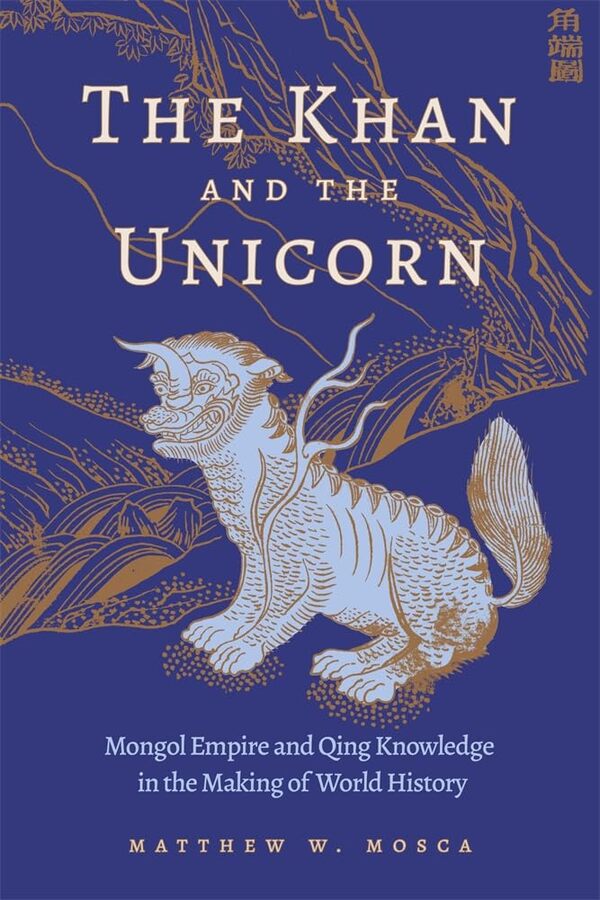
Leading the vanguard of his armies across India, Genghis Khan suddenly encountered an uncanny animal, blue‑green in colour, with the body of a bull, the tail of a horse, and a single horn. The Great Khan declared this apparition inauspicious, turned his reins, and led his army back to Mongolia.
In The Khan and the Unicorn, the mysterious apparition is Genghis Khan himself. Who he was and what he represented puzzled the world’s historians for centuries. Matthew Mosca does not explain the uncanny animal to us (a rhinoceros?), but he shows how historians in China, Inner Asia, and Europe painstakingly came to understand the Great Khan and his historical significance.
It may come as a surprise to learn that, despite the renown Genghis Khan achieved in his lifetime, Europe soon forgot about him, while in China he joined the ranks of innumerable northern barbarian chiefs. Paradoxically, the legacy of Genghis Khan persisted most strongly in the lands of Islam, where many dynasties claimed descent from him. They sponsored the compilation of major historical works about his empire. In Mongolia itself, although ruling families also vaunted their Genghisid descent, the rise of Buddhism changed their assessment of the khan, whom they began to see through the lens of dharma rather than historical fact.
Chinese accounts also suffered from an ideology that considered the grassland peoples inherently cruel and rapacious.
Chinese historians seeking to understand the life of Genghis Khan faced a number of obstacles, even though his Yuan dynasty ruled China for a century and the succeeding Ming dynasty authored an official history. The transcription of non‑Chinese names of people and places, as well as limited familiarity with the geography of Inner Asia, resulted in garbled and contradictory accounts of the khan’s extensive conquests. Even today, it can be difficult to follow his campaigns across Inner Asia, Iran, and India, so one can sympathize with Chinese scholars working without maps. Chinese accounts also suffered from an ideology that considered the grassland peoples inherently cruel and rapacious. Bias against the Mongols could be subtle: names transliterated using derogatory characters, or recording a ruler’s passing with the simple word “die” 死 instead of the respectful “expire” 崩.
Europeans, on the other hand, gained considerable insight into the Mongols by translating key Persian and Arabic historical texts. Compared to the fraught politics, less efficient printing, linguistic complexity, and bureaucratic obstacles faced by their Chinese counterparts, 18th century scholars like Pétis de La Croix and Joseph de Guignes enjoyed relatively smooth sailing. But both Europeans and Chinese suffered from an inability to understand the Mongols on their own terms. Both sides of the Eurasian continent saw Genghis Khan as a barbarian, and the Mongol conquests of the civilized realms of Iran and China as a historical tragedy.
Manchus, Mongols, and Tibetans, however, had different points of view. Mosca’s detailed account of their efforts to describe the Mongol empire is one of the book’s most fascinating aspects, illustrating early modern multilingual scholarship. That many of these writers were at once Buddhist monks, battle‑hardened bannermen, or Chinggisid princes makes the story even richer.
Whereas Chinese historians had to master—or at least have access to—sources in Chinese, Mongolian, Manchu and Tibetan, their European counterparts worked with Latin, Persian, Arabic and Russian, as well as Chinese and Mongolian. More recently, scholars have mined sources in Korean and Armenian. Mosca observes
“No one, perhaps, could master every language in which the deeds of Chinggis Khan and his successors were recorded. Even the most accomplished specialists needed to rely, to a greater or lesser degree, on translation.”
A historian‑philosopher like Edward Gibbon wondered whether the vitality of the Mongols was not inevitably lost with the luxurious lifestyle of a Kublai Khan.
A historian‑philosopher like Edward Gibbon wondered whether the vitality of the Mongols was not inevitably lost with the luxurious lifestyle of a Kublai Khan. Chinese historians, realizing that speculative questions like this could endanger them under their Manchu overlords, developed a school of strict evidentiary history, identifying new sources and striving to establish factual accuracy while leaving interpretation to later generations.
In the late 19th century, with Japanese scholars increasingly entering the field, researchers began comparing Chinese and European accounts of Genghis Khan. Chinese scholars learned from the West, for example, that the khan had instituted law codes, the Yasaq. This revelation profoundly changed their perception of him—from merely a successful warrior to a visionary statesman. European scholars like Paul Pelliot gained insights about Genghis Khan’s early life from the Secret History of the Mongols, after he and the book survived the Boxer Rebellion.
While the Great Khan gradually emerged from the obscurity of myth, his fateful encounter with the mysterious Indian creature remains an enigma to this day. Like the stories of his funeral and burial location, some aspects of his life continue to elude scholars, eight centuries later.
Readers of The Khan and the Unicorn will learn more about the workings of Qing‑dynasty historiography than about European scholarship, for the former is Mosca’s focus. The result is a fascinating—if sometimes dauntingly dense—portrait of scholarly inquiry in a non‑Western tradition.