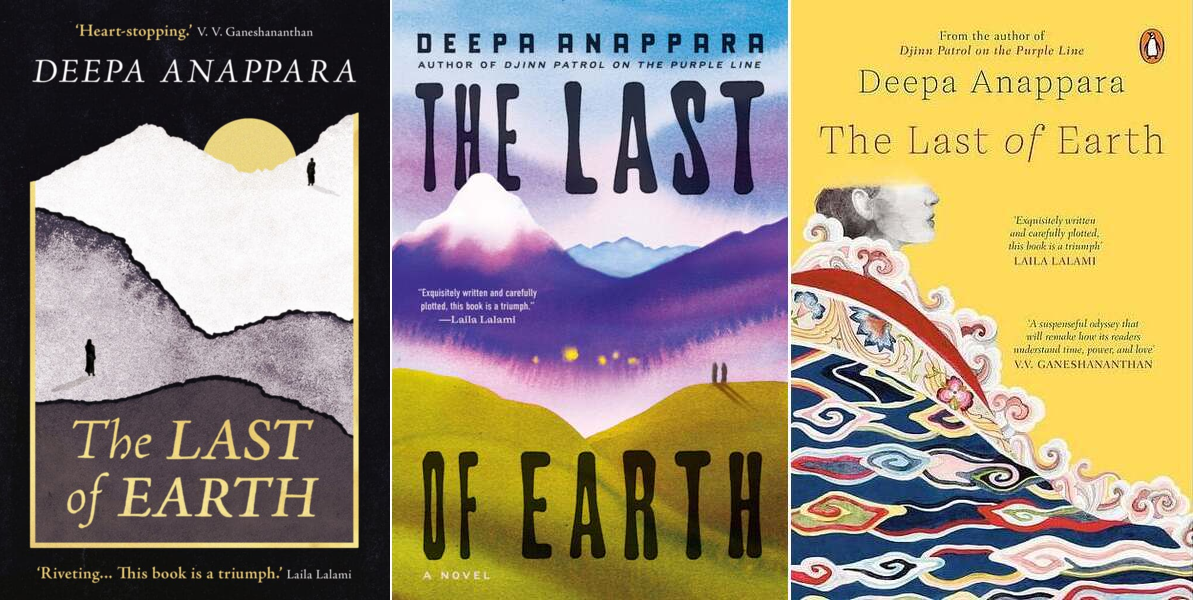
“The Last of Earth” by Deepa Anappara
1869 was a time of Russian expansion into Central Asia and British anxiety about India’s northern borders. Because Tibet was closed to Europeans during this “Great Game”, the British trained Indians in surveying and sent them across the mountains as covert mapmakers.
In The Last of Earth, Deepa Anappara uses this setting to construct two parallel journeys into the Tibetan interior. The first follows Balram, a schoolteacher turned surveyor-spy, who agrees to guide an English captain on a mission to chart the Tsangpo river. His real motive is to rescue his dearest friend Gyan, rumoured to be imprisoned in a monastery near Shigatse. The second follows Katherine, a fifty-year-old woman who is the illegitimate daughter of a British government official and an Indian woman. Her complexion allows her to pass as a Hindu pilgrim headed to Lake Manasarovar. Excluded from the all-male Royal Geographical Society but possessed of a modest reputation as a travel writer, she aims to be the first European woman to reach Lhasa. The novel alternates between these two narratives: Balram’s told in close third person with the momentum of an adventure, Katherine’s punctuated by journal entries addressed to her dead sister Ethel, whose loss has sharpened her restlessness into compulsion.
The novel charts an attempt at imperial cartography, and yet its deepest conviction is that the important things go unrecorded in maps—”mountains and hills and lakes were like signposts to Balram, the shape of a ridge or the mouth of a cave telling him where to turn left or right.” This is true of mental interiors no less than the physical terrain of the Himalayas: “a map may anoint a man Tibetan or Kumaoni, but it can no more alter his soul than the wind can scatter the constellation of stars in the sky.”
The colonial expedition is a familiar frame, which the novel subverts by treating it from below. Balram’s chapters are saturated with the texture of subordination: the bearers who “jumped out of the path into a ditch when a white man’s carriage spat a cloud of dust in the distance,” the captain who threatens deserters with the “full force of the British government’s fury” against their families. Never reduced to a figure of resistance or victimhood, Balram is wry, exasperated, and entangled. His friend Gyan once said that Balram’s thoughts “were no longer his own but of a race that would never see him as an equal.” Balram’s narrative is a sustained act of recovering what official reports, like the one that begins the novel, suppress: fear, coercion, labour, and interior lives. The book does this with sentences that combine exact physical observation with an awareness of moral ambiguity—”where the beard touched his robe, uneven patches of black spread like mold.” It is strongest in these moments of divided consciousness, when Balram’s loyalties compete without resolution.
Katherine’s narrative offers a counterpoint, exploring a different sort of entanglement. She is both an insider and an outsider to empire: her mixed heritage means her mother called her “Mongrel”. She too has a divided identity: “she was English and she wasn’t, she had loved Ethel and she hadn’t, she loathed Mother and Frederick and she didn’t, she wanted to escape into the forests of India with this outlaw and she didn’t.” Her journal entries are the novel’s most emotionally exposed passages. Her encounter with Buddhist teachings on impermanence becomes the book’s philosophical spine, and the closing image of Tibetan monks creating and then destroying sand mandalas is a metaphor for what the novel does: recreating a historical world to demonstrate its fragility.
The two narratives converge only at the very end, and the novel’s Tibet exists in a binary relationship with the British empire—Russia, the Qing dynasty, the Gurkhas and the Dogras, and other parts of the messier historical picture are kept offstage. Both Balram and Katherine are tethered to the moral drama about British imperialism and its Indian collaborators or victims.
The one figure who disrupts this binary is the Muslim bandit Chetak, anti-colonial and unattached to any state. He allies with Tibetans pragmatically, and he is the only character whose freedom of movement is not dependent on either British or Tibetan permission. He represents the novel’s glimpse of a fluid and plural Himalayan world, populated by traders and pilgrims, itinerants and border communities, which existed beneath and between the imperial frameworks. His coincidental appearances in both Balram’s and Katherine’s narratives reveal connections between people and places that colonialism severed. He is also the most elusive character: “It was a sort of freedom too, to retain a self that the world—and the English masters—could never grasp.”