Old post
This post was published before January 2026. Some links, images or other content may no longer display or work as originally intended.
“The New Byzantines: The Rise of Greece and Return of the Near East” by Sean Mathews
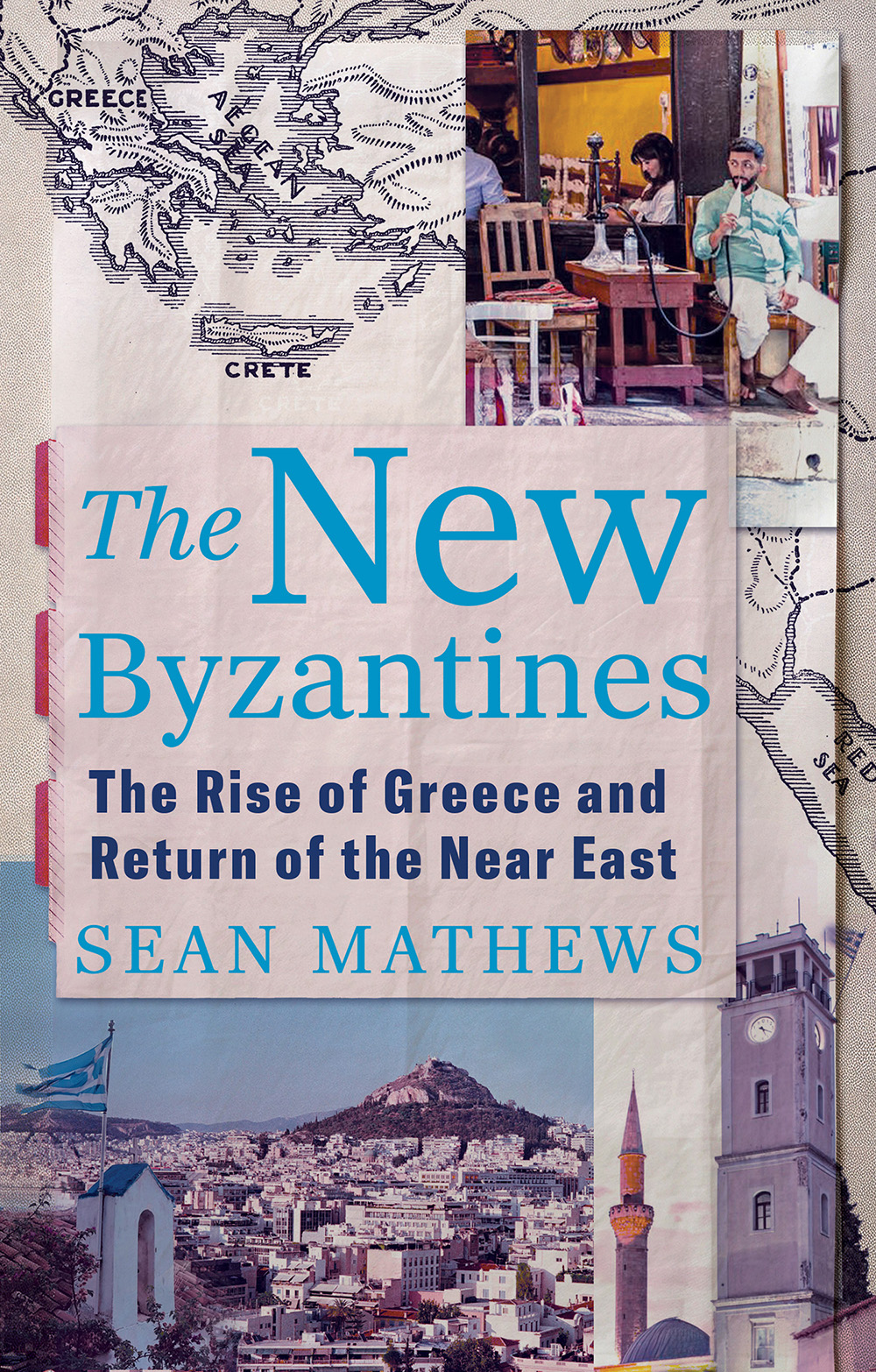
Back in the (pre-EU) day, the American Government and US corporations would place Greece into a Middle Eastern or Near Eastern department; I seem to recall my 1980s-era employer doing so, to the (mild) annoyance of its Greek distributor. Europe was more tightly-defined in those days.
Sean Mathews would put it back there: “Living and traveling across Jordan, Lebanon, Egypt and Türkiye, I realized that Greece is much closer to its Eastern neighbors.” He goes on:A bias toward ancient Greece and the “birthplace of democracy” in academia, politics and popular culture has long overshadowed Greece’s place in the Near East. But the latter is the one in the ascent now.
This, he says, is the Greece of Byzantium rather than that of Pericles and Thucydides:A whole generation of British writers—eloquent, cosmopolitan and cash-poor—recognized that modern Greece was closer to Byzantium than the ancient Greece of Socrates and Plato. They came to Greece between the First and Second World Wars, and drifted listlessly across the Levant as diplomats, journalists, soldiers, teachers and ne’er-do-wells.
Mathews does travel-writing reportage very well.
Although The New Byzantines dips in and out of history, economics and geopolitics, the book perhaps belongs better on the “travel-writing” shelf. It’s not that Mathews eschews data or analysis, but he is especially at home with reportage: the book is for the most part on-the-ground description and personal interview. Mathews does this very well. His travels include the less-traveled parts of Athens, Epirus and Thrace, as well as tracking down (what remains of) the Greek communities in Cairo, Istanbul and Jerusalem.
But Mathews has a few serious points to make. The first is that Greece is no longer the economic and political basket case it was so recently considered:Athens is taking its place among the Eastern Mediterranean’s entrepôts. The ones last century, in order of their destruction, were: Smyrna, Alexandria, and Beirut. Just as the Lebanese capital became a magnet for wealthy Arabs fleeing war and socialism in the 1950s and 1960s, Athens has become the region’s new bolthole. Turks are seeking refuge from their authoritarian government, secular Israelis are buying back-up homes, and middle-class Arabs are fleeing their inept and corrupt rulers.
In Epirus’s Ioannina he finds a new “attractive, cost-friendly bolthole” for tech startups and remote workers, at costs a fraction of those in, say, Germany.The “Near East” is very real.
Mathews’s second point is that “Near East” is, as US once-dominant position declines and regional powers rise, once again very real.
The term “Near East” is a throwback to an earlier era when borders and identities were fluid. Admittedly, it is a Western-centric term… But this term is the best one I know to describe the region where half of my family is from, which I live in and report from. The Near East stretches like a big scimitar from the Black Sea through the Eastern Mediterranean, down to the Red Sea.
As a corollary, he argues that Greece’s “Levantine” “shiftiness” will turn out to be an asset:That shiftiness is a feature I’ve noticed across the Near East. It’s why Greek shipping magnates have showed no qualms transporting Russian crude oil that counterparts wouldn’t touch amid the war in Ukraine. And it helps explain why Greek businessmen often are more comfortable operating in Russia or even Syria than their Western peers. Like Lebanese, Syrians, and Armenians, entrepreneurialism is a part of Greek diaspora identity.
Mathews is not arguing that Greece will slip away from Europe and the US; on the contrary, he considers these links to be more solid than those of some others. Rather, he argues that Greece will find an enhanced role as an intermediary between regions.From a Greco-centric point-of-view, Mathews surely has a point.
Mathews (or perhaps his editor) has a few quirks, one of which is to use the now official “Türkiye” for the country previously known as Turkey. There is no obligation to use the local-language name of a place when writing about it in English. The usage finds its way, surely anachronistically, even into a quote taken from the 1970 book Bright Levant.
One might also quibble about the framing. Mathews intends to turn the somewhat insalubrious connotations of “Byzantine” on their head, and treat them as assets. The Byzantines, themselves, however, might neither have understood or appreciated this; they—up to the end—considered themselves “Romans”, the true decendants of what would now be considered the “Western tradition”: it was the Franks, not the Greeks, that had degraded this legacy. And the Turks, meanwhile, are surely giving the Greeks a run for their money in this role, either as the “New Byzantines” per se, or as the commercial and political hub of a re-emerged Near East.But from a Greco-centric point-of-view, Mathews surely has a point. The world is changing and Greece—and the Greeks (whether “Byzantine” or not)—are uniquely well-placed to take advantage.