“The Tree Within: The Mexican Nobel Laureate writer Octavio Paz’s Years in India” by Indranil Chakravarty
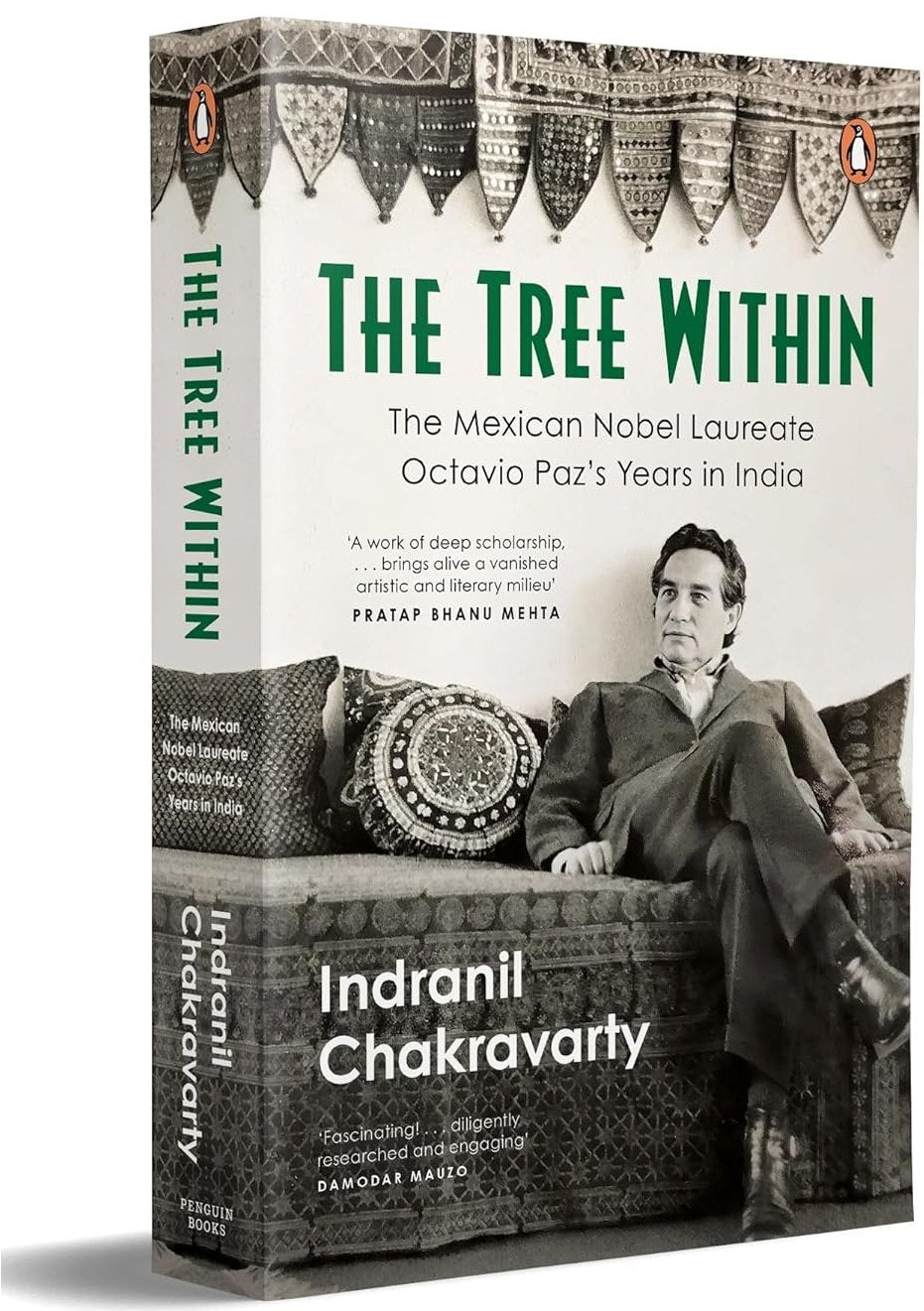
It seems that the Nobel Prize-winning Octavio Paz was “obsessed with the idea of the Other as not an external entity but a tree within”. Borrowing the phrase for the title of his new book, Indranil Chakravarti generously explores and develops this point, presenting his readers with different trees in different spaces, including Paz’s own neem tree in the inner garden of his home during his sojourn in India in the 1960s. .
That was the intimate space where “We asked the neem to marry us,” Paz indicated, referring to the most decisive moment of his romantic life: his wedding to his second wife, Marie-José Tramini in 1966. The Tree Within provides great insight into Paz’s love life in India, treading lightly to turn it into an inspiring story for those who are themselves still looking for a special someone. Chakravarti recounts that once Paz met Tramini at a social event in New Delhi in 1962, their love erupted explosively, despite both being married to other people at the time. Their attachment developed to the point they needed to find their own freedom to be together and did not separate once until the poet’s death in 1998.
In the book, it is both through the rooting idea of the tree and the powerfully poetic and invigorating feeling of love that we come to know of Octavio Paz’s friendships, diplomatic connections as Mexican ambassador to India (1962-1968), patronage of the arts, and thoughts on both Mexico and India—heavily criticizing the former and deeply loving the latter, or the other way around depending on what was going on. Paz’s first appointment to India was between 1951 and 1952; it was a rather difficult time for him as he first considered it a punishment.
Paz found striking similarities between his native Mexico and India.
Appreciation of the book is aided by a prior awareness of the resounding influence of Rabindranath Tagore on Latin American poetry. Yet although Paz was just one of the many Latin American writers who developed a special relationship with India, he singularly spent many years there, unlike fellow Nobel Prize awardee, Chilean Gabriela Mistral, who enjoyed extensive mail exchange with different relevant Indian figures but never visited the country, let alone Asia.
Towards the end of the book, Chakravarti is emphatic that “no matter how much he loved India, Paz’s understanding of India remained largely Eurocentric,” not that this necessarily detracts from Paz’s experience. He was, after all, the result of the Western tradition but one imprinted on a culture that still cherishes its pre-Columbian origins and mythologies. Indeed, it is possible to read his works from so-called “Oriental” perspectives and approaches to spirituality which are different from the deeply rooted Judeo-Christian tradition that is impressed upon any Western subject: the influence of both Buddhism and Hinduism are unavoidable when approaching Paz’s works written around the times The Tree Within is set.
Paz found striking similarities between his native Mexico and India. Through his “parallel mode of thought, New Delhi would evoke Mexico City in terms of its historical memory of past civilizations that existed as ruins in the middle of the city.” Chakravarti goes beyond this as a mere note and expands it to the poetic realm as “poetry could rescue the remains of the past from the bulldozers of the future.” This erudite book shows deep research and provides tremendous knowledge, while remaining accessible to a wide readership. One does not need to be a Paz expert to understand what is being developed. The beauty of The Tree Within is that everyone is welcome to learn something and feel a healthy urge to revisit—or to initially approach—Paz’s poetry, especially his most celebrated piece, “Sandstone” (1957), frequently mentioned and studied in Chakravarti’s volume.
This book is homage to one of Latin America’s most distinguished voices, and the details pertaining to his experience in India, soirees, meetings, travels, friendships and hardships are precious snippets of a life well lived. Paz was a welcoming figure who befriended great artists such as André Breton, Pablo Picasso, Severo Sarduy, Gabriel García Márquez and Julio Cortázar among many others. Paz’s support for Indian plastic artists both in Mexico and India is certainly celebrated in this book, especially in the first chapters.
Chakravarti’s great work following Paz’s life before, during and after his time in India is certainly a great addition to the ever-expanding literature on Mexico’s greatest contemporary poet.