Old post
This post was published before January 2026. Some links, images or other content may no longer display or work as originally intended.
“The Woman Dies” by Aoko Matsuda
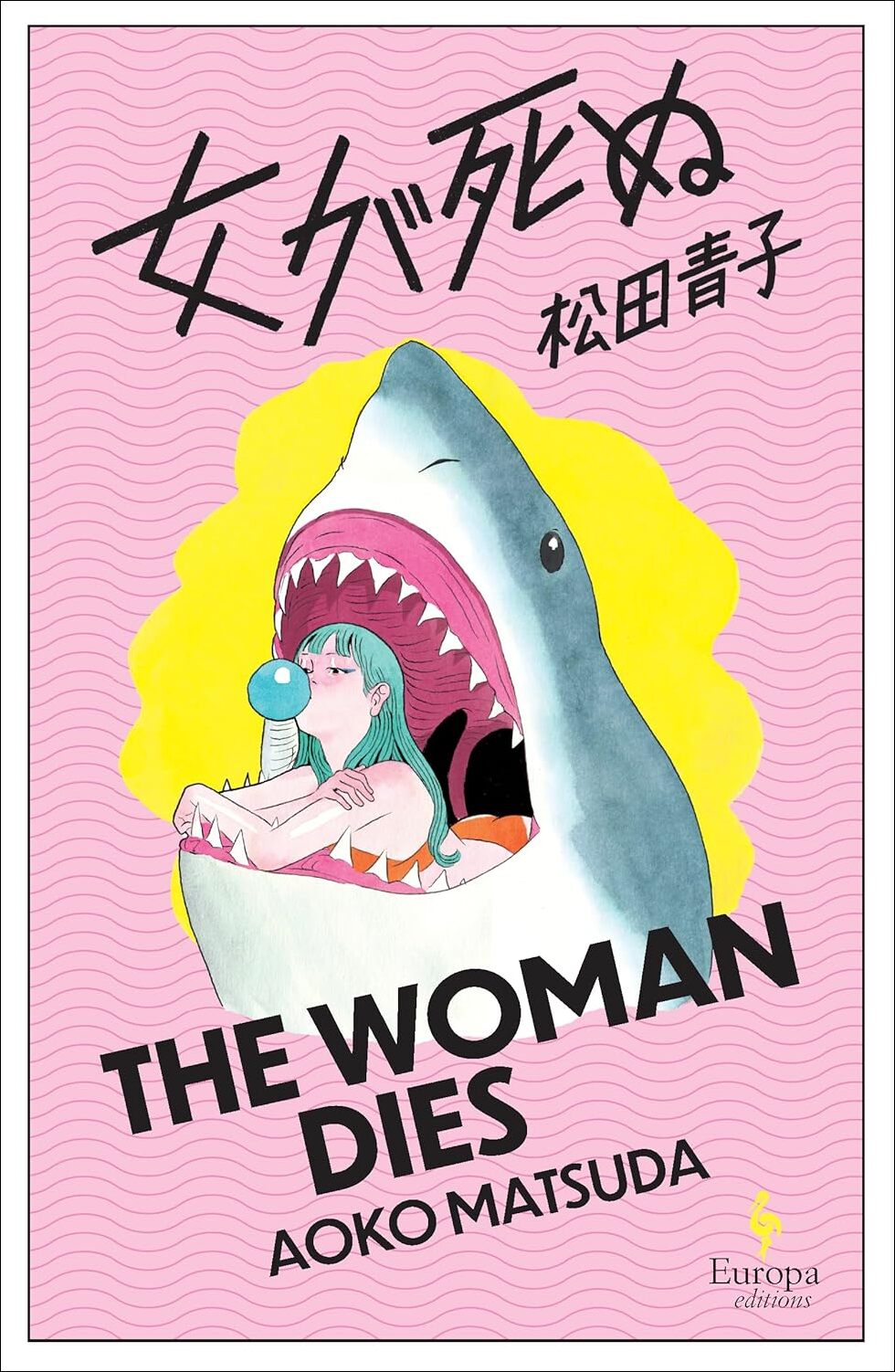
Across fifty-odd flash stories (particularly short pieces of fiction) in The Woman Dies, Aoko Matsuda and translator Polly Barton lean into the weird, nitty-gritty world of womanhood. For the most part, there is no immediate throughline connecting the stories—and their rich inner worlds—to each other. Yet eventually, the lines blur enough for images of women, glittery face highlighter, and lingerie frills to appear, blending the stories into a sparkling collection. All the stories play a part in building Matsuda’s world, where girlhood is a state of mind that can never be outgrown; it is at once a curse and blessing, the only thing the world values and despises in equal measure.
“The Woman Dies”, easily one of the best of the collection, explores all the ways a woman might suffer for the sake of a story: “the woman dies… the woman miscarries… the woman dies…” The story opens as a character-less commentary on the function of women in story plots. It’s a literary cliché that, as Matsuda reflects: “The woman is raped. She is raped so that the man can be angry about it. She is raped to spark his vengeful spirit.”
The story then hones in on a scene in a movie theatre, where a group of strangers stumble out at night to find the real body of a dying woman, warm blood and all. The story twists from simple commentary to a meta narrative of a literal dying woman. The reader is then thrown into a scene that dismantles the fourth wall: a “real” character arrives (distinctly seperate from the initial, character-less commentary of the story), looks down at the dying woman, and asks, “Excuse me, but were you raped?” Black comedy steeps the pages.
And after the heaviness of pages of what women endure for the sake of a story (“The woman miscarries. She miscarries so the happy ending will be more moving.”), it is a relief to meet the real dying woman, a more honest character than any trope. As the group around her asks if she has any last words, she says, “I wish I’d had the opportunity to deconstruct the vagina, at least once.” Upon sensing the group’s confusion, she clarifies, “Aesthetically, I think they lack balance. In fact, just between us, I don’t get how anyone can say they find genitals beautiful.” A figurative “ba-dum-ts”concludes the story, and the police take her away.
The Woman Dies is a collection bursting with originality, humour, and razor-sharp wit.
The varying length of the stories in The Woman Dies (some span several pages, while others are a single sentence) plays with the conventional notion of a “short story”. Matsuda’s dissection of societal norms and taboos, particularly around femininity and girlhood, is at its strongest when woven into a larger narrative, like in “The Purest Woman In The Kingdom”. A darkly comic fairytale about a prince searching for the truest virgin of the land, the story finds its twist when the reason for the woman’s purity is revealed; no one can touch her because she’s highly trained in martial arts. The prince is successful in his quest, but is left beaten and bruised.
Yet on occasion, Matsuda’s take on gender is too ordinary and obvious in its commentary, especially when contrasted by the sharp wit of the other stories. “Dissecting Misogyny” is a short story about a mock lecture, where a version of anthropomorphised misogyny is literally dissected—”I’m applying pressure, like this, to sever the neck. Oof! This is a particularly tough one!” The point is that misogyny, though entirely hollow and baseless, is still remarkably tough to dismantle, a fact that any reader of Matsuda is already aware of and would probably like to see presented in a more interesting light. In a sea of better stories, with sharper wit, the sporadic weaker one stands out more.
At the very end of the book are Matsuda’s “one-line commentaries”, supplementing the stories with context and inspiration. The glimpses range from the banal—on the story “English Composition No. 2”, Matsuda notes, “I was very happy when I saw both these paintings at the Tate Britain”—to the thrilling; :on receiving an award nomination for “The Woman Dies”, the commentary reads, “one morning I was half awake, breastfeeding my one-month-old baby and checking my email with my free hand.” Yet part of the charm of Matsuda’s stories is their tenuous grip on reality, and when that grip is tightened through authorial context, the stories lose some of their mystical appeal and fall flatter upon a reread. The inspiration behind a story is often less exciting than the final product, a testament to the vividness of Matsuda’s storytelling. The adage holds true; less is more.
From tales of android boys to bulimia that transcends time and space (the protagonist begins to vomit Natalie Portman’s vegan meals), The Woman Dies is a collection bursting with originality, humour, and razor-sharp wit. There’s something here for everyone—probably two or three somethings, in fact.