“Japan: A History in Objects” by Angus Lockyer
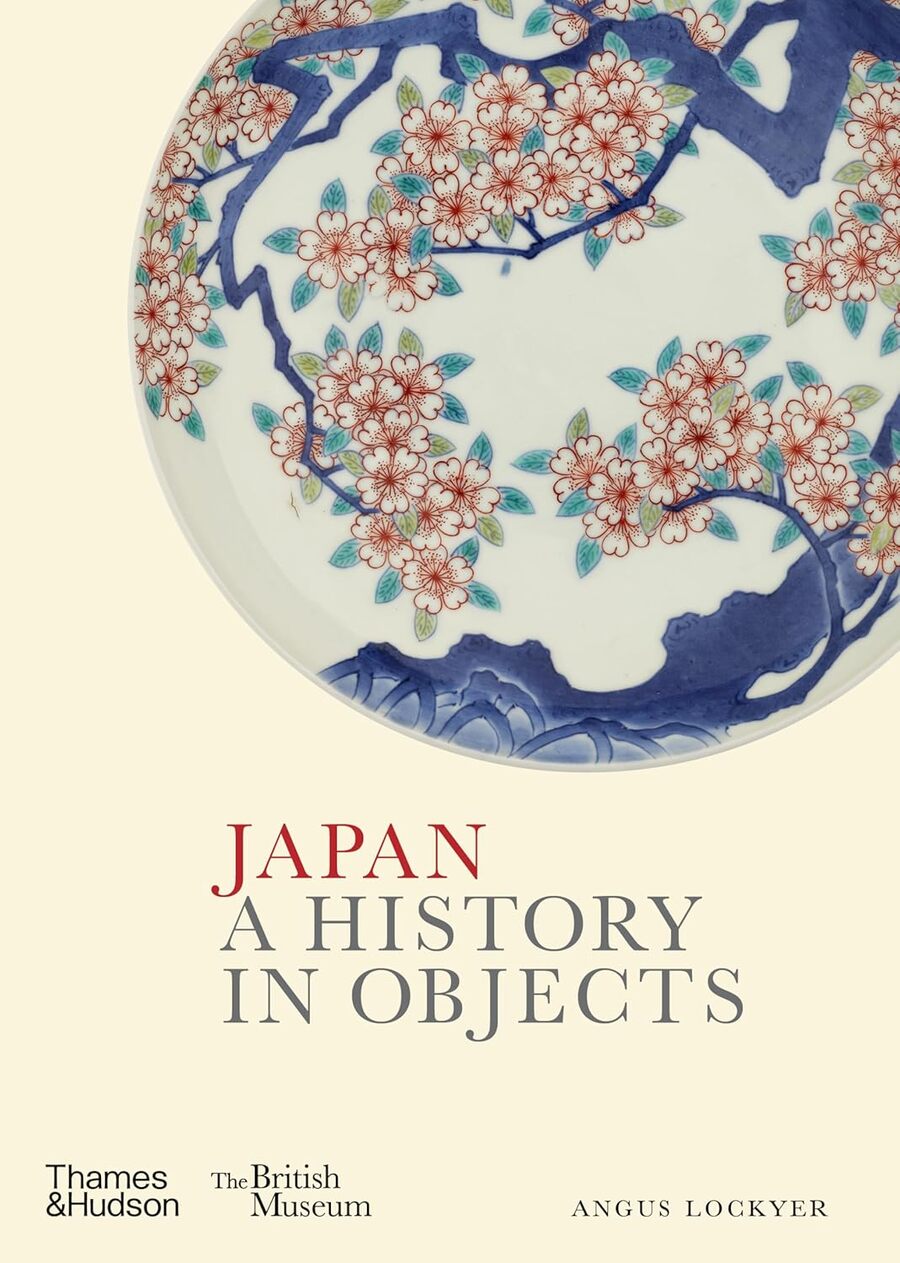
Japan: A History in Objects, Angus Lockyer (Thames & Hudson, February 2026)
Those who know other volumes in the “History in Objects” series from Thames & Hudson and the British Museum will find much that is familiar in this latest one on Japan: a wide and often eclectic collection of objects well-displayed on pages balanced with bite-sized yet informative blocks of text.
Yet in the balance between history and objects, this one perhaps leans a bit more toward the history and less towards the objects themselves. Many events and themes are illustrated with objects (usually prints) that—while “historical”—date from well after the subjects they represent; a section on the early history of rice and agriculture features a print from ca 1800, while a Hiroshige print of Nintoku, a 4th-century emperor, is on the spread discussing the early state. One can understand why: Japan has a wealth of highly attractive and illustrative artwork depicting periods and themes of the nation’s past and mythology, whereas material culture (insofar as it exists) from these earlier periods can be less immediately accessible. It is however rather like illustrating Ancient Rome with paintings from the Renaissance.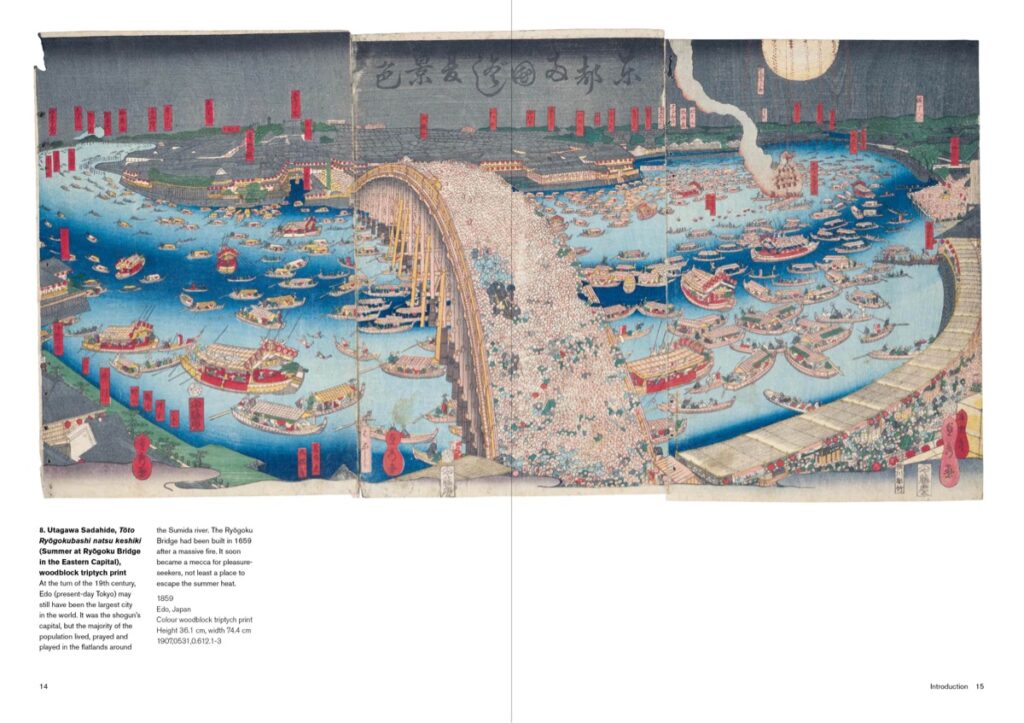
As a history, Japan: A History in Objects is particularly helpful in the earlier periods and in tracing cultural throughlines. The chapter “Japan before Japan” traces pottery back to an astounding 16,000 years ago (in the Late Pleistocene), well before agriculture.
The Japanese population was formed, for the most part, from two distinct groups. The islands were settled first during the Pleistocene period by a people who in time learned to chip and polish stone, then to coil the pots that gave the subsequent Jōmon period its name. Then, from roughly 1000 BCE … successive waves of immigration from Northeast Asia began to arrive … reaching Tōhoku by 300 CE. The new arrivals brought with them new materials and technologies – wet rice agriculture, then bronze and iron – which would allow them to engineer the environment, and the elite to subordinate the population at large. The Japanese who live today in Kyushu, Shikoku and Honshu are descended primarily from this second group of immigrants.
The Ainu (now largely restricted to Hokkaido) are thought to descend from the original Jōmon people.The book emphasizes the connections to mainland Asia, in this earlier period, and then beyond, where ideas, technology and culture came via Korea and, of course, China, although the latter sometimes mediated via Korea and even Okinawa to the south.It traces society through material culture, from arrowheads and pottery to religious and consumer items. But it’s fair to say that Japanese objects are (some pieces like a stunning earthenware horsehead from the 5-6th century CE aside) on the whole rather unprepossessing until the second millennium CE. By the time the book gets to the 17th-century, the story and the objects become more familiar and what most people probably think of as “traditionally Japanese”. In these sections, the objects relate more directly to the topic being discussed; the objects themselves are well-chosen, some well-known, others such as clothing, sword guards, votive offerings and everyday objects, perhaps less so.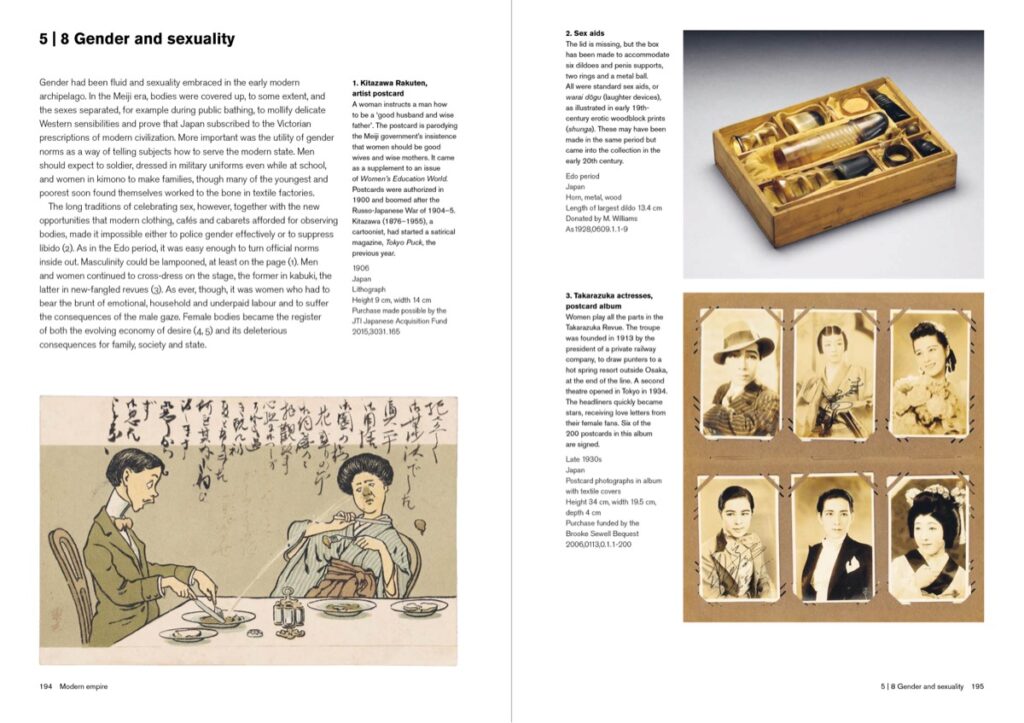 The book’s pages are mostly organized by theme: “Esoteric practice”, “Japanese writing”, “Passing the time”, “Enterprising warriors”, etc. Few extend over a single spread; the effect is rather like a collage, with understanding coming as the pieces fill in and overlap.Japan: A History in Objects continues to the present day, up to including digital art. One of the final pieces is a copy of the Rosetta Stone etched on a tiny silicon chip.
You must be logged in to post a comment.