“Traversing the Belt and Road: The World According to China and China According to the World”
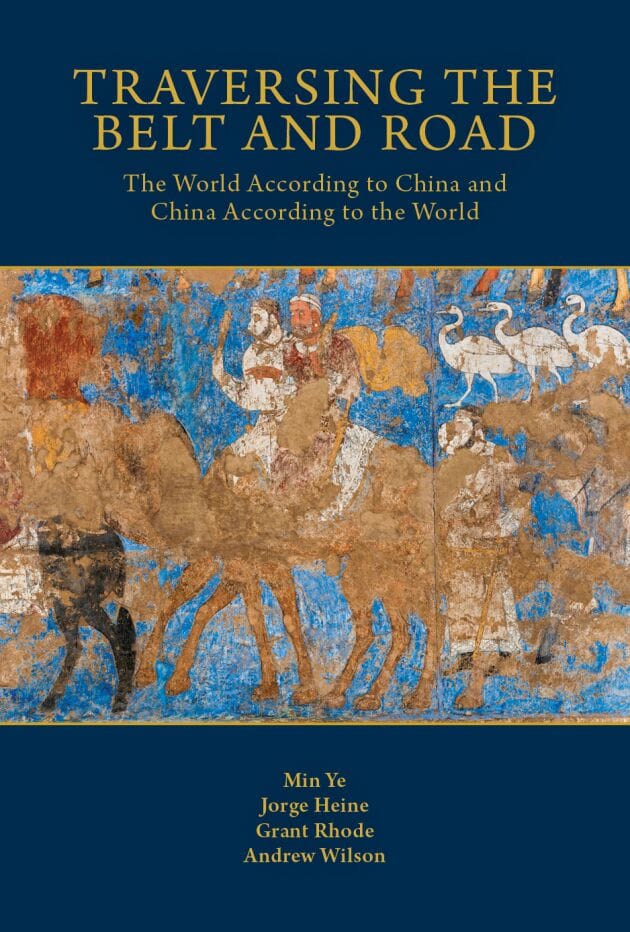
As are many things regarding China’s developing place in the world, the “Belt and Road Initiative” (or BRI)—the term used for China’s international infrastructure investment programme—is contentious. Discussion about the programme’s objectives and efficacy are almost inevitably coloured by one’s geopolitical view of “China’s rise”. Those who are discomforted by the latter are prone to a jaundiced view of the BRI, one in which international development can come to be regarded as a zero-sum game and an open-mind a sign of geopolitical naivete.
Traversing the Belt and Road is a collection of papers framed by the question posed in Min Ye and Jorge Heine’s Introduction: “The Belt and Road: Unilateral Act or Two-Way Street?”, a question they evidently consider somewhat rhetorical:
Central to our analysis is the recognition that the BRI functions as a complex network of interactions—multiple two-way streets connecting a globalizing China with diverse regions and countries.
The book’s often granular focus on the BRI means that it does not quite live up to its subtitle “The World According to China and China According to the World”; while the BRI is an important part of China’s international relations, it is not the only lens through which China views the world and is viewed in turn, not least because the BRI largely excludes Europe, North America and America’s northeast Asian allies of Korea and Japan.
The book’s chapters cover too much ground, both geographically and thematically, to review in detail. The first 100 pages are spent on the policy as centred in China. In going through the world region by region—Central Asia, South Asia, Africa, Europe and Latin America—the bulk of the rest of the book divides BRI into into the two buckets of land and sea-based approaches (with India having an entry in each, and Latin America, perhaps fitting in neither, shunted off into a final section “Looking Ahead”).
Books tend to be written with a target audience in mind and the subtitle of David M Lampton’s opening chapter, “The Big Picture”, makes it clear which this one is: “China’s Big Vision, the Challenges It Faces, and Lessons for US-China Relations”. These lessons, Lampton lists, are:
Lesson One: Recognize What China Has Accomplished and Do Not Underestimate the PRC
Lesson Two: Building Roads Requires More than Rhetoric
Lesson Three: Smaller Countries Have Agency in Dealing with China
Lesson Four: China Has Domestic Politics
These serve as a fair summary of the book as it moves from region to region, while in the next chapter, Kevin P Gallagher’s summarizes the situation as follows: “In a very short decade, China’s Belt and Road Initiative (BRI) has become a deep and far-reaching program of economic integration, connectivity, and cooperation between China and its partners.” It is, however, something of a moving target, Gallager goes on:
The Belt and Road Initiative (BRI) has changed over time and has been sculpted by domestic forces in China and partner countries; domestic and global reactions to Chinese projects and behavior; changing geostrategic realities, not least relations among powerful countries; and China’s technological advances, as seen in electric vehicles, solar panels, AI, high-speed rail development, and much else. On balance, over time, the BRI has become more global in character, more aimed at the Global South, and somewhat “greener” and more digital.
The cases range from Port of Piraeus in Greece to Port of Chancay in Peru, from trains in Southeast Asia to trains in Africa; those who follow China will no doubt have read much of this before. While spreading the book thin, its global coverage nevertheless put some things in perspective. One is Russia’s continuing (but perhaps understandable given overlapping interests in, among elsewhere, Central Asia) reticence to embrace the BRI. Another is the inclusion of Latin America in a programme that started in emulation of China’s ancient trade routes to its West; Sino-Latin American trade relations are often treated as a separate subject especially when viewed from the vantage point of the United States. In a key passage, Jorge Heine, a former Chilean Ambassador to China, points out that the BRI is not synonymous with having an economic relationship with China:
Curiously, though, despite the very strong links between China and Brazil, Brazil is among the very few Latin American countries that have not signed on to the BRI… The reality is that ties between Brazil and China are so strong that formally signing on to the BRI does not make much difference. The Brazilian market is so attractive that Chinese companies flock to it anyway. Brazilian diplomacy concluded that signing on to the BRI in such a fraught international environment would have entailed a needless rattling of the cage and so it decided to pass.
He goes on:
The BRI provides a grand design and useful umbrella for China’s infrastructure and connectivity projects abroad, but its formalities will not necessarily stand in the way of links with what China considers its key international partners.
Traversing the Belt and Road is not a book for the uninitiated: it assumes at least rough familiarity with, if not the BRI itself, then at least some areas of international economics, trade or economics. And as a collection of its papers, it is a sum of disparate and not always entirely connected parts.
Finally, like many such studies, this one has to some extent been overtaken by events. Whatever the BRI was going into 2025 (much of the book’s data ends before this), new American tariffs, the Iran War, AI and the coming of age of EVs, has surely changed perspectives in both China and much of the rest of the world.