“What’s a Snow Leopard to You?” by Chen-Fu Hsu
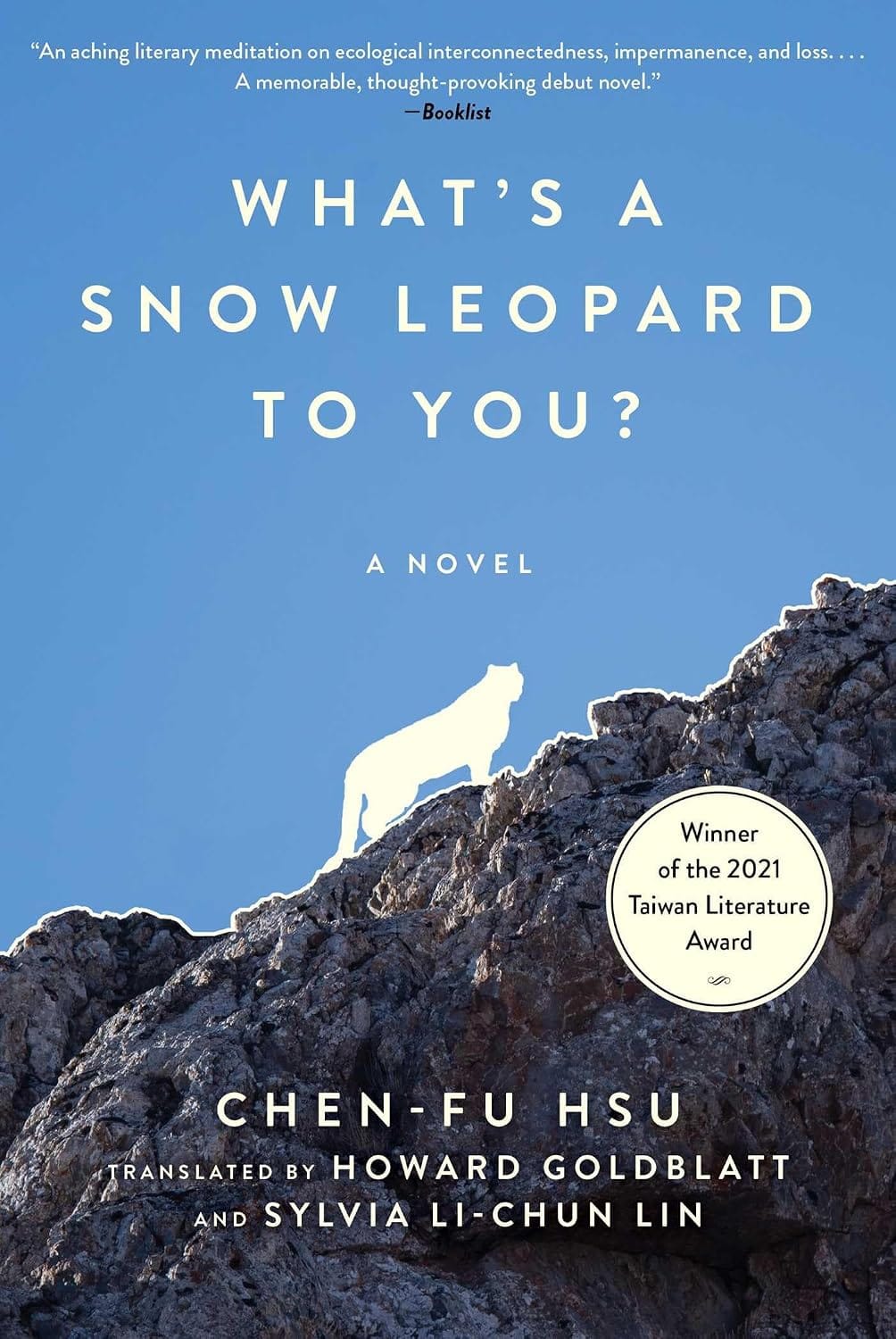
Chen-Fu Hsu, a Taiwanese writer interested in bugs, photography and geography, traveled to Tibet to gain first-hand experience with snow leopards for What’s a Snow Leopard to You?, his collection of more than forty short prose pieces. The collection won the 2021 Taiwan Literature Award, an award that joins a number of others earned by the writer as he travels and writes about places like Borneo and the South Pole. What’s a Snow Leopard to you amounts to a travelogue in search of a story.
The reason behind my many travels in recent years might well be a persistent naive faith in an ancient art form. What’s different is my early belief that stories were a form of wild fruit that grew in one place at a time, waiting to be picked by a devotee. But now I feel that language is like footprints, leaving behind fragments of speech as it passes, and that after years of saying too much, I find myself all but unable to say anything. What, after all, is there in Tibet?
The short answer appears to be: a wild snow leopard. The early essays detail his movement through the highlands of Tibet as he watches sheep and vultures, tracks footprints and stars, and talks with local people. The spoiler alert is, however, that he doesn’t find one in the wild. He does reveal in a later essay that he visited the Tromzikkhang market in Lhasa, where a vendor took him to the back and showed him the pelt of a snow leopard. In his closest encounter with the leopard, Hsu touched it. “It was like touching a hot wire.” He quivers with the life that used to wear it.
Left without a snow leopard, two major issues emerge. One is to generalize from the individual animal to the overarching category: Nature, or the natural world. The scientist in him is interested in observing and documenting nature untouched by Culture, Nature’s opposing category in the book.
In a distant alien land still untrampled by human feet, standing before a glacier I could almost reach out and touch, could I now say that I had drawn closer to nature? This question would come to me again and again over my many months of roaming the highland.
The cultural anthropologist in him knows the answer is “no”. He is left with culture, language and its footprints, stories, and the variety of genres those stories take.
This leads to the second issue driving Hsu’s understanding of the snow leopard in his collection: what is the nature of storytelling? He presents a brief philosophical-historical account of the issue. More to the point, however, is what kind of “footprints” he employs across his forty prose pieces: travelogues, personal essays, fictions, philosophical treatises, scientific reports, political discourses, proclamations, spiritual meditations, biographies, histories, translations, quotations, excerpts, and more in what amounts to philosopher Gilbert Ryle’s “thick description”. What is being described? Snow leopards, Tibet, and the author himself, in what anthropologist Clifford Geertz, expanding on Ryle, would call a “web of meaning”.
The genres themselves lend themselves to certain topics and organizations of experience. The fictions highlight a dramatic structure and are loosely based on people he has met, including the vendor from the Tromzikkhang market. “Kashif” provides an underlying economic context as it tells the story of a leopard pelt for sale by a young boy who had killed it. The drama begins when a broker, Kashif, receives a call about a potential sale and travels into the countryside to negotiate for the pelt. He then takes the boy and his brother back to the city to be an “intermediary” in the negotiation for the pelt with a”boss”. Will the boy sell? Is Kashif who he says he is? Is he the boss? What is the value of the snow leopard as a commodity? “Lhamo Tashi” is a parable involving a monk who studies vultures and a young boy in a conversation exploring a core question—since killing is bad, can there be any exceptions?
There are critical reviews of the arts as he spends a few days in Lhasa. He visits the Chenpa Temple to witness the monks perform a Cham Dance, which is a dance of exorcism or vajra spirit dance. It is a lesson in art history, but a lesson much as a tourist might recount. Princess Wencheng is a character in a traditional Tibetan Opera of the same name, one of eight traditional operas performed by traveling drama troupes. The section bearing her name is largely a work of literary criticism, discussion of the Tibetan Opera, and its history.
There is an extended biography of Pema, an older man in Guoqin Village. He is a performer in traditional dramas and entertainments. A highway has been repaired and for the first time in a long while, the movie van has arrived with its own collection of genres from education films to dramas. There is a small TV in town that presents, among other things, the news. In contrast, Pema performs in a world of extravagant masks and costumes, with cameras rolling. The interaction of the arts and technology in an isolated world is compelling.
There are numerous presentations foregrounding history, the isolation of Tibet, and movements across borders, and everywhere and in between Hsu engages in philosophical discussions with his favorite intellectual—Walter Benjamin.
Underneath all of it is the snow leopard and its absence.
By the end, Hsu has managed to sneak nature back into the story, a story told in the language of the Earth and its memory.
When geologists retrieve the Earth’s memory core and analyze it from the deepest layer outward, they will find snow that quietly preserves seven hundred thousand years of story, from the Pleistocene to the Holocene, like a dust-covered collection of poems in a library’s storage room, eternally waiting for someone destined to be comforted by time…
A cold rain pours out the matters in the mind; a grassland sings a sad little tune. If you hear the sound of snow, can you tell me what snow remembers?
Hsu, perhaps, has hope in the form of poetry. If so, it is a poetry of absence and loneliness.