“Electric Vehicles: Implications for Developing Countries”
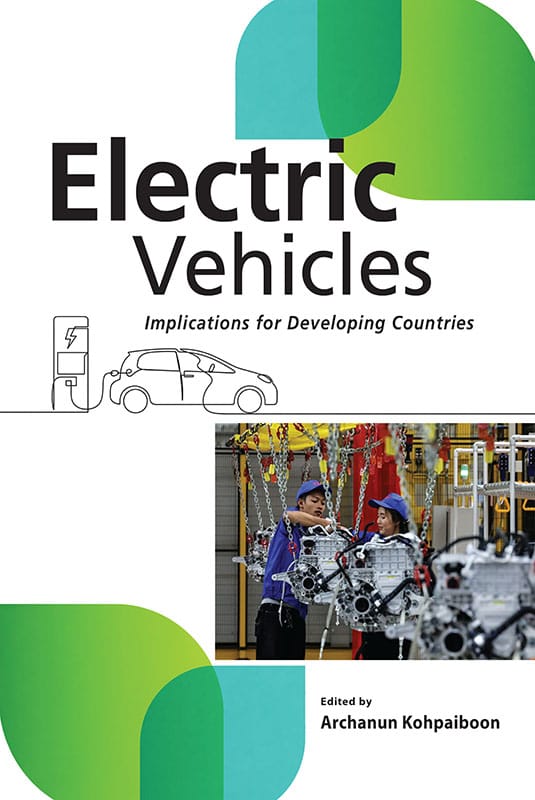
Electric Vehicles is a dense and chart-laden monograph; it is not for the faint-hearted. What makes it worth the effort, however, is its focus on developing countries (rather than the main players of China, the US, Europe and Japan) and that the “developing countries” in question are all in Southeast Asia. In addition to industry and regional overviews, there are separate, dedicated chapters on Thailand, Malaysia, Indonesia and Vietnam.
For the specialist, whether in the automotive industry or in development economics, the book provides an overview and considerable data that might be hard to glean otherwise. For the generalist, the book is worth skimming just for the diversity in perspectives: after all, there is more to this subject than just the current US-China trade rivalry.
There are few (for the most part, unsurprising) take-aways. One is that most countries see EVs (or BEVs—battery electric vehicles—as referred to here) in economic and technological development terms (that is, they want to build their own manufacturing and technological base) as much as for the benefits of EV adoption per se. The jury is still out as to whether things will turn out that way: the authors expect that, due to their weight, “BEVs manufacturing localization could be associated with EV battery factories.” Other trends act against localisation:
In particular, Tesla is proposing giga casting or mega casting using casting machines to force molten metal into moulds under high pressure to produce large aluminium body parts, such as the entire underside of a vehicle. This is different to the standard practice where the main body is made by welding or stamping together many separate parts. As a result, the number of separate parts would drop, whereas the initial investment in assembly factories would rise substantially. Under the giga casting setup, the economies of scale in terms of the assembly factor become more important.
But in any event, if it does take hold, it will almost certainly be led by China and Chinese companies who already dominate.
Thailand is the largest regional market for EVs, due, says contributor Archanun Kohpaiboon, in large part to concerted government policies:
Since 2022, when the government chose its technology winner, BEV manufacturers have rushed into Thailand. Great Wall Motor (GWM) and SAIC Motor-CP were the first two companies engaged in the EV 3.0 programme. The models to be sold include the ORA Good Cat 500 Ultra, ORA Good Cat 400 Tech and ORA Good Cat 400 Pro for GWM and MG ZS EV, MG EP and MG EP Plus for SAIC Motor-CP.11 They began their production in 2024. The other followers are BYD, Neta, GAC Aion and Changan Automobile. Mercedes is the only traditional carmaker participating in the 2022 EV promotion packages, producing a fully electric Mercedes-EQS for both domestic and export markets
Vietnam, however, is the only country with, so far, a potentially viable independent producer in VinFast, which has also started to expand regionally. Indonesia, on the other hand, has large suppliers of nickel, with which it hopes to catalyse battery manufacturing.
Then, while the larger discussion of EVs usually neglects vehicles other than “cars”, motorcycles and variants are relatively much more important in Southeast Asia. Independent success in this area seems more likely that in four-wheelers.
The book then provides a useful test case and in some cases counterpoint to some of the common narratives about how this industry will develop.
There are, as one might expect, some drawbacks. Some conclusions, such as that EV takeup depends on the prevalence of public charging stations, hardly needed this book to point out. But in an industry changing so fast (and as subject to new American trade policy), a lot may change even in a year; most of the charts and data only go up to 2024 or 2025, and some only 2023. In the Indonesia section, there is a line: “Looking ahead, the Indonesian government has set ambitious goals for the automotive industry in 2024.” And as for Malaysia, “Data on BEVs in Malaysia is not publicly available, and there appears to be no government agency that is tracking this information.”
The Malaysia section, indeed, seems to have some problems with chart axis scales. A chart of “Import and Export of Lithium-ion Batteries, 2017–23 (USD’000)” goes up in increments of “200000000” or 200 million, ie US$200 billion; one suspects that the scale is just USD, not USD’000, an error repeated in the next chart. Another chart “Import and Export of Electric Motor Vehicles, 2017–23” has a Y axis in increments of 100000000, ie 100 million. That’s an awful lot of cars for a country the size of Malaysia; perhaps these are US$. (The publisher has said that an erratum will be issued.)
The authors also make use of equations like:
D_BEVi,t = α0 – α1P_EVi,t + α2Yi,t + α3Policyi,t
… a rather complicated way of saying that demand (D) depends on price (P), income (Y) and policies. This would seem self-evident, hardly needing an equation. But the equation postulates that the demand function is linear against these variables; that seems far from obvious. Developing a model based on this assumption would seem a bit fraught.
A careful reader, and for a book like this, that is probably the only kind, will no doubt twig to these issues with no harm done; but they probably should have been caught somewhere along the way.
