“First Bite: Breakfast Stories from Urban India” by Priyadarshini Chatterjee
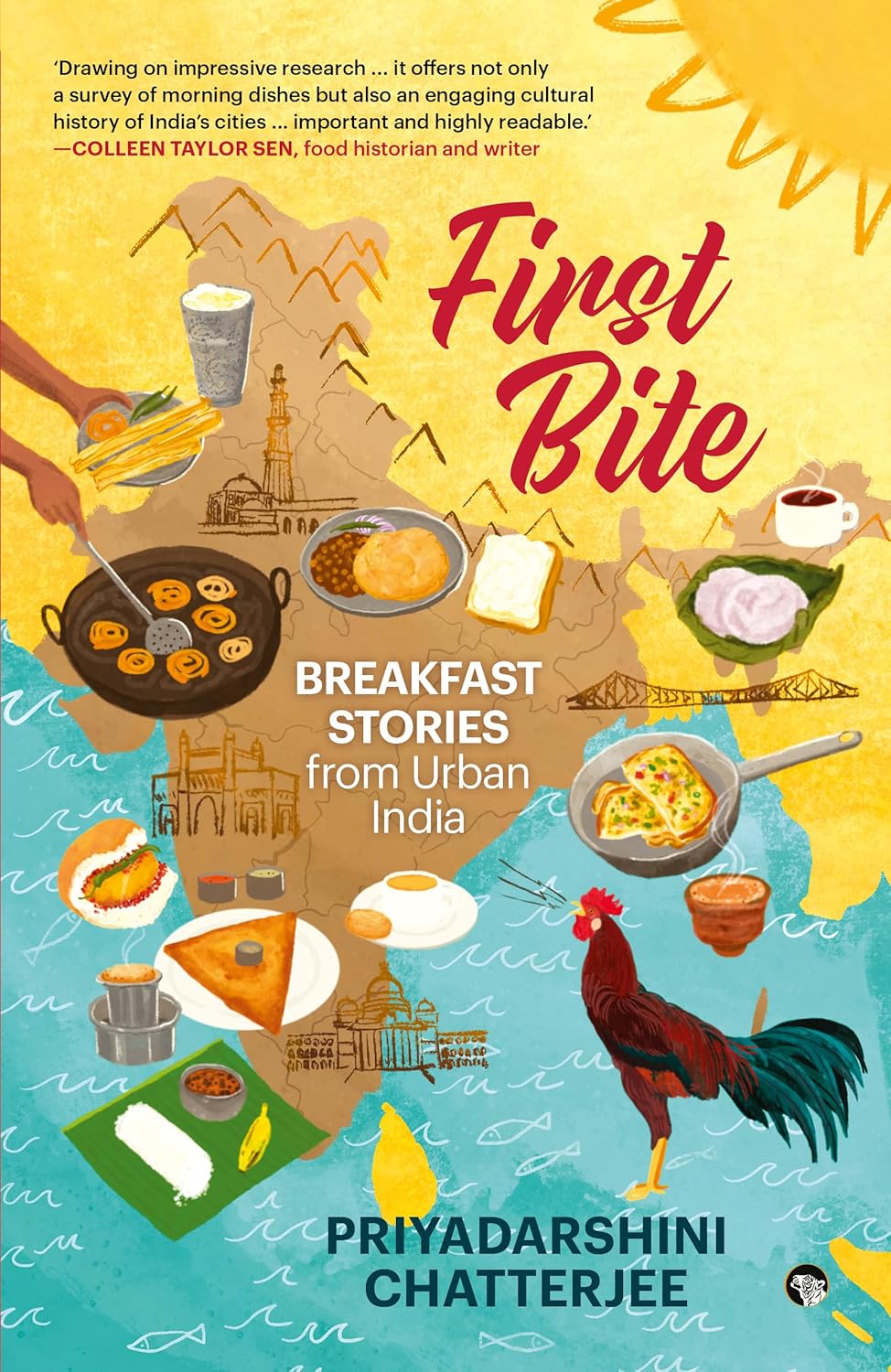
Breakfast, the first meal of the day, in India carries two competing traditions. On one hand, ritual references to food offered to the gods each morning suggest the meal has always held a place of its own. On the other hand, for the labouring classes, breakfast was rarely more than the previous night’s leftovers, hurriedly eaten before a day of fieldwork. In India (as elsewhere), it is really only in the wake of industrialisation—compounded by the upheavals of colonisation and migration—that breakfast crystallised into a fixed, valorised meal time for India’s urban citizens. In First Bite: Breakfast Stories from Urban India, Priyadarshini Chatterjee traces this crystallisation across ten Indian cities, combining first-hand sampling of their breakfast offerings with a reading of existing food-history scholarship.
Her method is two-fold: she eats her way through each city’s morning fare and reads against the grain of historical texts to contextualise what she tastes. Her itinerary is itself a kind of argument—starting in the north with Amritsar, Delhi, and Varanasi, moving east to Shillong and Kolkata, leaping west to Ahmedabad and Mumbai, and closing in the south with Bengaluru, Kochi, and Hyderabad. Most of these are regional capitals, which shapes the kind of cosmopolitanism the book keeps returning to.
That cosmopolitanism is the book’s recurring theme. Each of these cities, shaped by decades of migration, offers a broader breakfast spread than its regional identity alone would suggest. Delhi, for instance, is understood as the seat of a heavy, ghee-forward North Indian breakfast tradition—and yet Delhiites have also adopted the South Indian dosa, treating it as the lighter, healthier option against their own native fare.
Delhi’s Nihari, a slow-cooked, richly spiced meat stew traditionally eaten at breakfast in the old quarters of the city, gives Chatterjee one of her most striking historical details. Many of the city’s oldest Nihari shops, she explains, maintain a practice called taar: a small portion of each day’s leftover stew is folded into the next fresh batch, so that a trace of the original broth is carried forward indefinitely. Some of these lineages stretch back more than a century, meaning a bowl eaten today may still carry something of a stew first cooked generations earlier. Similar continuously replenished stocks exist in other culinary traditions around the world—Chatterjee mentions the Chinese lu mei and the Japanese oden—but the effect here is a small, literal kind of time travel with each spoonful continuous with a broth begun long before the diner was born.
Elsewhere, her research turns up less-known trivia with the same time-deepening effect: where Anthony Bourdain ate on his visit to Amritsar, or where the Dalai Lama settled on first arriving from Tibet.
The writing itself leans on atmosphere as much as history. Her account of Varanasi sets the tone before she turns to food at all:
It’s perhaps only in Varanasi – among the most sacred sites in the Hindu cosmos – that spirituality and corporeality coexist at such propinquity. It is after all, a city of contrasts and wild juxtapositions – home to anchorites and hedonists, ascetics and pleasure seekers, saints and impostors, all at once: the luminous city of death, bursting with life.
Such scene-setting recurs throughout, alongside an appetite for sensory description of the food itself that is, as one would expect from the genre, unabashedly vivid.
Beyond individual cities, Chatterjee is most interesting when she traces how food moves between them. The Kolkata kochuri, for example, did not originate in Bengal at all: it
is, in fact, said to have arrived in Kolkata with the halwais [sweetmakers] of Varanasi. Some of the most famous sweet shops in Kolkata today were opened by North Indian immigrants, especially from Uttar Pradesh. For instance, the illustrious Ganguram’s, known for their stridently Bengali sweets, was established by Ganguram Chaurasia, who migrated to nineteenth-century Calcutta from Varanasi to work for a local zamindar.
She notes that many of Kolkata’s present-day breakfast eateries began as sweet shops before pivoting toward savoury morning fare.
This migratory logic extends to individual dishes as much as to institutions. Fafda and jalebi, a combination of fried crispies made from gram flour and a syrupy sweetmeat, one of Ahmedabad’s signature breakfast pairings, turns out to be a local configuration of a jalebi that recurs, in different forms, across several of the ten cities, much like the puri.
Shillong, in contrast, offers Chatterjee a folktale cautioning the Khasi community against consuming “foreign” food:
According to the story, rice is the only grain ordained by the Great God for the Khasi man to survive on. But one day he comes across a stranger who offers him cakes of bread to taste. ‘Thy offer is kindly made, but do not take it amiss that I refuse to accept thy bread, for it is decreed that we shall live on rice alone,’ man says. But he eventually succumbs to temptation and takes the forbidden bite. The Great God says, ‘What hast thou done, oh man? Thou knowest the decree that rice was provided to be thy food, yet thou hast unmindfully transgressed and partaken of the strange food of the tempter. Henceforth thou and thy race shall be tormented by the strange being whose food thou hast eaten. By eating his food thou hast given him dominion over thee and over thy race, and to escape from his torments thou and thy race must give of thy substance to appease him and to avert his wrath.
The story is an aside that has survived; perhaps it is a response to the mixing of cultures visible in what was once an isolated state. Today, it offers as much “foreign” food as does any other Indian city.
To return to the reappearance of same or similar food items in different cities, one must note that Chatterjee is alert to how locality reshapes it. Bengaluru’s dosa, though recognisably the same dish found across the south, is a distinct creature:
The batter … is typically made of rice and black gram, soaked fenugreek seeds, and avalakki, or flattened rice, that is crucial to the fluffiness. Some recipes even call for a dash of maida or refined flour. Some say the trick is in the proportion of ingredients in the batter; others credit the combination of high heat and generous fats for the distinct taste and texture of the dosey. Bengaluru’s weather also has a role to play, the cooler temperature tempers and slows down the fermentation of the batter, so the dosey lacks the tangy punch of the Tamil dosai; instead there’s a mellow, hardly noticeable sweetness.
She pairs this with a charming aside on Bengaluru’s coffee culture: locals drink coffee often but in small quantities, frequently splitting a single cup between two, a habit pronounced enough that cafes post signs refusing “no by two service.”
The dosey/dosai example above is one instance but there are likely to be many more stories about how transpositions of recipes can be very scandalising. Then there is the medu vada, a donut-like fried item in South India eaten with sambhar, which doubles up as dahi vada, which is an item made of a fried item made from a batter of a different consistency and is spherical. To the rest of the country, that Kolkata medu vada might seem like a perversion. Another example of mutation is that of the community with Chinese origins offering Bengali-Chinese hybrids as offerings at the local Kali temple: chow mein and singhara chow (singhara is the Bengali version of what people in the Hindi speaking regions in India call samosa, a fried item made of potatoes stuffing within an outer layer of refined flour).
Kochi offers a heartier, more challenging register, a breakfast of deep-fried onion vadas served with mutton cooked in coconut milk gravy, which Chatterjee suggests is not for the faint-hearted, though that description could apply to most of the carb-heavy, fat-laden breakfasts she encounters throughout the book. The clear exception is Bengaluru’s ragi ganji which
isn’t a thrilling revelation or a flavour explosion, it slithers down my throat without much ado. It belies preoccupation with flavors and textures, or nuances of taste. Instead, it underscores food’s primary role as sustenance. Besides, in a glass of ragi ganji, there are numerous tales of resilience and resistance.
The Sindhi community’s food surfaces in her chapters on Delhi, Ahmedabad, and Mumbai alike, reinforcing the sense that migration has left every city’s breakfast table plural rather than singular. But it is Kochi that emerges as the most distinctly cosmopolitan of the ten, not through internal Indian migration but through centuries of direct Dutch and Portuguese contact.
That said, Chatterjee’s fieldwork is, almost without exception, restaurant- and eatery-based. While the ten cities’ breakfasts with all their commerce, their migrations, their showmanship makes for a well-researched and tasted ethnography, what remains unwritten is the private one: the version of nihari, kochuri, or ragi ganji made at home, adapted to a single family’s taste, budget, or memory, free of any pressure to represent a city to a visitor. That absence isn’t so much a flaw as a boundary Chatterjee has drawn around her project. It makes room for an interesting opening into something else: a companion study of home breakfasts across these same ten cities would likely tell a quieter, less legible story than the one First Bite tells. It is likely to be less about cities announcing their identities through food stalls and sweet shops, and more about how migration, memory, and improvisation settle into the ordinary, unphotographed act of feeding a family before the day begins. If Chatterjee’s book maps how these cities eat in public, that unwritten companion volume is the one that would show the readers how they eat in private.