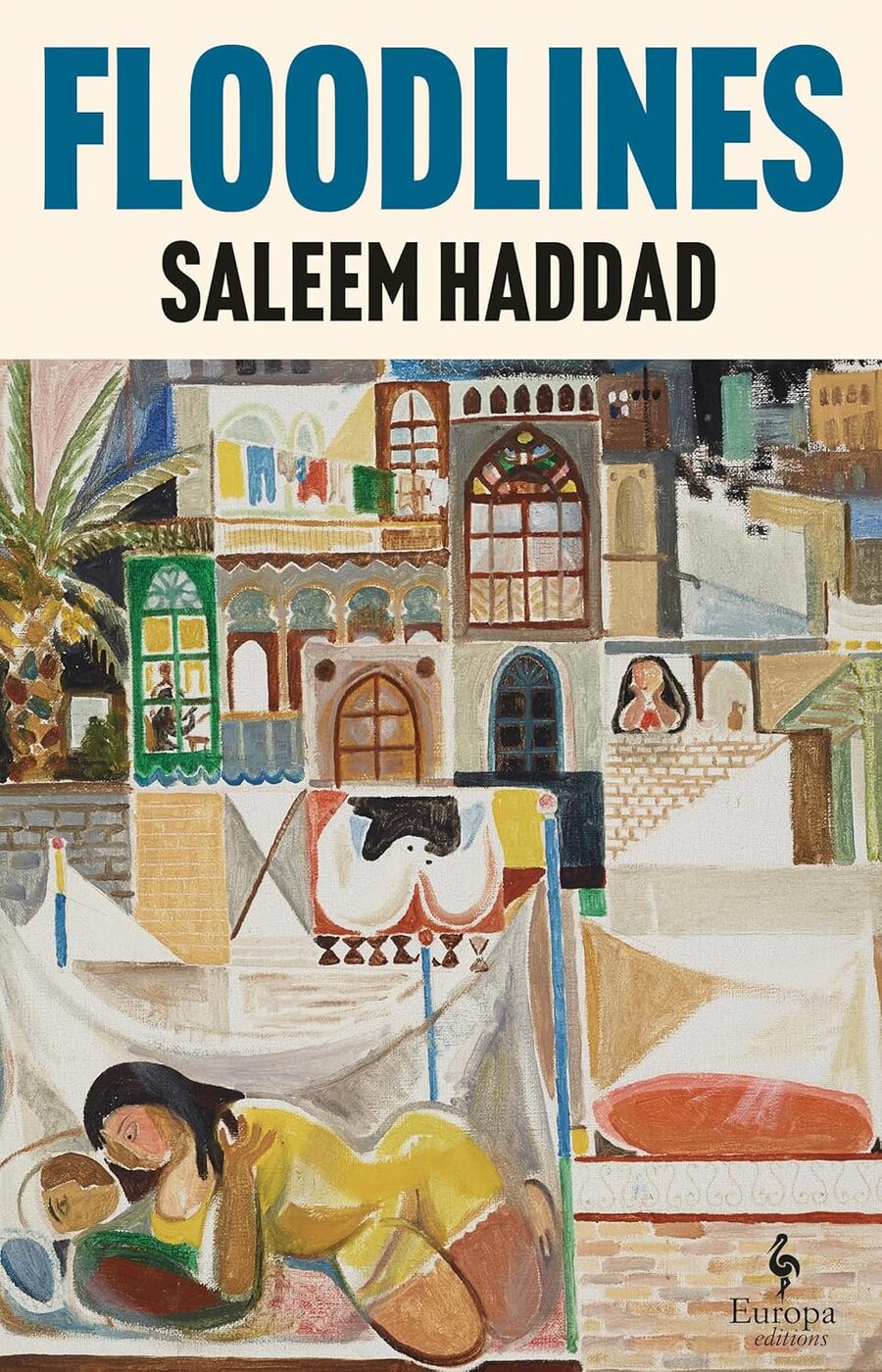
“Floodlines” by Saleem Haddad
Saleem Haddad was born in Kuwait in 1983, of an Iraqi-German mother and a Palestinian-Lebanese father, whose own mother, a Christian, was displaced to Beirut at the formation of Israel. He was raised between various countries, including Jordan, Canada, and the United Kingdom. Before he published his first novel he worked as an aid worker with Doctors Without Borders in conflict zones from Yemen to Syria and Iraq. He is also queer. Various biographical strands thus combine to make him more qualified than most to explore the maxim: the personal is political.
His much-praised debut novel, Guapa (2016), followed the life of a young queer man in an unnamed Arab country. As its title suggests, his new novel, Floodlines, concerns the psychological debris—the tide marks left in individuals’ lives—by politics, history, and personal trauma. Also, the ways in which we are changed by creative encounters: it asks about the meaning and definition of art; it explores the roles of art (whatever it is) in one’s life, one’s family’s heritage, and in preserving a whole cultural heritage threatened by war.The novel layers societal and personal memory and trauma over many years. Most of it is set in the summer and autumn of 2014, as the Islamic State tightens its grip on Iraq—but it begins much earlier. In the winter of 1925, artist Haj Akram, a former officer of the Ottoman Empire, has been captured and imprisoned by the Atatürk government. Atatürk spares him, for the sake of his art.In the 1950s Haj Akram’s son, Haydar Mathloum, becomes an influential member of a Baghdadi modern art group. His British wife, Bridget, tries to establish her own career as a painter before marriage and motherhood result in her having her identity subsumed into his; she becomes “the artist’s wife”.Even the barest plot summary surely suffices to show that Floodlines is a hugely ambitious novel which asks challenging questions on every page.
Haydar and Bridet have two daughters: Ishtar and Zainab. In 1958, Iraq is taken over by the military. Haydar is commissioned to design a public monument telling the country’s story from ancient times to the present. He now begins to show signs of madness, and is soon deeply unwell. He drowns himself in the Tigris, though the cause of death is hushed up. Bridget discovers she’s pregnant again, with a third daughter, Mediha.
In 1979, Saddam comes to power. Zainab, who is by now a young woman, becomes an informant for the new regime. She dates a Palestinian whom Saddam sends to fight in the Lebanese civil war; he dies immediately he arrives—leaving Zainab pregnant. She flees for Kuwait with her infant son, Nizar. Mother and son flee again when Saddam invades Kuwait. Eventually Zainab settles in Dubai, and Nizar in London.The Iran-Iraq War rolls through the 1980s. By now, Ishtar, who is queer, and Mediha are living in the UK. Both are artists. Meanwhile, Zainab makes Mesopotamian-inspired craft for Iraqi expats and exiles in Dubai; her work, trading in nostalgia, is dismissed by Ishtar as “handicrafts”, a word Zainab appropriates to herself.Bridget is still in Baghdad, where she’s selling Haydar’s paintings to make ends meet. In 1992, after she’s sold the last one, she too leaves Iraq and returns to Britain.In 2014, when relationships within the family are strained, Haydar’s paintings, lost for so many years, reappear. This reappearance initially worsens relations between Ishtar, Zainab and Mediha who have conflicting ideas about their father’s artistic legacy—what it is, and how to honour it—and differing understandings, too, of his personal legacy.While Zainab and Mediha are quarrelling, Ishtar proposes the ark project: an art happening to honour Iraqi heritage in which an ark composed of three types of traditional Iraqi boat (the guffa, kalak, and meshouf) is sailed down the Tigris from the north, to Shat al-Arab. Against all the odds, Ishtar manages to pull off this project: the final section of Floodlines follows Bridget, Ishtar, Zainab, Mediha and Nizar as they float down the Tigris, with Haydar’s paintings prominently displayed on their ark.For once, the riverine metaphor “the prose flows”, fits perfectly.
Even the barest plot summary surely suffices to show that Floodlines is a hugely ambitious novel which asks challenging questions on every page: Does Ishtar’s ark represent a literal preservation of culture, or is it a challenge to the (bourgeois?) tendency to keep grief private, or is it both? Do Zainab’s “handicrafts” represent a commodification of collective grief? Is Ishtar right to dismiss them, or is Zainab right to claim the belittling label “handicrafts” as a defiant riposte to all those who sneer at things (straight?) women like, and women produce? What more is going on when a woman artist sells her husband’s artworks, even if she’s forced to do so by circumstance, to make ends meet? And so on and so forth.
But if Floodlines challenges the reader to think, it’s also eminently readable. For once, the riverine metaphor “the prose flows”, fits perfectly. Often, the language is arresting. An abusive man’s breath is described as “rancid, like garbage”. The waters of the Tigris are described as “a murky jade, swirling with silt and flecks of light.”Beyond the skill of its prose, Floodlines is humane and moving. In 2014, Nizar is a war-reporter who has born witness to atrocities across the Arab world. He has recently parted from his former lover, Alfie. The complexities of their relationship, which had to accommodate the legacies of colonialism, and the inevitable challenges when one partner must return to normal life after reporting on war, as well as all the everyday irritations of living with another person, is sensitively drawn.In one extended section Bridget, old now, is being bossed around by Mediha. Here, Mediha is cooking chicken for dinner, and the smell of the meat causes her mother to relive a miscarriage.