Old post
This post was published before January 2026. Some links, images or other content may no longer display or work as originally intended.
“Forgiving Imelda Marcos” by Nathan Go
Despite a slow drip of new writers, Filipino fiction remains relatively thin on the ground, at least from publishers with wide distribution, and at least when compared to writers from such other countries in the region as Japan and Korea. With his debut novel Forgiving Imelda Marcos, Nathan Go joins a club which, while small, contains some illustrious members.
Told almost entirely in flashback, Go’s novel opens in Lito Macaraeg’s nursing home. Suffering from acute heart disease, he reaches out (or at least intends to) to his estranged son, now a journalist in the US. He is offering, whether out of affection or in hope of a reconciliation, a scoop: that former President of the Philippines Corazon Aquino had a secret meeting with her nemesis Imelda Marcos (she of the 3000 pairs of shoes).
Lito had been Aquino’s long-time driver; he was to drive her to Baguio where Marcos had her villa. It’s a long drive, and the car’s not in the best shape; they talk and reminisce. Lito’s not at all sure that Imelda Marcos deserves Aquino’s forgiveness. The somewhat Driving Miss Daisy nature of these scenes is belied by further flashbacks to Lito’s upbringing, his negligent father who joined a Communist rebel movement in the hills, taking Lito with him.
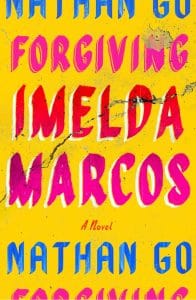
Go’s novel is contemplative and his prose straightforward, contrasting sharply with the vigor and bite of such compatriots as Miguel Syjuco and Gina Apostol. And while he deploys one well-known Filipino politician as a protagonist and another as a foil, Forgiving Imelda Marcos is less directly political; or rather, politics is not the main point, despite some quite lengthy monologues by Lito on politics and history (much the same thing):
I’ve said before that I think the land has an amazing capacity for memory. What I mean to say is that people come and go—we are born and then we die—but the land remains. The land has witnessed all the injuries we’ve suffered. Far more so than its people, it would be in the best position to answer the question of whatever happened to the Philippines. Because the Aquinos always blamed the Marcoses; the Marcoses blamed the Communists and the Muslims; the Communists and the Muslims blamed American imperialism; the Americans blamed the Japanese and fascism; the Japanese blamed Western colonialism; the colonialists blamed the uncivilized natives; and so on till the dawn of time.
Lito will also digress on society, religion, relationships and much else. The rebel leader Ka Noel adds his own:
“In ancient Rome we have patricians, knights, plebeians, slaves. In the Middle Ages, feudal lords, vassals, guildmasters, journeymen, apprentices, serfs. In almost all of these classes, again, we have subordinate gradations …”
The novel is, at least partly as a result, something of a slow-burn, even more so because Go uses plot and digression, rather cleverly, as deflection; to say more would be to give things away.
The invocation of Corazon Aquino is perhaps a qualified success; she no doubt provides some zing to the narrative, but it can be hard to write about a public figure who is so well-known.
I was called aside by her daughter Kris. From that day forward, she told me, I needed to report any “incident” or “unusual behavior” on Mrs. Aquino’s part, as Mrs. Aquino apparently had been skipping her pills at times. In short, I was made into a double agent, working for both mother and daughter.
Did something like this happen? Kris Aquino, of course, is very much still alive. Fiction in these cases comes close to fabrication; that will presumably bother some readers more than other but the TV series The Crown nevertheless comes to mind.
Hong Kong can take some credit for Go’s emergence as a writer. He was a David TK Wong Fellow at the University of East Anglia, a program funded by the eponymous Hong Kong businessman and writer.


You must be logged in to post a comment.