“Hyper” by Agri Ismaïl
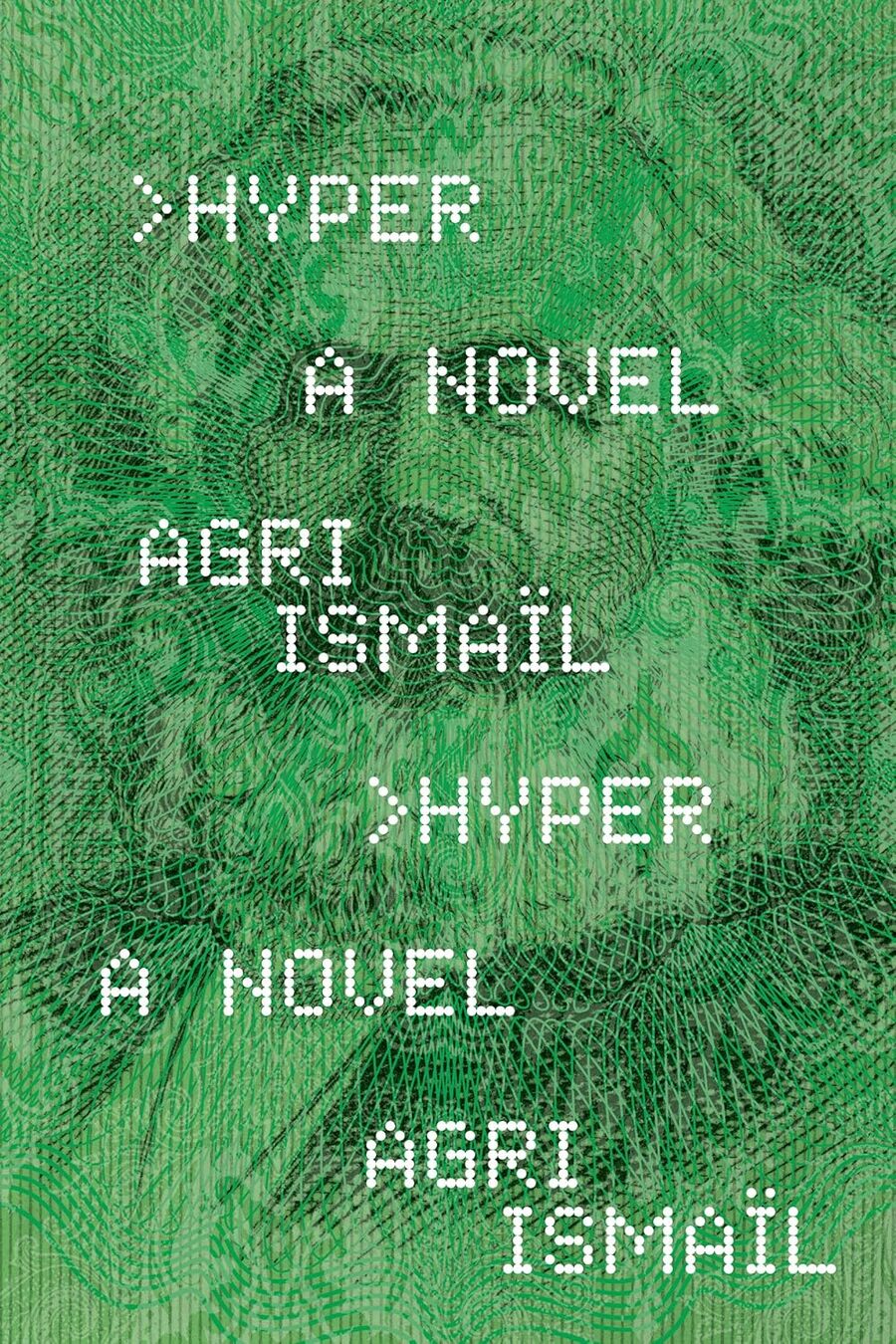
Agri Ismaïl’s Hyper is an unusual migrant family saga of an unlucky, Kurdish family’s epic displacement across countries; refugees who struggle and fail to achieve a sense of being at home anywhere they live. An inventive novel of ideas, it is a hard, pitiless satire on migrants’ love of Western values (whether Marxism or Capitalism), whose black humour consistently points to darker themes. In this ironic exploration of modern globalised capitalism and its effect on immigrant families, characters are often exaggerated and behave inconsistently, while the plot is often driven by the themes.
The father of the family is Rafiq Hardi Kermanj, the founder of the Kurdish Communist Party and a wealthy, Baghdad-trained medical doctor, from “one of the most influential Kurdish families in the whole of Iraq”. Rafiq was originally named Mohammed, but renamed himself Rafiq, Kurdish for “Comrade”. as his birth name was tied to “the Islamic conquering and subjugation of the Kurdish people”. Having fled with his family to Tehran from Iraq, he can be found:Sitting on the floor in a circle with a handful of moustachioed men, smoking cigarettes, drinking counterfeit whisky, and discussing the various exploits of Lenin and Marx. At night, at least one of the children would wake up from the sound of a drunk man reading aloud from Marx’s Capital as though it were juvenile love poetry.
His long-suffering wife, Xezal, who had married Rafiq partly because of his aristocratic background (while she is described as a “plain-spoken peasant girl”), regards his politics as eccentricity. But even she must draw the line somewhere:Rafiq. Our homes have been taken away, all of our belongings you have sold, you take the food from our mouths, from the children’s mouths, to give to the people… But what have they ever done for us, the people? … You want me to sell a king’s ring to feed our children, I will do it, I will do it right this minute… You want me to sell my only remaining belongings so that you can print more pamphlets.
Fleeing to Britain to avoid the Iranian Islamic revolution of 1979, they wind up refugees in suburban Sutton, where Rafiq insists on politically principled poverty and lives off “welfare for the rest of his life while complaining about colonialist powers.” It is not that he doesn’t love his children, but his politics is everything and additionally, he considers himself a failure.Every day invaded by thoughts of money, money for rent, for groceries, for bus fare. His mind had once felt vast, a space where the entire world could fit, where he could converse with the world’s foremost thinkers. Now it had narrowed into a constant worry about making it to the end of the month. There was nothing, nothing in his life that he still looked forward to, nothing he hoped for, nothing he felt able to strive towards.
Xezal, tries her best, working as a cleaner (secretly, to avoid shaming her family) to save the family from destitution but nonetheless all the children grow up with a deep fear of penury, matched by a lack of self-worth and considerable self-loathing.When they were younger, Rafiq would drag his three children to demonstrations seemingly every weekend… Then the kids would go back to school and hear their classmates talk about what movies their parents had taken them to see over the weekend, the new rollercoaster at Chessington World of Adventures.
The Hardi children must learn to lie to pretend that they have normal lives like their British classmates. As a family, they are isolated from the Kurdish community in Britain and face continual, frustrating incomprehension by the British public as to their Kurdish identity. Laika, the youngest son, jokes about a “secondary school teacher who kicked him out of class because she refused to believe that his home country was not on a map.”Every time there was a war in the region, newspapers ran articles explaining what Kurds were and why they were being killed. “They write of us like we are strange animals,” Rafiq kept saying. “Something you can only see in a zoo.”Consequently, while they share their father’s lack of faith, all reject his political views and find their Kurdish identity a psychological burden.The novel does not unfold chronologically, the narrative continually moving between past and present. The three children’s lives that we follow are all set in the first decade of the 2000s. Although written in the third person the narrative is told through the various characters’ distinct points of view with overlapping perspectives at different times and in different sections.
The daughter Siver lacks self-esteem and is deeply anxious. Due to her parent’s incapability, she has spent her childhood in charge of the family’s financial, legal and medical affairs. To escape, Siver marries a wealthy Baghdadi, Karim, partly for the security his money offers (mistaking that for love). When they first meet at London’s SOAS, Siver dissembles: