“In the Shade of the Green Willow” by Zhang Ruzhao
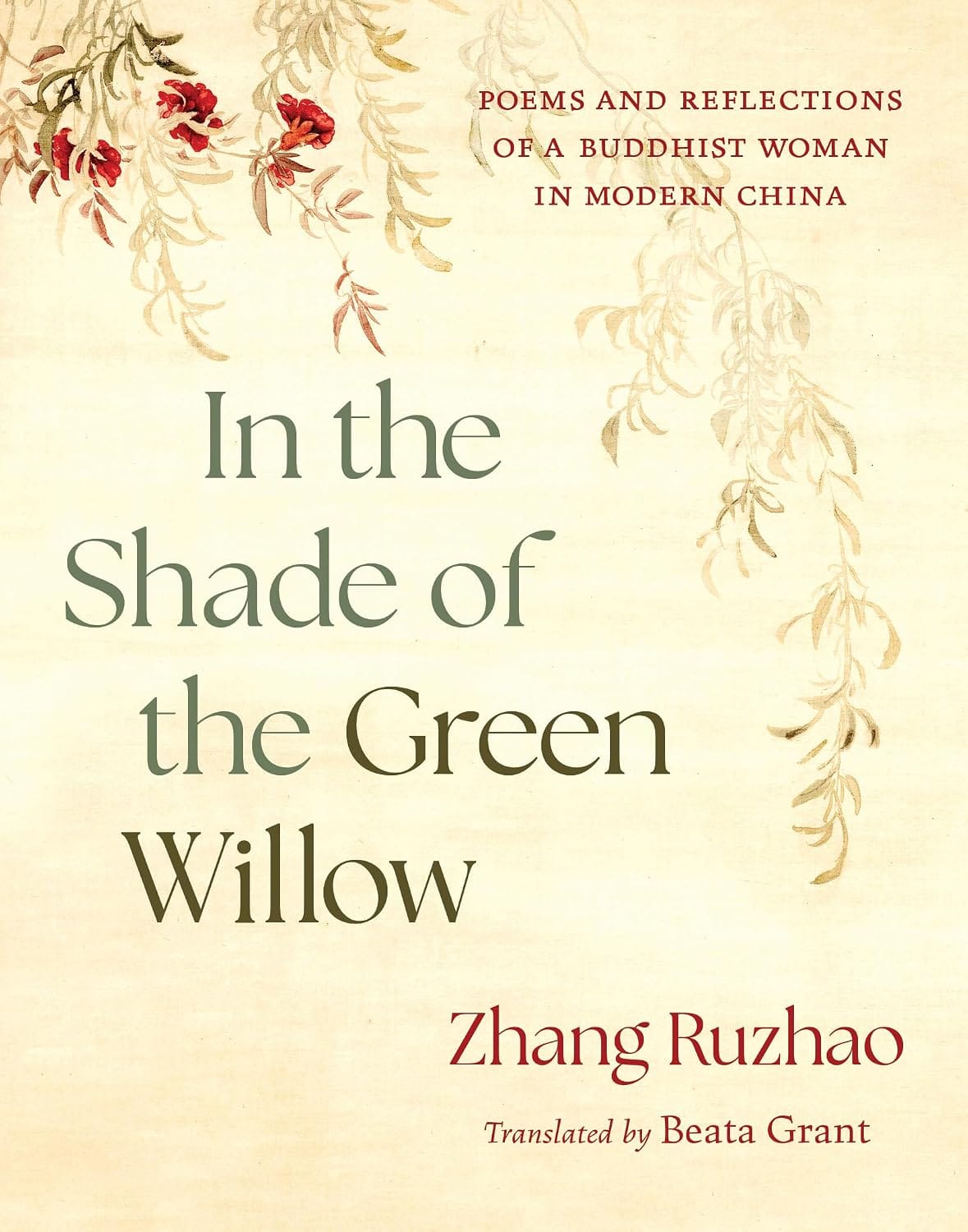
Chinese Buddhist poetry traditionally calls to mind ancient monks like Hanshan, traveling up mountains in terrible poverty. Zhang Ruzhao does not really fit into that mold. For one she was born in the turn of the 20th century, earning an English degree in 1925, then later worked at a local office for the National Party government. However, she soon became disillusioned with the corruption and retreated to a home near a lake. She is, in many respects, a modern woman who turns her back on the very same modernity. In the Shade of the Green Willow, translated by Beata Grant, records that juxtaposition through her pastoral poetry.
The first part of the book, “The Gaya Farm-Forest”, refers to the lakeside home. The long verse introduces the key motifs, as well as the poetic and political traditions that Zhang follows.
The Penglai mountain is barely visible,
Shrouded in mist and floating clouds.
Hidden fish are happy in clear waves,
Exotic birds choose the greenest trees.
Confucius left for the state of Qi,
Bodhidharma crossed on a reed.
Walking, walking, again walking,
Once you leave, do not look back.
“Walking, walking, again walking” refers to a line from “Nineteen Old Songs”, which was written anonymously at the end of the Han dynasty. It is a foreboding source, but also an indication of how Zhang views herself in the great traditions of Chinese poetry: a poet writing during great political turmoil, for which retreating is the only option.
These facts are many, but not beyond the reach of the reader. Embedded within the book are endnotes that make sense of these religious and historical references. The essence of her poetry, however, is unambiguous and does not require much elaboration.
The poem, “Experiments in a Life of Farming-Chan”, is a series of passages and verses that record both Zhang’s farming experience and her introduction to Chan-Buddhism. The book reveals Zhang’s own intellectual assessment of Confucianism, Buddhism, and the school of Chan Buddhism.
After studying and comparing these three different approaches, I concluded that the first two relied too much on conceptual understanding and hypothetical propositions, and only the last one emerges purely from a realm of self-realizing divine knowledge, with a transcendent universality that encompasses all phenomenon [sic]. For this reason, I decided to try to study the principles of Chan Buddhism.
Other passages are surprisingly technical and reveal a woman not so divorced from the present:
Right now, everyone is using new methods to test the soil quality and select seeds. However, I am unable to purchase chemical fertilizer and modern tools because I have limited financial means. In any case, my idea is to make use of handmade tools even if they are cumbersome, like Gandhi with his spinning wheel. It would also be more appropriate, since not buying things imported from abroad would be a patriotic act of passive resistance.
What Zhang is resisting, however, remains elusive. In early poems, the pressing issues relate to corruption and imperialism. However, in “Gathering Medicine Herbs”, even her poetry gets in the way of a truly peaceful life.
In the mist-covered peaks
happily gathering herbs;
A curtain of mist and rain
playing a game of go:
Who says there’s no more
left for me to do—
Requests arrive by telegram
to write more poems!
Not only writing, but reading too proves to be an obstruction to life.
Harboring doubts about things
can bring on troubles;
Reading books is pleasurable
but can also be a curse.
What once seemed to be a cure
now feels like a sickness:
In the lonely and empty forest,
I pay homage to the Buddha.
The passivity of paying homage, framed by the empty forest, is an eerie pivot from the previous lines. Her devotion to Buddhism transcends the duality that plagues her, a clear departure from her previous devotion to poetry.
Years after publishing her poems, Zhang took up residence at the Miaoyin Hermitage, where she would receive students, and in 1950 was ordained as a nun. However, her convent was later converted to a military factory, and the Gaya Farm Forest sold. Little was recorded of Zhang’s life after that. Only in 1985 was the Miaoyin Hermitage restored, and fifty years after her death, participants visited the Miaoyin Hermitage and “not only made offerings of incense at the altar but also sat down to write their own poems and couplets in her memory, a testimony to the enduring inspiration of her writings.” This latest translation of her poetry by Beats Grant also serves as an offering of a different kind, an homage by a different language.