“Rival Civilizations: The Rise of Japan and Visions of World Order in Britain” by Chika Tonooka
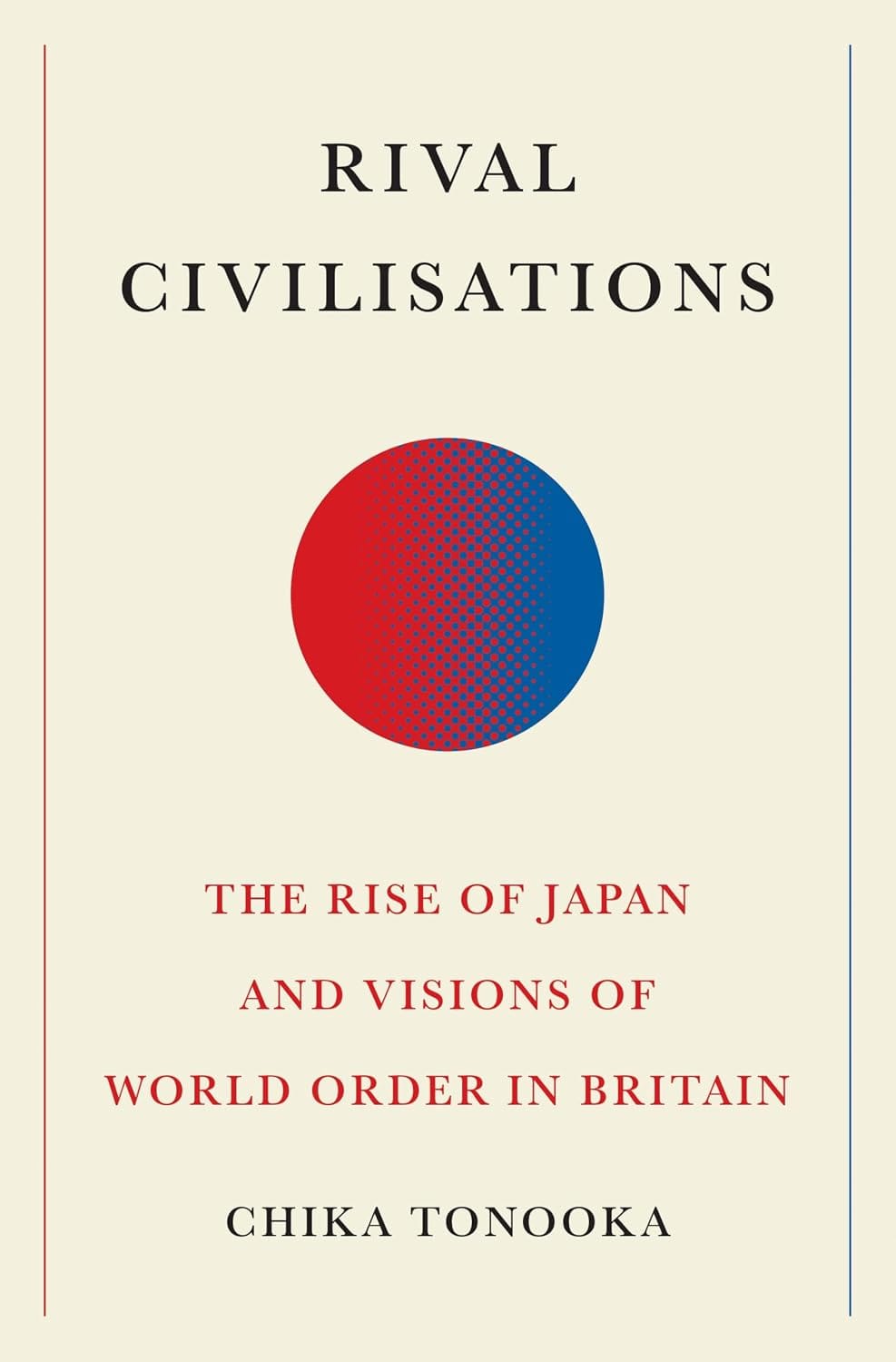
The rise of Japan as a world power in the early 20th century produced in Great Britain a rethinking of geopolitics and world order. It marked a shift from Eurocentrism to a more global approach to thinking about world politics. Japan’s stunning victory over Russia in the Russo-Japanese War of 1904-05, Cambridge professor Chika Tonooka writes in Rival Civilizations, heralded the “awakening of Asia” and the “emergence of modern Japan [as] the first non-Western nation to rise to modernity and imperial power.”
Tonooka describes her project in the book as “rehistoricising Europe” by presenting and assessing the British intellectual response to the geopolitical growth of a rival civilization. She reviews the works of members of the Coeffecients—a group of British intellectuals and imperialists in Edwardian Britain that included Sidney and Beatrice Webb, HG Wells, Halford Mackinder, Richard Haldane, Bertrand Russell, and Edward Grey. Mackinder, as Tonooka notes, foresaw the challenge to Britain’s global preeminence in his 1904 paper “The Geographical Pivot of History”. In that paper, Mackinder speculated that Japan could politically unify China, conquer the “heartland” of Eurasia, and threaten Britain’s imperial project.
Tonooka’s book, however, is more concerned with the impact of Japan’s rise on British civilizational thought than its geopolitical position in the world. Japan for many British intellectuals represented a rival civilization that was emerging to challenge Western civilization. Some British writers attributed Japan’s emergence as a world power to its adoption of Western science and technology—in other words, Japan was becoming Westernized. But others recognized that Japan, although indebted to Western industrialization, maintained its own culture that differed culturally from Britain and the West. As Tonooka explains that a:
military-technological convergence with the West, and not least with Britain, was critical to Japan’s ascendancy, even as Japan simultaneously developed a form of sociopolitical organization conspicuously distinct from Britain’s liberal, individualist model.
This development impressed such British intellectuals as Arnold J Toynbee and Goldsworthy Lowes Dickinson, both civilizational thinkers. Tonooka writes that Dickinson was highly critical of Western civilization and suggested that Britain emulate certain aspects of Japanese culture, while Toynbee’s assessment of Japan’s rise coupled with the experience of the First World War caused him to warn against a “clash of civilizations” (anticipating Samuel Huntington’s thesis of post-Cold War geopolitics) that could doom mankind.
For these and other British intellectuals, Japan’s rise meant that Eurocentric history and geopolitics had to be replaced by global history and geopolitics. Tonooka highlights the writings of GP Gooch and HG Wells, both of whom considered nationalism as outmoded and too parochial. Even as they recognized national aspirations in Japan, China, and India, Gooch and Wells had visions of a world community where all nations would converge towards a uniform civilization characterized by Western political modernity. These intellectuals foreshadowed the post-Cold War “end of history” thesis of Francis Fukuyama. Such writers, Tonooka explains, were attempting to “universalize” Europe, just as Fukuyama later attempted to universalize democracy.
The Second World War, especially Japan’s aggressions and atrocities in that war, but also the post-colonial nationalist uprisings in Asia and Africa during and after the war, refuted some of the musings of Gooch, Wells, and others. There would be no civilizational unity and no uniform vision of global order.