“Tree” by Aya Kōda
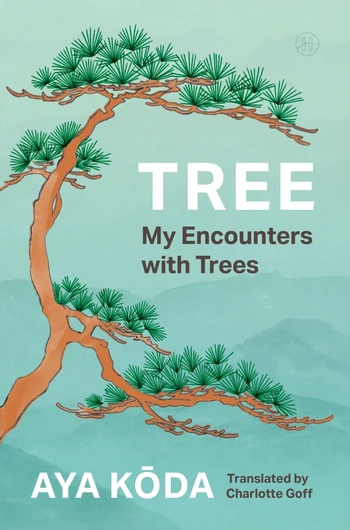
Until she was forty-three years old, Aya Kōda (1904-1990) was known primarily for being the daughter of the novelist Rohan Kōda, who was influential in the development of early modern literature in Japan. Yet after Rohan’s death, a publisher asked Aya to write a memoir about her family, and she soon proved a force in her own right, publishing extensively from 1947 on and becoming known for her essays and novels exploring themes of female life, family, and culture, frequently blurring the line between fiction and memory. Her collection of essays Tree (published with the subtitle My Encounters with Trees in North America) is particularly beloved in Japan, and an English translation by Charlotte Goff now allows readers to experience this tranquil book in lucid, conversational prose.
The North American subtitle to Tree suggests the personal approach the author takes. There is little scientific or botanical information to be gleaned here; the work is concerned precisely with one woman’s meetings with trees and the reflections these meetings evoke. Each essay finds the author in a new place, with a new plant, reflecting on everything from what the tree itself has experienced, to her own childhood, to the passage of time.
Kōda’s emphasis on the trees’ perspective is particularly unique, and she is moved by the beauty and plight of their lives. In “Poplars”, for instance, Kōda describes a cypress with a “rectangular window cut into its trunk”, presumably to make the tree useful for pulling construction supplies up a hill. Her response is grief for the tree itself: “Such a cruel fate, I thought, watching as drops of resin spilled like endless tears from the gouged-out skin of the tree”. She sees other trees as living in families, as gaining and losing weight, as wearing their bark like kimonos. Plants are alive for Kōda in a way uniquely their own; they speak, and she endeavors to hear them.
The broader human relation to trees is not absent, moreover, and the author’s interpretations of a tree often tell us more about herself: a plant lover with an inferiority complex, an eccentric struggling against her age, a divorcée, a parent. Plants curl around her life, gathering memories as they go and prompting reflections on her own experiences.
The book is also full of people who work with trees, from timber specialists, to tour guides, to botanists, each with a unique perspective. The botanists are frequently attached to the trees, sometimes even viewing them as their own children. Others are more utilitarian, such as the carpenters and timber specialists who consider only whether a tree will produce good lumber. While Kōda considers the beauty and resilience of a certain camphor tree in “Pine, Camphor, Sugi”, she describes a specialist who tells her the tree had probably been left alone because it was useless for timber. Similarly, a carpenter tells her camphor trees are a nuisance because their leaves have a tendency to erode rooftops. On the other hand, Kōda describes how other carpenters enlightened her on the living nature of wood used in construction, how it expands and contracts, how it smells, and so on. All these perspectives are integrated and transcended, for Kōda frequently comes back around to the trees themselves, not as resources, but as living, communicating beings.
Nor are trees the only plants considered, though they form the bulk of the book. “Wisteria”, for instance, details how the author’s parents, particularly her father, tried to instill a love of plants. He gave his children plants of their own, and took a young Kōda to view a massive wisteria, the sight of which left her “fully satiated”. As a parent herself, Kōda tried to instill this same love of plants in her own daughter, a task in which her father encouraged her. Her dismay at her initial failure indicates the importance she believes plants have for a full life. As her father puts it,
There’s no saying how far the buds of this passion of hers might have extended: from wisteria to ivy, perhaps, from ivy to maples, and then on to pines and cedars. What could be more valuable than that?
If Kōda struggled to interest her own daughter in plants, she does not struggle to interest readers. Her own enthusiasm for trees (perhaps even obsession) is apparent on every page, and she offers not specialized information but a way of approach, a means of considering the lives of plants in their own right. The book is profoundly personal and tranquil (even if placid at times), but over and over again, it imparts an empathy and attentiveness to the natural world that all readers surely need. Her work can spark a passion, from books on trees to trees, from trees to plants in general, and from there to nature as a whole, to a more empathic and attentive way of being in the world.
