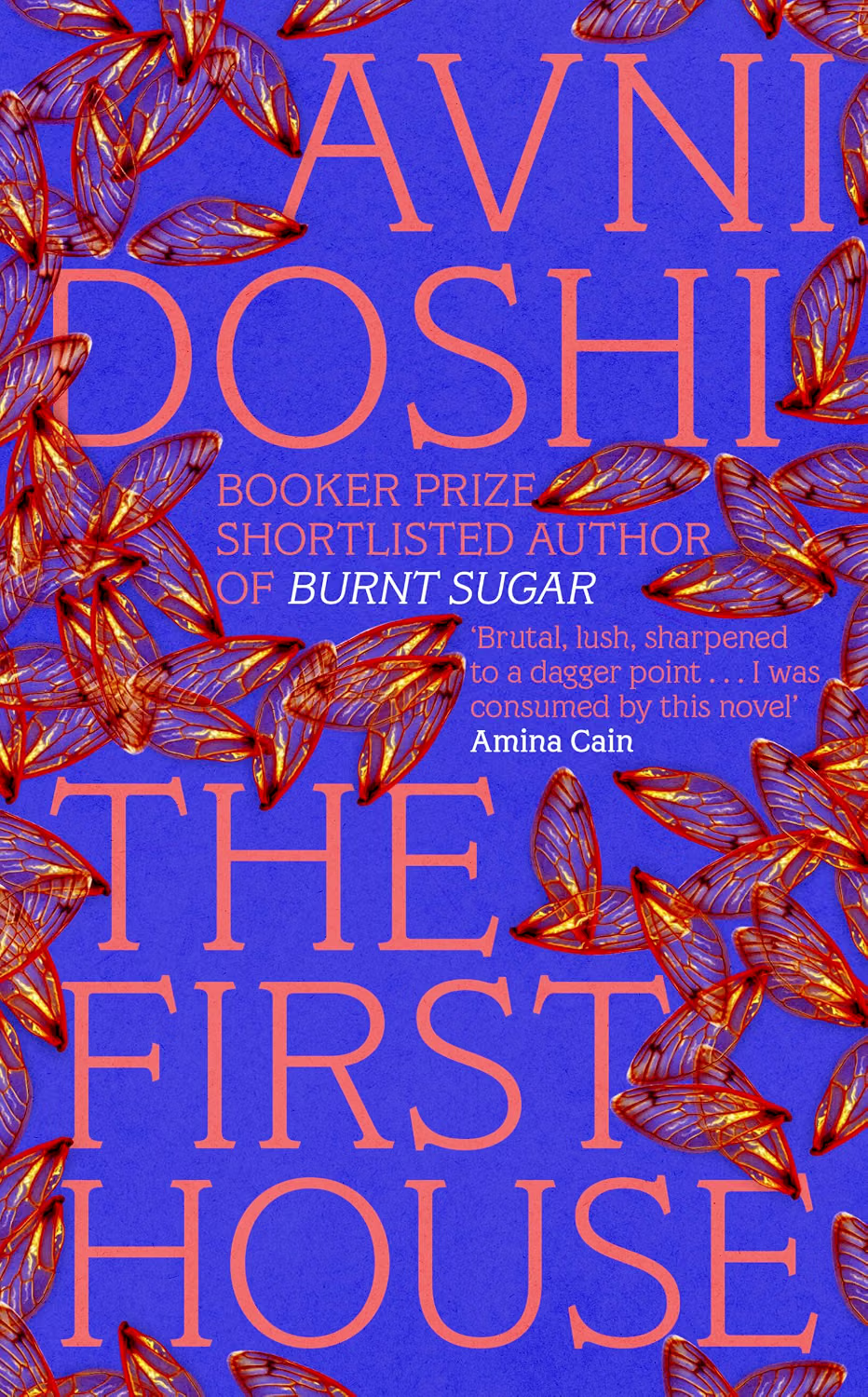
“The First House” by Avni Doshi
The First House opens with a dramatic pitch: a woman’s husband walks into their bedroom and tells her, with no warning, that the marriage is over. She’s stunned; she thought her marriage perfect.
In her latest novel, Doshi gives readers a raw, jolting look into how the unnamed narrator comes apart in the months after her husband’s declaration of divorce. She approaches life after separation with a mix of denial and delusion. At first, she barely tends to her two daughters, who her husband also takes little responsibility for. She can’t bring herself to seek help from family or friends, even as a persistent paranoia over why he left—including theories of an affair he neither confirms nor denies—eats at her. Even when her friend checks on her and offers her two cents on the matter, the narrator can’t bring herself to listen to her husband’s critique.
She replays scenes from her marriage as she processes her husband’s abrupt departure and finds, in hindsight, that what she’d dismissed as the banalities of domestic life were in fact quiet signs of a decaying relationship.
I never thought of myself, I never thought about how I felt – I put him first at every moment. Relationships could only support one whole person at a time. For the other partner, marriage was a Procrustean bed.
The protagonist admits to feeling “the diminishing of desire and purpose”—she suspects her husband felt too. Underneath, a quieter wound emerges: her own dreams of writing halted when she had children, leaving her financially dependent on a husband she can neither forgive nor fully understand.
The collapse of a marriage and a woman left to fend for the family is, on some level, a familiar story. But what keeps The First House from being more of the same is something Doshi has done previously, in a different key. Six years after Burnt Sugar, her Booker Prize-shortlisted debut about a fraught mother-daughter bond, she brings the same instinct for turning ordinary domestic space into something dangerous.
Doshi’s edge lies in explaining the conflict of intimate relationships through her evocative prose. Routine settings, such as a kitchen or bathroom, feel like canvases for nightmares.
Elements of her natural surroundings become metaphors for her search for meaning: a foster cat becomes the contested male figure of the household in her husband’s absence, while the cicadas’ reemergence from the ground seemingly signifies her own rebirth.
To explain the sudden turn of events in her life, the narrator turns to astrology and Hindu mythology for answers, mapping her marriage onto the misalignment of hers and her husband’s birth charts. The novel’s title itself is a nod to the “first house” of a birth chart, the foundation said to govern one’s identity.
The mythology doesn’t always land with the same force as the domestic detail. Astrology and old myths can on occasion distract from the narrator’s patiently detailed thoughts. Yet it’s a minor trade-off, and for the most part, the allegories add layers to the narrator’s coping mechanisms.
Even a dysfunctional marriage offered an unshakable sense of normalcy, but some of the narrator’s insecurities and warped perceptions of relationships had stemmed from her own parents’ marriage of compromise. The narrator’s fraught relationship with her sister, Didi, who proves to be a doting aunt to her two daughters, adds to the friction in the plot. Didi lives a starkly different life from the narrator: she’s devoted to her parents, buys expensive things, gets work done to her face, and is unmarried.
Didi’s path reads like the road not taken by the narrator: where the narrator disappeared into domesticity, her sister opted out of marriage altogether, channelling the same family instability into self-sufficiency rather than self-erasure. The two rarely agree, but Didi’s presence gives the novel one of its few glimpses of a woman who has made some kind of peace with her choices while the narrator is only now starting to question them.
As Didi helps the narrator pull herself together in quiet and bold ways, it becomes clear that while the sisters are different, they are products of the same unstable upbringing.
What a joke it was, the story we told ourselves that marriage meant safety. Marriage required a terrible fear of consequences to stay together. And if either person in a couple stopped being afraid, it would certainly break apart.
By the end of the 224-page novel, it’s hard to tell what the narrator truly wants—to salvage her marriage, one-up her husband in her grievances, or to run away from it all. That state of confusion is perhaps the point Doshi is making: as the protagonist’s life was destabilised overnight, Doshi doesn’t rush her towards clarity.
However, the payoff in The First House comes from the unnamed narrator slowly getting her bearings. She’s figuring life out as a single parent to her two daughters and feeling more liberated than burdened by the demise of her marriage.