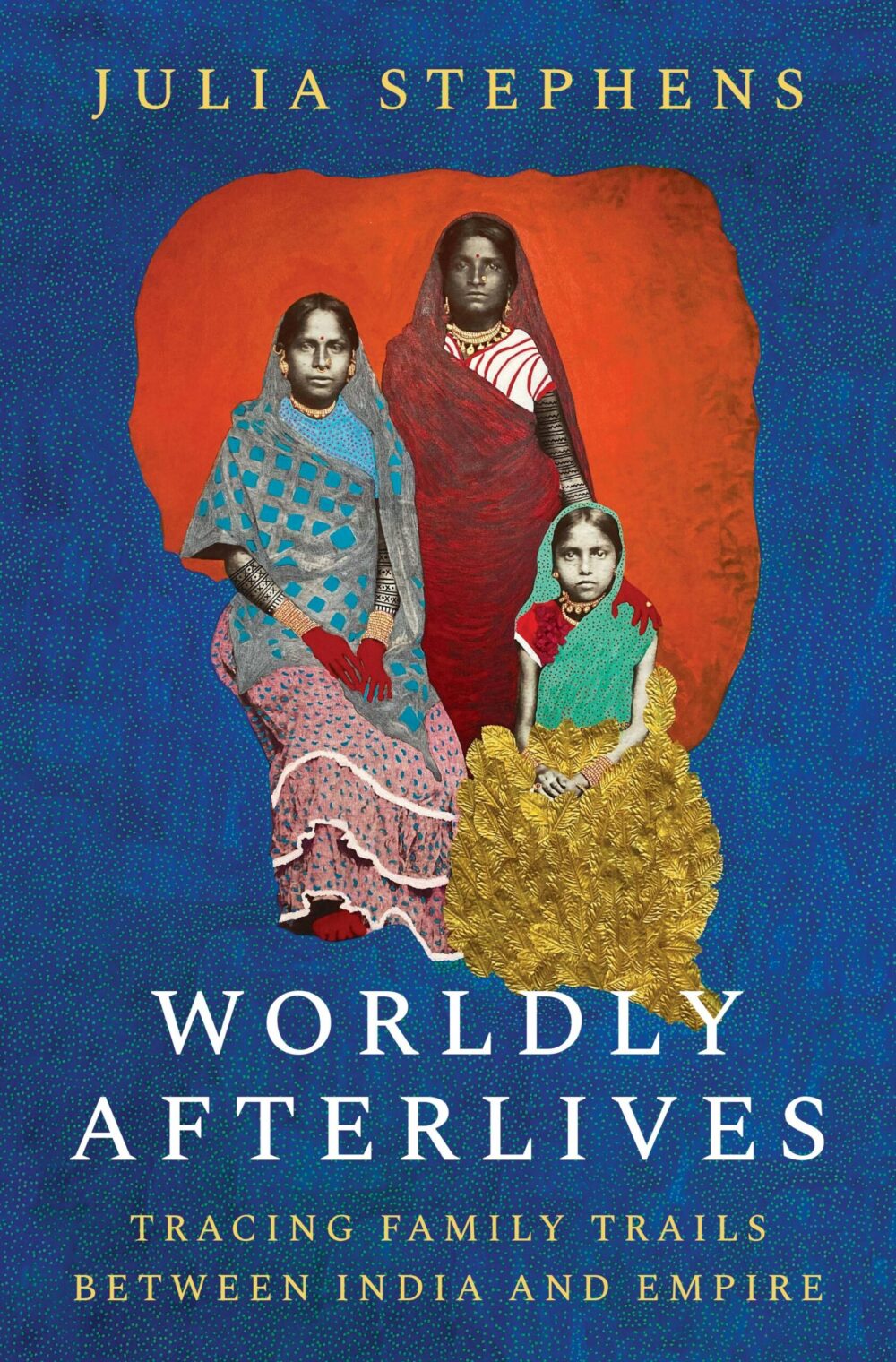
“Worldly Afterlives: Tracing Family Trails Between India and Empire” by Julia Stephens
The lives of those impacted by the British Empire were complex, deeply intertwined, and, as Julia Stephens describes, transcend boundaries. The lives of the generations that follow the initial immigrants are varied and pluralistic, so they can no longer fit the identities their forefathers held.
Worldly Afterlives traces the journeys that some groups of the Indian diaspora undertook under British rule. Rather than writing a conventional account of imperial-era mobility, she draws on existing and new material to trace the “afterlives” of the descendants of such families: how they have retold stories about their roots, how they have themselves documented them through the years, and what this says about being part of a global diaspora. “The economic extractions of British colonialism pushed Indians out of India while propelling them towards other parts of the empire.”
Stephens challenges the narrowness of traditional genealogical approaches.
19th-century Indian migrants dispersed across regions that today include Malaysia, Sri Lanka, Mauritius, South Africa, and East Africa. Their motivations were varied—economic opportunity, social mobility, trade networks, or marriage—but the consequences were often profound, altering the trajectories of families for generations.
Stephens pieces together fragments of their history from a wide range of sources: archival material scattered across Asia, Africa, and the Americas, government records, museum catalogues, and even digital genealogy platforms. A central ambition of Stephens’ work is to give voice to migrants whose experiences have often been flattened into statistics or labour categories within colonial history.
In investigating the “afterlives” of migrants, she takes an approach that is both scholarly and personal. She describes encountering historical photographs and portraits as a “haunting” experience: one that reminds her that history should be “seen, touched, and felt,” not merely read as text. Even when the individuals themselves are long gone, their photographs and belongings sustain their presence in the historical record.
This interest in ancestry and roots research is hardly new. But Stephens challenges the narrowness of traditional genealogical approaches, which often cast neat narratives onto lives that were anything but orderly. In recent years, the tools available for investigating the past have expanded dramatically. Digital archives, social media, and genealogy websites now allow descendants and researchers to push the envelope on what can be uncovered about family histories. For instance, platforms like Instagram and Substack account Brown History have created spaces where South Asian migrants’ stories can circulate widely, often reaching audiences that academic scholarship struggles to engage. These platforms demonstrate how public curiosity about the past can coexist with, and sometimes challenge, existing historical research by expanding our knowledge of the diaspora community.
Women appear only fleetingly in colonial archives and in diaspora history.
The book is organized around five case studies, each centred on one person or family during the 19th-century British Empire, whose life extended beyond the Indian Ocean—from Malaya to the United States. One is Thamboosamy Pillai, a prominent businessman who settled in Kuala Lumpur in the late 19th century. Skilled at navigating colonial bureaucracy, he built connections with both British administrators and the Chinese diaspora community, relationships that proved crucial to his commercial success. Despite his cosmopolitan social world, Thamboosamy also played a major role within the Tamil Hindu community in Malaya, founding two significant religious sites that remain important today.
Since he was a public figure, much of Thamboosamy’s life is well documented. Yet Stephens’ research extends beyond official records. She meets his great-granddaughter, Santa Kumarie, who possesses a wealth of family documents and stories that add nuance to the public narrative. Documents in Kumarie’s records point to the possibility that Thamboosamy’s wife may have been Malay and Muslim, suggesting an interreligious marriage that would have been unusual for a prominent Tamil Hindu leader of the time. Over generations, parts of the family also converted to Christianity, a development that remains contentious given the family’s continued association with the Batu Caves.
Women, Stephens argues, often appear only fleetingly in colonial archives and in diaspora history, reduced to “nodes within networks governed by men.” Recovering their lives requires historians to read between the lines of legal records, family narratives, and scattered artefacts. But when they do so, it opens up alternative theories about the past. She attempts precisely this in her account of Janbai, the wife of a merchant involved in an extensive international trading network. Using court records and genealogical material, she traces Janbai’s role in a complex inheritance dispute after her husband’s death. Years of research eventually led Stephens to locate Janbai’s photograph and a thick bracelet recorded in a museum catalogue—objects that anchor the historical figure within a tangible material world.
Further discoveries, including an unpublished ancestral biography, reveal Janbai’s marriage to the influential merchant Sir Tharia Topan and her position as matriarch of a family based in Zanzibar and Bombay. Rather than remaining a passive figure, Janbai emerges as someone who exercised legal agency (a pattern that appears again in the records of her descendants), negotiated property disputes, and forged friendships with other women.
Worldly Afterlives is as much about the process of historical discovery as it is about the histories themselves.
Across these case studies, Stephens encounters descendants who often see themselves less as inheritors of a single national lineage than as citizens of a global diaspora. Their responses to her research vary. Some share documents and memories enthusiastically, while others are wary of revisiting painful or controversial aspects of their roots. These encounters raise ethical dilemmas about how historians should handle private narratives, particularly when they intersect with traumatic pasts.
The history of indentured labour highlights these tensions most clearly. Women formed a crucial part of the workforce that travelled to British colonies such as South Africa, yet reconstructing their experiences remains difficult. The legacy of apartheid further complicates one such story that Stephens highlights: “Indians were simultaneously colonized subjects and migrant settlers.”
Stephens repeatedly reflects on the ethical challenges of writing such histories. Families may wish to keep aspects of their past private or distance themselves from the experiences endured by earlier generations. Rather than claiming definitive authority, she suggests a case-by-case approach that balances historical transparency with respect for living communities.
Another case study centres on Jan Mohamed, a migrant seaman whose life spanned the United States and Britain. Through a series of portraits taken across his lifetime, Stephens highlights how he might have altered his name, appearance, and identity depending on where he lived, including possibly appearing as “John Mohammed Ali” in American records. Court documents provide glimpses of his professional and personal life, though many details remain uncertain.
Stephens openly acknowledges the limitations of this method, noting a lack of in-depth interviews with people close to the subject. It is impossible to confirm that every archival document refers to the same individual; the historical figure may remain a “mobile shapeshifter” moving between identities. Yet this uncertainty is precisely what makes such microhistories valuable: they illuminate broader patterns of migration and adaptation through the fragments of individual lives.
Genealogy websites and digital databases prove crucial to this process, helping Stephens trace family trees and locate descendants whose stories might otherwise have vanished. These tools add new dimensions to historical research, though they also reveal the uneven accessibility of knowledge—particularly when technologies like DNA testing fail to capture the diversity of global populations.
Worldly Afterlives is as much about the process of historical discovery as it is about the histories themselves. Stephens reflects on how the project reshaped her understanding of diasporas and archival research, and how it will influence the way she teaches her students.
By pulling readers into the uncertainties and revelations of her investigation, Stephens offers a compelling portrait of lives that unfolded across the vast geography of the British Empire. The result is a richly textured account of migration, memory, and identity, reminding us of how the movements of the past continue to reverberate in the present.