“On Thin Ice” by Charlie Walker
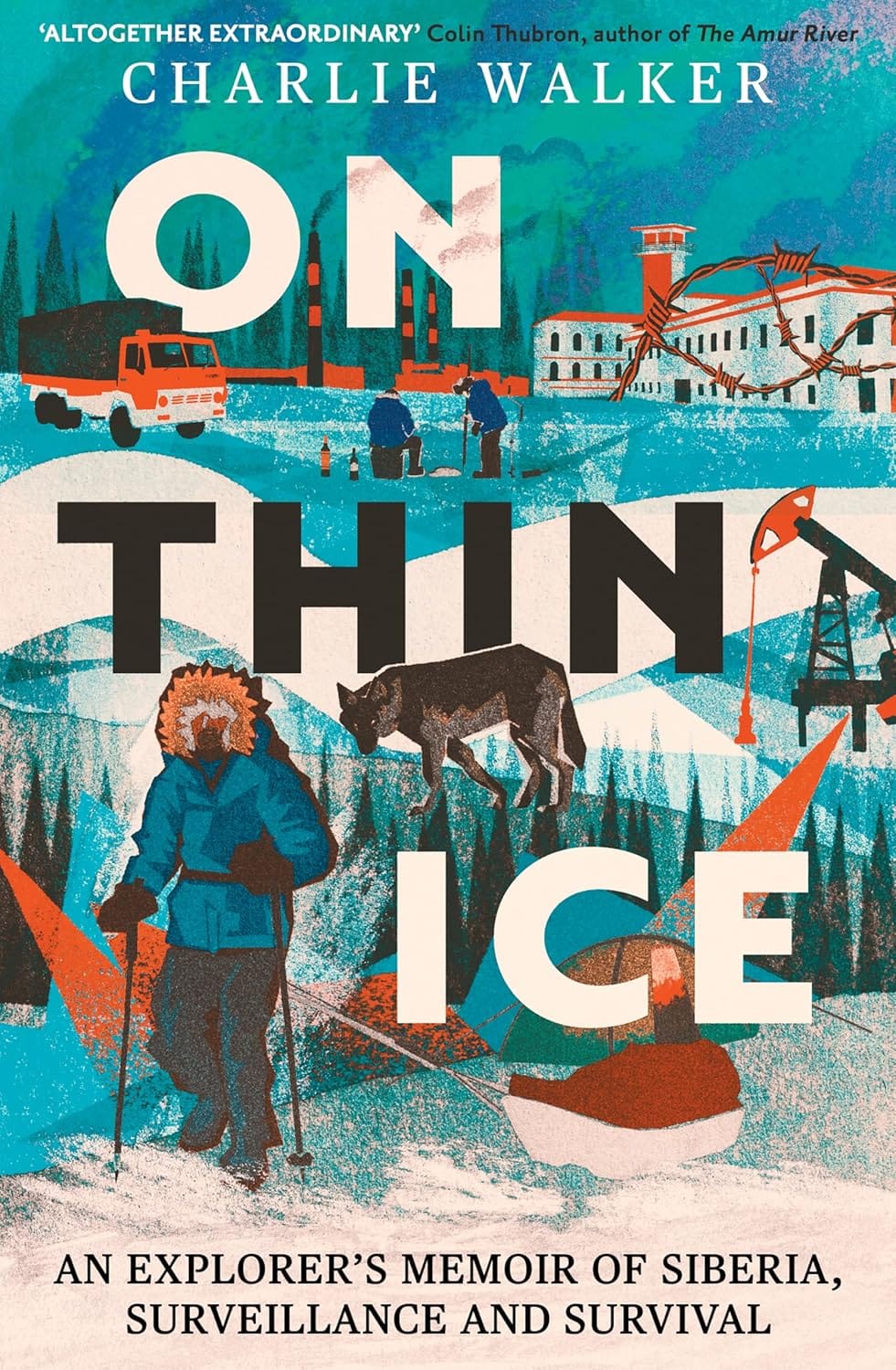
Walking through Siberia in the dead of winter may not, on the face of it, sound like a very good idea, yet that is what Charlie Walker intended to do in February 2022.
Yakutsk is built on the banks of the Lena River and I would ski-trek northwards along the water’s frozen surface for 1,000 miles to the Laptev Sea, a large peripheral bay of the Arctic Ocean. From the port town of Tiksi I would fly back to Yakutsk and then home.
It was not without purpose:
I could expect to meet Sakha horse breeders and Eveni reindeer herders, as well as the odd Slav cast out to the Arctic wastes by the caprices of Soviet industrial ambition… I anticipated finding a tension between the fluidity of ancient nomadic tradition and the rigidity of communist collectivism.
But February 2022 wasn’t the best timing. Days after Walker’s arrival in Siberia, Russia invaded Ukraine. It’s not as if there hadn’t been warnings:
for weeks Russian forces had been building up on the Ukrainian border… British and American intelligence services suggested that an invasion was imminent, but the prevailing wisdom… was that the entire exercise was a bluff…
I recall concurring with the prevailing wisdom; nevertheless, despite having been to Russia many times in previous decades, I would not have chosen that time to go. Walker—still in Yakutsk—could at that point have turned around and gone home; he didn’t.
I felt a desperate urge to get moving; to get the hell away from the city, from the news, and from the needless, reckless horror of it all… I decided to leave in the morning and start the trek.
Walker does in fact make it to Tiksi and—once there—is, unsurprisingly perhaps, arrested: the authorities don’t quite seem to believe he’s a tourist. He spends several agonizing weeks in a Yakutsk jail before being deported.
The trip, which takes up the first two-thirds of the book, is—given what might have happened—relatively uneventful. The first couple of days are rather hard going (it’s the wrong kind of snow); he changes plans and flies half-way to Batagay. Although he spends many of the nights dodging frostbite in a tent, there are others in cabins, at someone’s flat or in one of the various dom kulturi (cultural centres) that all but the smallest villages seem to have. No wolves, bears or bandits show up to menace him. Some people along the way are friendly; others less so; the police officious and hostile. The cold—natural and human—is leavened by the northern lights.
Once in Tiksi, he starts reading The Trial by Franz Kafka, which proves portentous as the authorities come knocking; the remaining legal and prison saga is, well, Kafkaesque. He’s convicted of “committing journalism” while on a tourist visa and photographing sensitive military sites. His trial is perfunctory, the appeal even briefer, but the sentence is immediate deportation and a five-year ban on returning. That didn’t sound that bad, except the flight out never seems to be scheduled and he (and just about everyone else) is kept in the dark about what is going until (literally) the last minute. He was in a Yakutsk jail for four weeks; no doubt it seemed much longer, and perhaps could have been. It was undoubtedly terrifying.
Walker excels at characterisation and the contradictions of human condition… The pages turn quickly
The title Walker gave his narrative—On Thin Ice—is perhaps belated recognition that discretion can sometimes be the better part of valour. Whatever misgivings the reader may come away with, the book itself is a solid example of travel-writing. It is both personal and collective. Walker excels at characterisation and the contradictions of human condition, and allows even the villains of the piece a slice of humanity. There is more than enough history, ethnography, political science and linguistics to follow along without needing to resort to Google. The pages turn quickly.
There is more travel literature about Siberia and the Russian Far East than one might expect. On Thin Ice, with its emphasis on the wilderness for its own sake, is perhaps closest in spirit to Sylvain Tesson’s Consolations of the Forest, which he quotes; Tesson however pretty much stayed put.
But it’s hard for Walker to avoid the “Special Military Operation”; it’s on his mind, his phone, the television and people (not just the authorities) keep bringing it up. The politics is as deep as the snow and as slippery as the ice. He ends up somewhat disillusioned: “I strive to remember my time in Yakutia with fondness,” he writes, once back home.
But On Thin Ice also contains passages such as this one:
The road north cut a straight corridor through the forest with compacted snow covering the surface of frozen earth. The land was locked in a purifying cold that seemed to freeze time itself. Frost hung in the air, crystallising on the slightest surface. Sound itself seemed brittle.
It is not hard to understand why Walker went, just when.
