“Railsong” by Rahul Bhattacharya
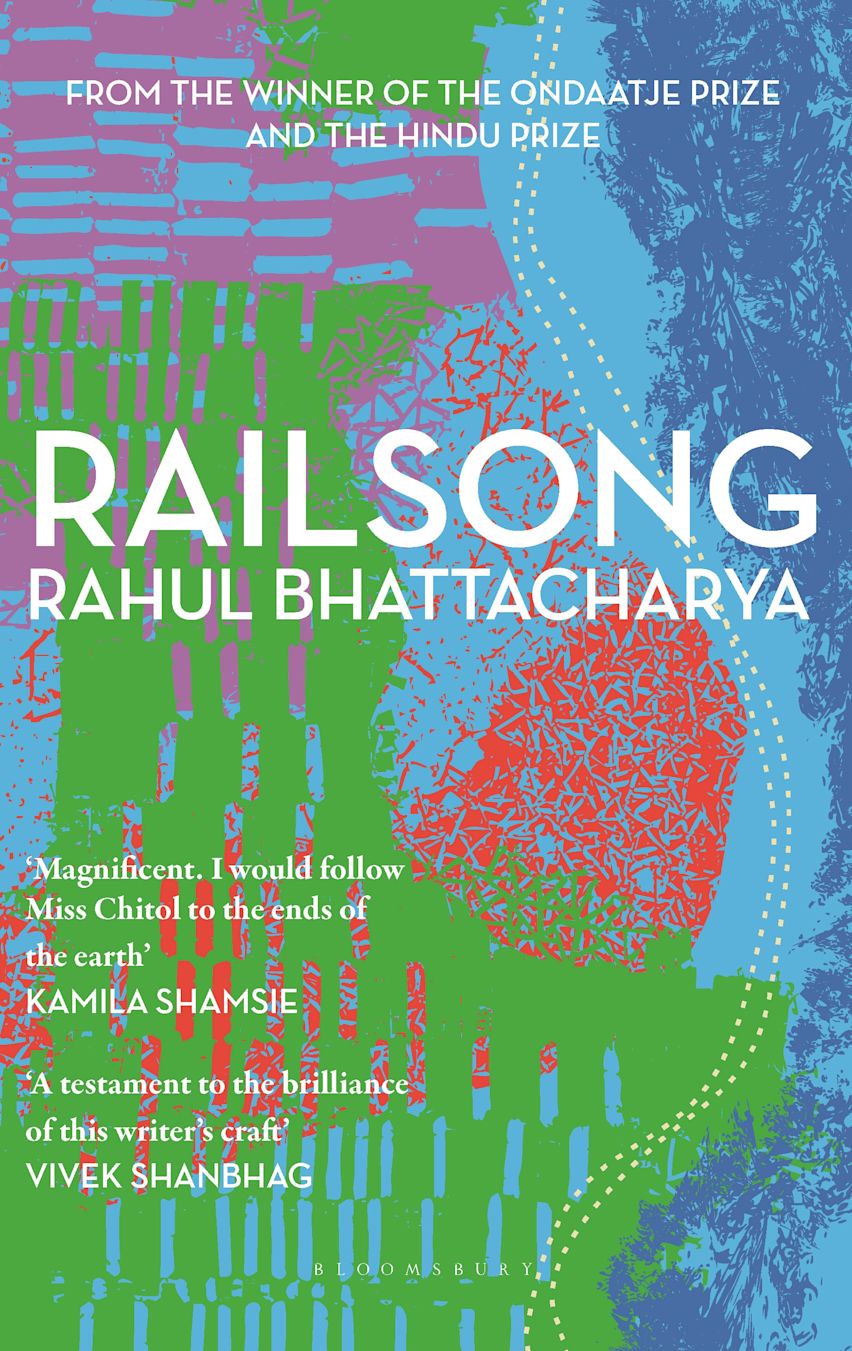
Few institutions in India have shaped the imagination of the nation as profoundly as the railways. Rahul Bhattacharya’s Railsong places this vast network of tracks, workshops, stations and employees at the centre of a sweeping narrative that follows one woman’s life alongside the evolving story of modern India. Moving from the decades after Independence to the politically charged early 1990s, the novel traces how personal journeys and national history travel along the same lines.
The novel opens with a deceptively simple line spoken by a young Charulata Chitol: “I want to count people.” At first the remark seems like the curiosity of a child watching passengers from a train window. Yet the sentence quietly introduces one of the book’s central ideas. The modern nation measures itself through numbers—censuses, registers, payrolls—while individual lives resist such neat accounting. Charu begins by wanting to count people, but over time she learns instead to observe them: their desires, frustrations, loyalties, and fragile hopes. The novel, in effect, becomes an exploration of the countless lives hidden behind those numbers.
The railway colony functions as a microcosm of a stratified nation.
Charu grows up in the railway township of Bhombalpur, a fictitious town in eastern India, where her father works as a chargeman in a railway workshop. The Chitol family itself begins with an act of quiet defiance. Charu’s father, Animesh Kumar, abandons his high-caste Brahmin surname of Chattopadhyay and adopts the deliberately ungainly “Chitol”, borrowed from a fish beloved in Bengali kitchens but lacking the prestige associated with caste titles. The gesture is both comic and radical. In rejecting the privileges attached to his caste identity, Animesh attempts to construct a new kind of social self—one defined less by inheritance than by choice. Yet the world around him does not so easily abandon its categories, and the unusual surname often requires explanation.
Bhattacharya portrays him not as a grand political reformer but as a warm, eccentric figure whose small act of rebellion reflects a larger tension in post-Independence India, where promise of equality often coexists uneasily with entrenched social hierarchies. The railway colony itself mirrors these tensions, functioning as a microcosm of a stratified nation. Workers from different regions and social backgrounds are compressed into a rigid institutional environment where their lives are regulated by the mechanical rhythms of workshops and trains. Within this structured environment, Charu begins to develop a curiosity about the wider world.
Books offer her the first route of escape. Reading authors such as Rabindranath Tagore and Eudora Welty, she encounters lives and possibilities that seem far removed from the disciplined routines of the colony. Yet the railway settlement is also a place where the realities of the nation intrude early. Drought, food shortages, and labour unrest gradually seep into daily life. These events culminate in the great railway strike of the 1970s, one of the largest labour actions in post-independence India. Through the experiences of Charu’s father and his colleagues, the strike reveals the precarious balance between labour and state authority.
The railways appear less as an abstract system than as a network connecting millions of precarious lives.
For Charu, adolescence arrives amid this atmosphere of uncertainty. The world she has known begins to feel increasingly constricting. Eventually she makes a decisive break. One morning she slips quietly out of the colony gate, murmurs a quick prayer, and boards a train to Bombay. The departure scene captures one of Bhattacharya’s central metaphors: the train not simply as transport but as transformation. From this point onward, movement becomes the defining condition of Charu’s life.
Bombay offers both liberation and hardship. Like many migrants to the city, Charu must learn the practical skills of survival. She moves between temporary accommodations, negotiates the expectations of relatives, and takes a series of small jobs. One of the most vivid episodes places her in a shoe shop with the grand name Kings & Queens, where the glamour suggested by the shopfront contrasts with the repetitive labour of fitting shoes for customers. The city’s crowds offer anonymity but also loneliness. Independence proves possible, but it comes with uncertainty.
Charu’s life takes a more stable turn when she eventually joins the Indian Railways herself. Following her father’s death, she enters the personnel department through a compassionate appointment. What begins as a clerical position gradually exposes her to the immense bureaucratic world that sustains the railway system. Bhattacharya describes this institutional landscape with patient detail: registers that record allowances and loans, files that circulate endlessly through offices, and rules that govern the lives of thousands of employees.
At first this administrative world appears impersonal. Yet Charu soon discovers that behind every file lies a story. As her responsibilities expand—eventually taking her across the railway network to investigate pension claims and grievances—she encounters families whose livelihoods depend on the decisions of the railway bureaucracy. Widows waiting for compensation, workers accused of misconduct, and households hoping for compassionate appointments all pass through her field of vision. Through these encounters, the railways appear less as an abstract system than as a network connecting millions of precarious lives.
Two sharply different visions of India share the same railway platform for a fleeting moment.
Bhattacharya’s portrayal of the institution is complex. On one level the railways function as a remarkable integrative force, linking regions, languages, and communities across the subcontinent. On another level they replicate many of the inequalities embedded in the wider society. Bureaucratic rules can obscure human realities, and the promise of equality often collides with everyday hierarchies of caste and class.
As the narrative progresses through the 1980s and into the early 1990s, the broader political climate begins to intrude more visibly into Charu’s life. The rise of religious nationalism gradually reshapes the atmosphere of the country. In one striking scene near the novel’s end, Charu finds herself at a railway platform where two groups of travellers converge. Ambedkarite pilgrims dressed in blue and white sing songs commemorating BR Ambedkar, the seminal Dalit leader and architect of India’s constitution, celebrating the ideals of equality and justice. At the same time, saffron-clad Kar Sevaks chant slogans demanding the demolition of the Babri Masjid.
The juxtaposition is brief but telling. Two sharply different visions of India—one grounded in constitutional equality, the other in religious nationalism—share the same railway platform for a fleeting moment. Bhattacharya refrains from overt commentary. Instead he allows the scene to embody the uneasy coexistence of competing national narratives.
Watching the trains arrive and depart, Charu realises that every passenger carries an origin story, a migration, a mythology that may stand in conflict with another’s. Yet the railway network binds them together within the same infrastructure of movement. The country, like the trains that traverse it, continues forward despite these tensions.
Through Charu’s life, Bhattacharya constructs a portrait of a nation whose people are constantly in motion, navigating the intersecting tracks of memory, labour and politics. Like the trains that run through its pages, Railsong moves steadily across decades, gathering stories from each station. What emerges is less a conventional historical chronicle than a meditation on the lives carried within a nation’s infrastructure—millions of journeys unfolding simultaneously along the same rails.